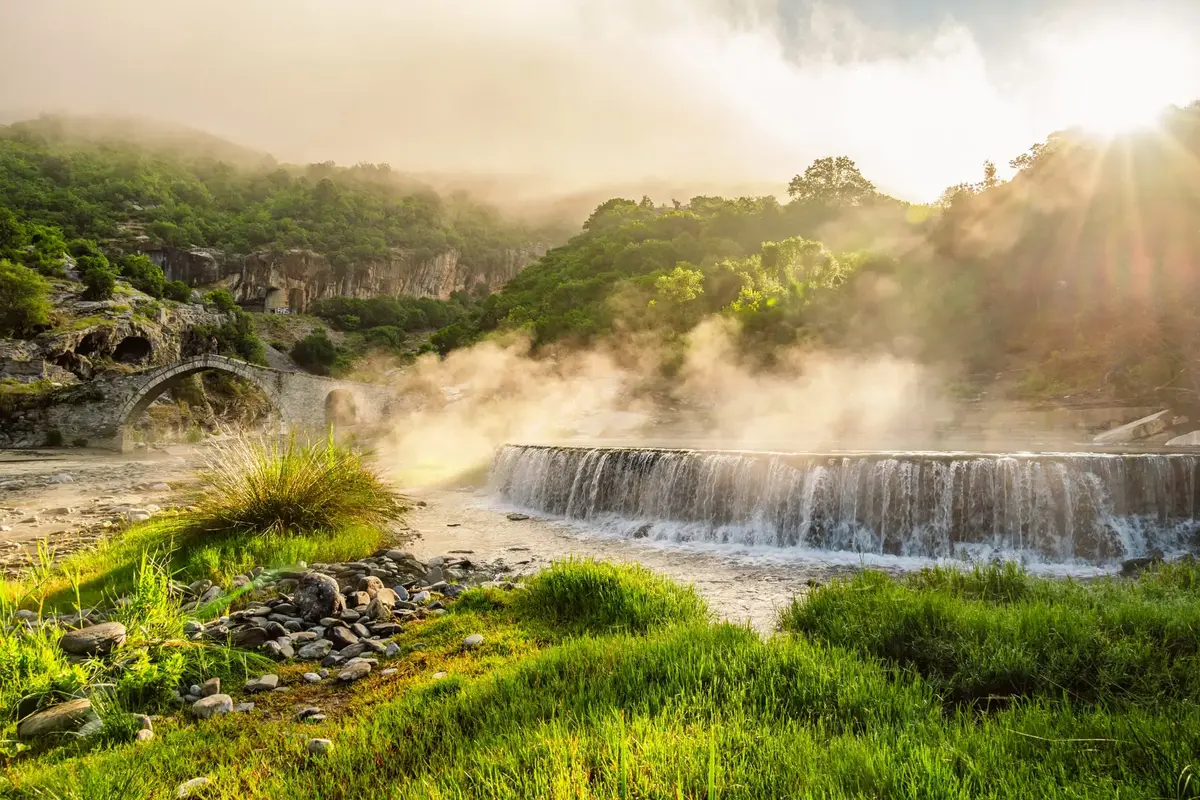
Benja Thermal Baths offer a turquoise river, an 18th-century stone bridge, and six open-air sulfur pools — all free. The water is lukewarm, the footing is rocky, and there are no facilities at all. Here is what the pools actually feel like, how to find the unsigned turn that gets you there, and whether they earn your detour.
Is Benja Thermal Baths Worth It? The Honest Verdict
Yes — if you are already traveling southern Albania and want a free, scenic, open-air soak. Skip it if you expect hot-tub heat, paved paths, or changing rooms. The setting earns the trip: an Ottoman bridge, a turquoise canyon, stone pools on the river. The water itself is warm at best, and summer weekends get crowded.
A lot of disappointed reviews come from one mismatch: people arrive expecting a hot spring and get warm river water. Manage that expectation and the place delivers. The draw is the scenery and the price — open, free, and right beside a 250-year-old bridge.
Some recent visitors have also reported reconstruction work around the parking area and pools. Conditions on the ground change, so it is worth checking the current state before you plan a whole day around a single soak.
Pro Tip: If you want water hot enough to call a hot spring, Llixhat e Elbasanit runs around 133°F (56°C). Come to Benja for the canyon and the bridge, not the heat.
Where Are Benja Thermal Baths, and What Exactly Are They?
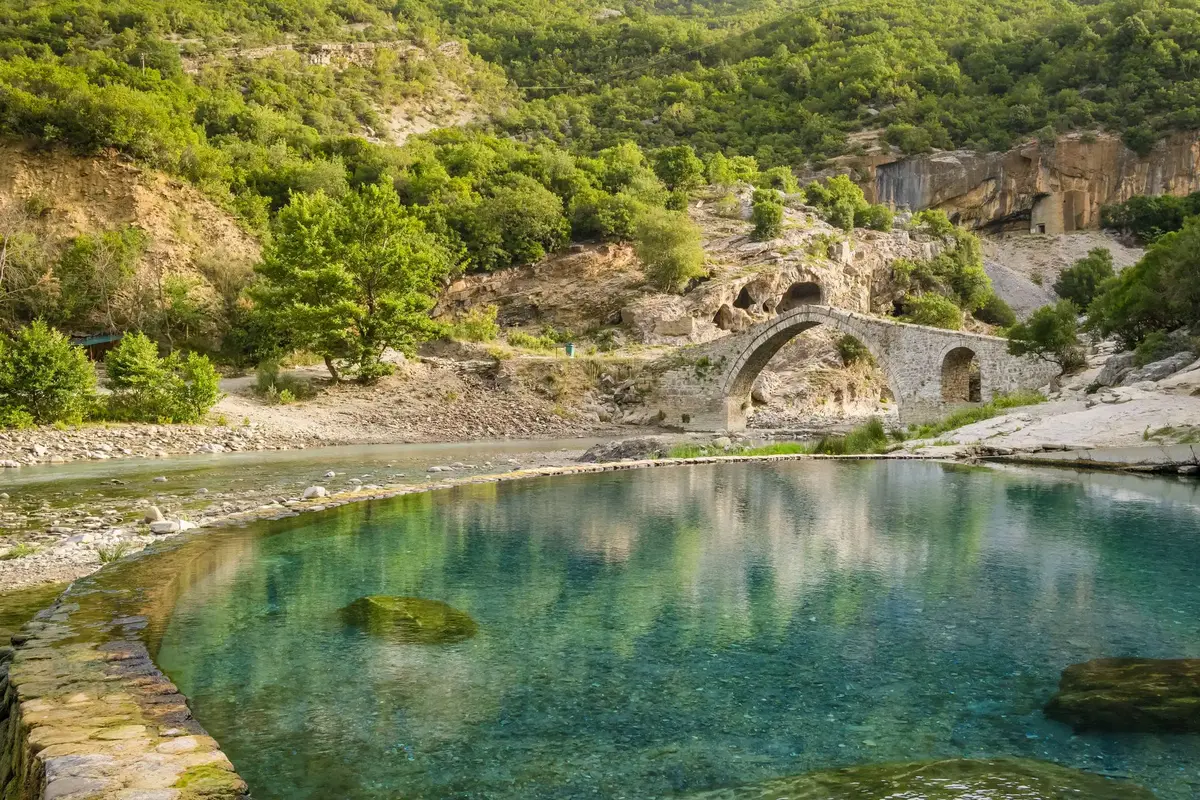
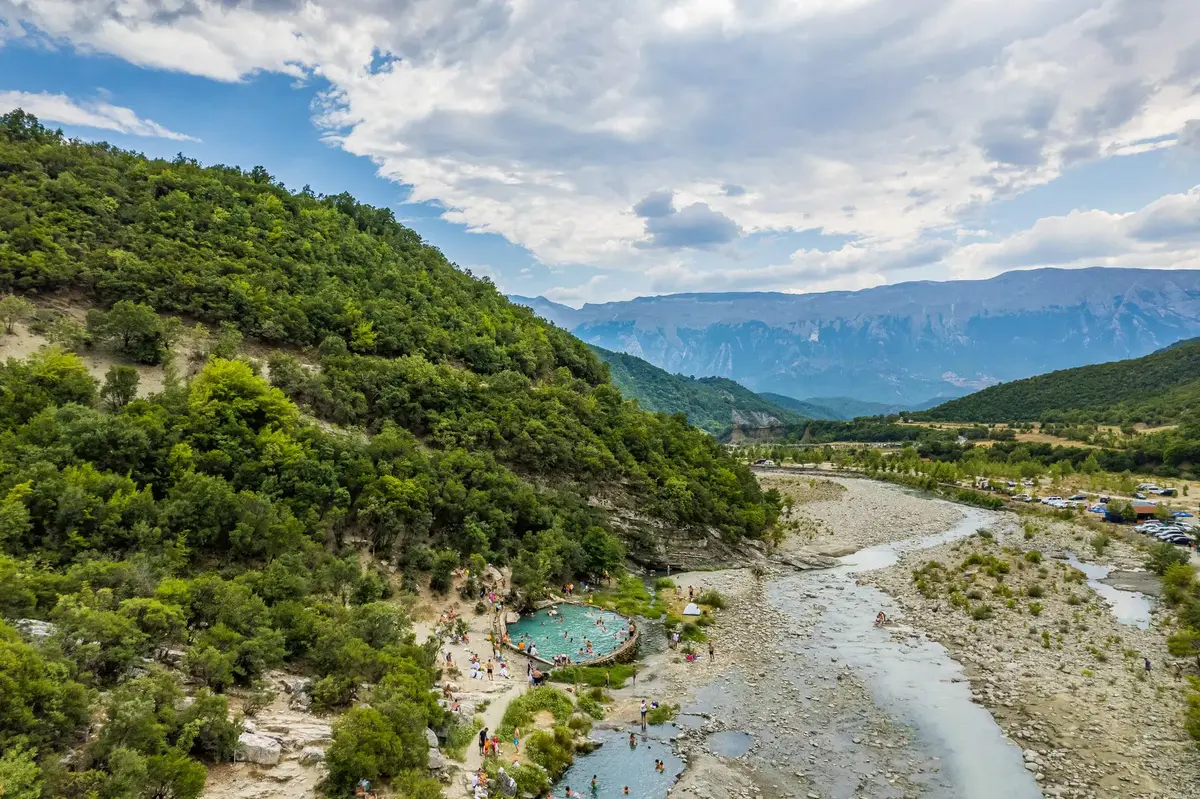
Benja Thermal Baths sit at the mouth of Lengarica Canyon, beside the single-arch Kadiut Bridge, about 9 miles (14 km) southeast of Përmet in Gjirokastër County, southern Albania. Albanians call them Llixhat e Bënjës. They are a cluster of natural sulfur pools on the Lengarica River — open, free, and undeveloped, not a commercial spa.
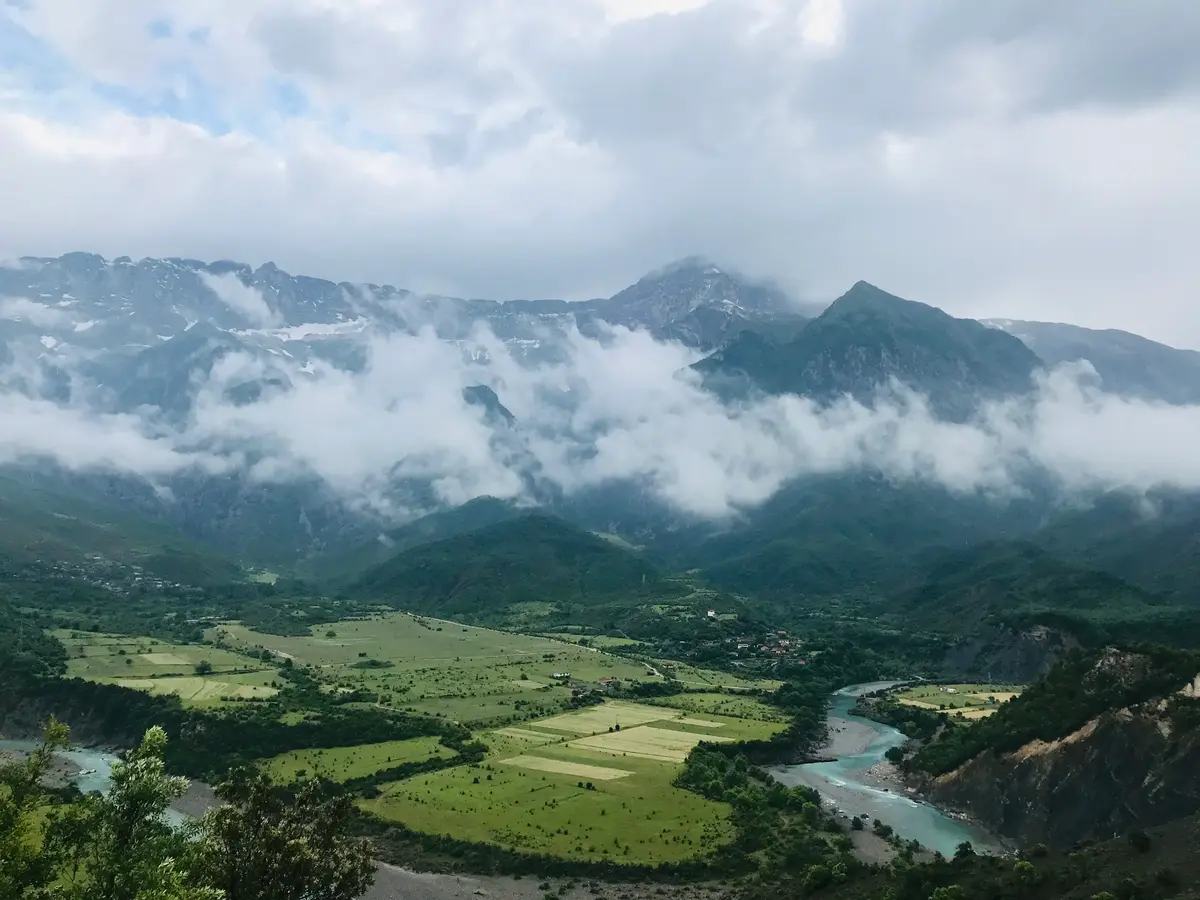
You will see the name spelled several ways: Bënjë, Benjë, Benje. They all point to the same place, a village and spring complex at roughly 750 feet (230 m) of elevation. The site is the headline attraction of the Vjosa Wild River National Park region — the first wild river national park in Europe.
One warning before you search for tickets or tours: there is a name collision. Type “Benja hot springs” into a booking site and you may get results in Thailand or a hotel in Bangkok. The pools described here are firmly in Albania, on the Lengarica River.
How to Get to Benja Thermal Baths
The hardest part of reaching Benja is a single left turn that almost nobody sees the first time. Your GPS will point you in the right general direction, then leave you guessing at an unmarked junction near a small village. Get the turn right and the rest is easy.
Driving and Parking
From Përmet, the drive is short but the navigation is the catch.
- From Përmet: about 9 miles (14 km), a 20–25 minute drive
- The turn: head toward Petran, then turn left before the village; pass through Langarica, turn left at the hill with a cross, and continue about 2 miles (3 km) to the parking lot
- From the parking lot: a walk of about 220 yards (200 m), roughly 5–10 minutes down to the pools
- Parking: around $2.50 (200 lek) per vehicle, cash only
- From Tirana: roughly 150–160 miles (240–256 km), 4 to 4.5 hours
- From Gjirokastër: about 1.5 hours
- From Sarandë: about 2 hours
Pro Tip: The unsigned left turn off the main Përmet–Leskovik road at Petran is the one most drivers miss. Locals slow down for it. Follow the car in front of you, not the arrow on your phone.
By Bus, Taxi, or Guided Tour
You do not need a car, though one makes the day far simpler.
- Minibus (furgon) from Përmet: runs roughly from 8 a.m. to noon, with returns until about 4 p.m., for around $2.50 (200 lek)
- Taxi from the Përmet bridge stand: one traveler was quoted about $20 (2,000 lek) one way to Petran — agree the price before you get in
- Day tours: available from Sarandë, Gjirokastër, and Tirana
If you are already road-tripping the southern loop, the guided day tour is hard to justify. The final stretch from Përmet is an easy drive, and a tour mostly adds cost for a road you can manage yourself.
Are the Pools Actually Hot? Water Temperature and What It Feels Like
No — the water is lukewarm, not hot. The pools run roughly 72–86°F (22–30°C) depending on which one and the season, closer to warm river-swimming than a hot tub. The upstream canyon pools sit a degree or two above the two main basins by the bridge, and a few side pools are genuinely cold.
The source water emerges at about 84°F (29°C), and there are several springs feeding the site, each flowing at roughly 2 to 10 gallons per second (8–40 L/sec). By the time it pools and mixes with river water, the temperature you actually feel is mild.
The sulfur smell is normal. It comes from the minerals in the water, not from anything gone wrong, and it fades from your attention within minutes. Keep soaks reasonable in length, especially for kids and older visitors, since the mineral content is high.
The Six Pools, Mapped: Which One to Pick
Most guides say six pools; counts in the wild range from five to eight, depending on the river level and which puddles you decide to count. The two biggest sit right by the bridge and take the crowds. The smaller pools upstream reward a short walk with warmer water and far more quiet.
| Pool | Where It Is | What It’s Like | Crowds |
|---|---|---|---|
| Main swimming pool | Right by the Kadiut Bridge | Largest and deepest, the postcard spot | Busiest |
| Bridge-side basin | Just left of the bridge | Smaller and shallower | Busy |
| The warm pool | A little further left | Runs a touch warmer | Moderate |
| Upstream pools | A short walk up the canyon | Warmer and more secluded | Quietest |
| Cold clear pool | Upstream | Genuinely cold, very clear water | Light |
| Canyon-view pool | Upstream | Cold, but the best outlook | Light |
Several pools have a soft mineral mud at the bottom that bathers rub on their skin. If you want warmth and space at the same time, the upstream pools are the move — they take a few extra minutes of walking that most day-trippers never bother with.
What the Water Is Made Of (and the Healing Claims)
The chemistry is where Benja gets genuinely interesting, and where most guides go vague. Published analysis classifies it as a chloro-sodium-calcium water with elevated bicarbonate and a trace of hydrogen sulfide — the source of that sulfur tang. Representative values from a peer-reviewed study (in mg/L unless noted):
- Chloride (Cl): about 702
- Sodium and potassium (Na+K): about 398 combined
- Bicarbonate (HCO₃): about 212
- Sulfate (SO₄): about 157
- Calcium (Ca): about 127
- Magnesium (Mg): about 35
- Hydrogen sulfide (H₂S): about 5.8
- Total dissolved solids: about 1.6 g/L
Geologically, the springs sit in the Kruja geothermal zone. The warm, mineral-rich water rises through deep karst limestone aquifers along tectonic faults before surfacing a meter or two above the river. That is why the pools sit where they do, right at the canyon mouth.
Local tradition uses the water for rheumatic, skin, stomach, and kidney complaints. Treat those as traditional uses rather than proven medicine — they are not independently verified, and you will also see fluoride and silica mentioned with no reliable numbers attached, so take those specific claims loosely.
The Kadiut Bridge and a Canyon Shaped by Water
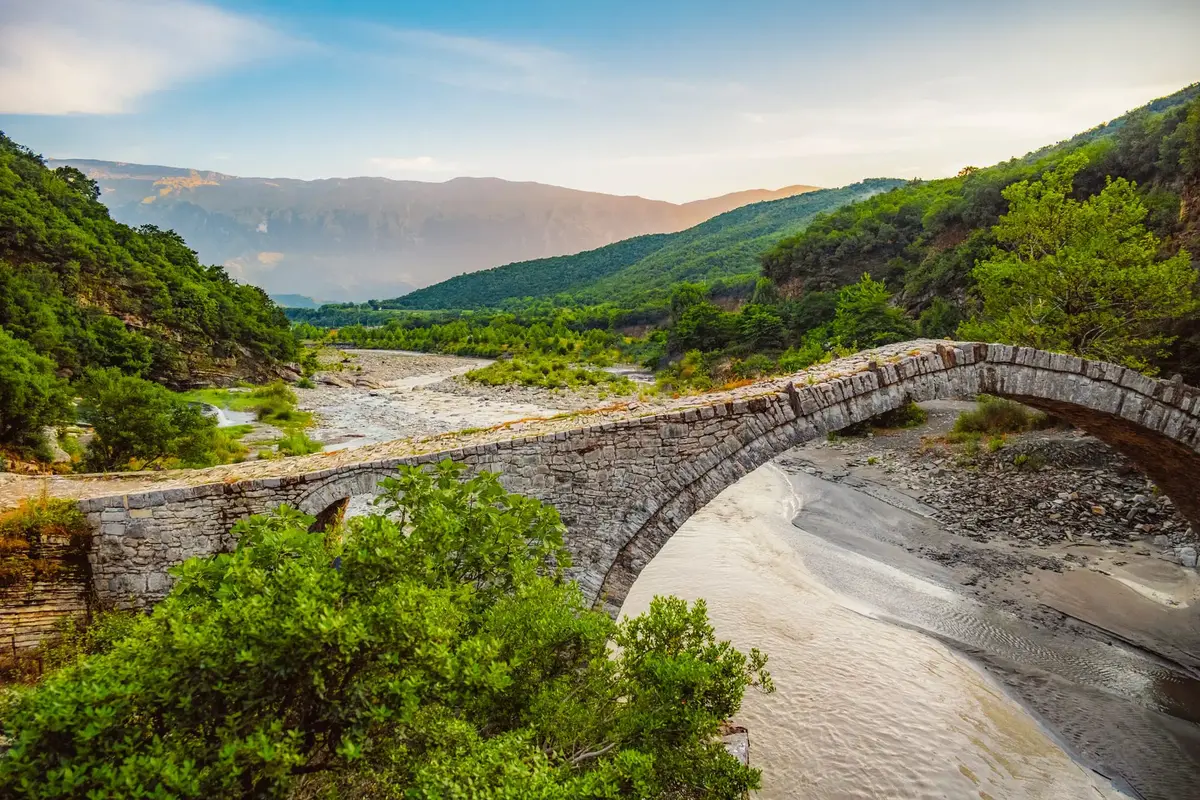
Stand on the bridge and the whole site makes sense. A single stone arch springs across the Langarica River where it is about 120 feet (37 m) wide, with the canyon yawning open behind it and the pools steaming below. The bridge is around 250 years old, built in the 18th century, and it is the reason this spot was photographed long before it had a parking lot.
Its name, Ura e Kadiut, means the Judge’s Bridge. The likeliest story is that it was funded by a donation from a kadi, an Islamic judge of the Ottoman period. Local tradition prefers a more famous patron — Ali Pasha of Tepelena — but that attribution does not hold up well, since he was only in his twenties when the bridge went up. Neolithic finds in caves nearby show people have used this gorge for a very long time.
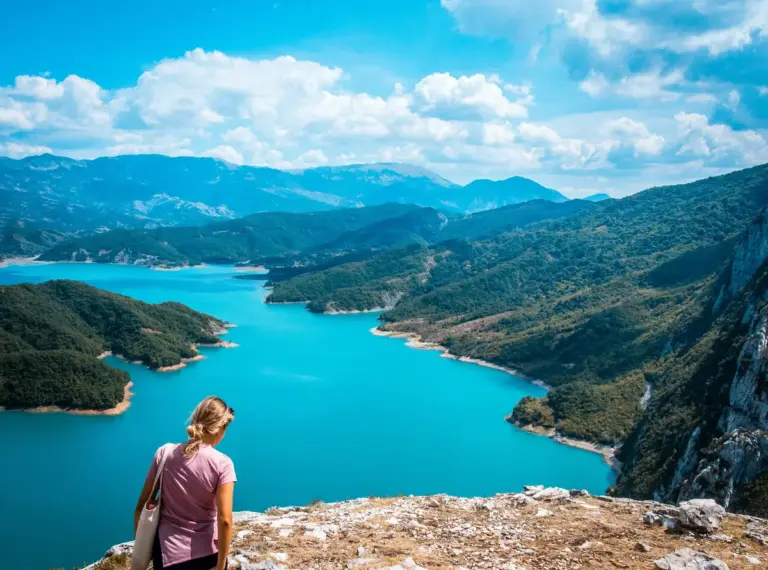
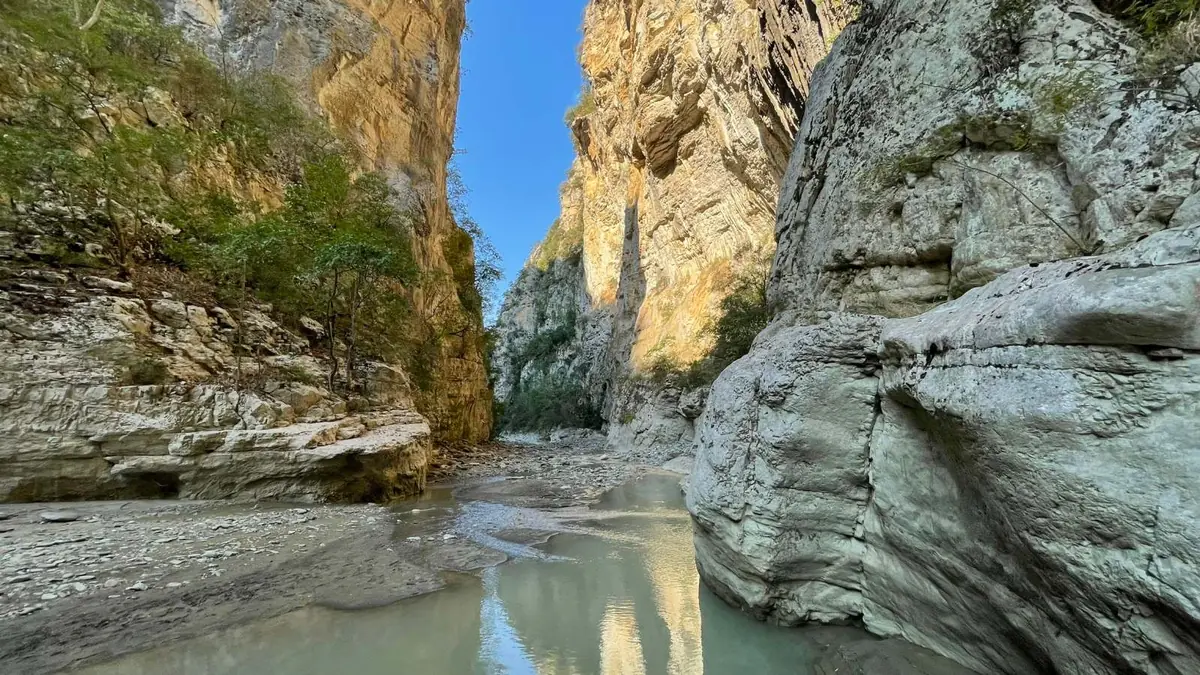
The canyon itself runs about 2.5 miles (4 km), narrowing to roughly 65 feet (20 m) across in places and dropping 65 to 230 feet (20–70 m) below the rim. It is the second half of a good day here, and most visitors never walk more than the first hundred yards of it.
When Is the Best Time to Visit?
Spring and autumn are best — mild air, a green canyon, and far fewer people than summer. The warm water feels most therapeutic when the air is cool. In summer, come on a weekday and arrive before late morning, because Albanian families pack the pools on weekends. Winter is steamy and dramatic, but cold getting in and out.
Even on a summer weekday, the main pools start filling up around 11 a.m. as tour traffic and locals arrive. Get there early and you may have the upstream pools to yourself for a while. Winter is the contrarian pick: bitter air, water that suddenly feels like a luxury, and steam rising off the river with almost nobody around.
What to Bring (and What You Won’t Find There)
There is nothing on site. No restrooms, no showers, no changing rooms, no lifeguard, no shop. Pack as if you are heading into the outdoors, because you are.
- Water shoes — the pool bottoms are rocky and slippery, and this is the one item you will regret skipping
- A towel
- Swimwear, worn under your clothes (there is nowhere private to change)
- Sunscreen
- Drinking water and snacks
- Small-denomination cash for parking
- A trash bag, so you pack out what you bring in
Pro Tip: Water shoes are not optional here. The rocks are slick with mineral film, and the walk between pools crosses uneven river stone.
Things to Do Around Benja: Canyon, Bunkers, Rafting, and Përmet
A soak takes maybe an hour. The reason to drive all the way out is to turn it into a full day. The Lengarica Canyon walk starts right at the Kadiut Bridge, and the popular loop runs about four hours of wading and scrambling — water shoes again, and only attempt it when the river is low.
Beyond the canyon, there is more here than the pools suggest:
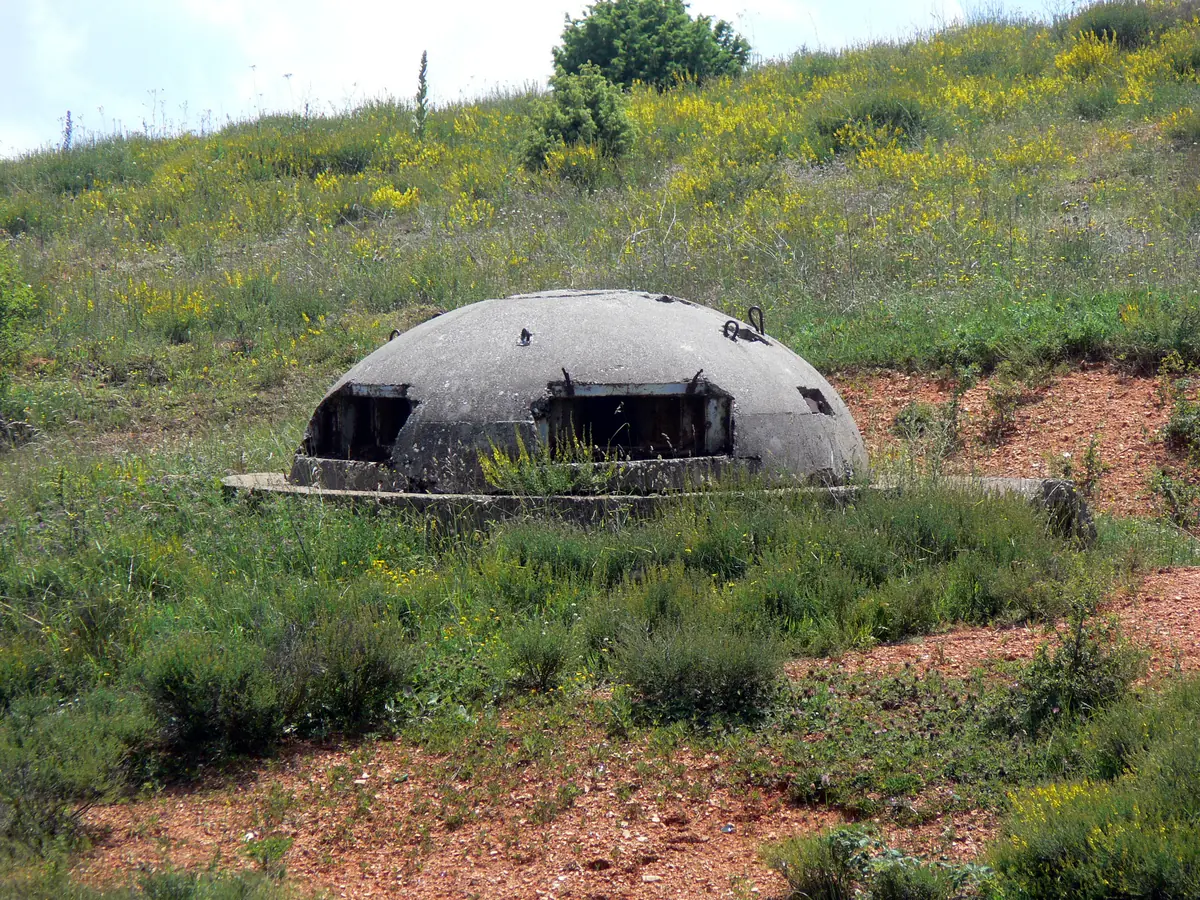
- Caves and communist-era concrete bunkers tucked into the gorge walls
- Whitewater rafting on the Vjosa, launched from Përmet
- Përmet town itself, a center of Albania’s Slow Food movement, known for gliko (fruit preserves), raki, and lakror
- Guri i Qytetit (the City Stone), a giant rock rising over the town
- The frescoed Church of St. Mary in nearby Leusë
Most pages bury all of this under the pools. Pair the soak with the canyon and an afternoon in Përmet and the long drive starts to make sense.
Where to Stay Near the Pools
There are two basing strategies, and they suit different travelers. Sleep in Përmet for restaurants and a walkable center, or sleep right by the canyon if you want the pools to yourself at dawn.
Base in Përmet, about 9 miles (14 km) away:
- Traditional Guesthouse Permet — in town, walkable to restaurants
- Hotel Alvero — a standard hotel option in the town center
- Best for: travelers who want dinner out and an easy stroll after
Sleep closer to the canyon:
- Stone House Guesthouse (Petran) — near the turn-off, minutes from the springs
- Chri Chri Guesthouse (Leusë) — in the hills above the valley
- Campervan plot near the lot — around $18/night (1,500 lek) with electricity; wild camping nearby is free
- Best for: early risers and self-drivers who want the dawn soak
Prices shift season to season, so confirm rates directly when you book.
Practical Info for International and US Travelers
This is the planning layer most guides skip. The springs are easy once you are in Albania; getting into the country and out to Përmet takes a little setup.
- Flights: fly into Tirana International Airport (TIA). There are no nonstop flights from the US — expect one stop via Istanbul, Rome, Vienna, or London
- Entry for US citizens: no visa is required, stays of up to one year are generally allowed without a residence permit, and your passport should have at least three months of validity remaining
- Money: the currency is the Albanian lek; carry cash, since parking, minibuses, and small guesthouses often will not take cards
- Driving: a rental car is strongly recommended for this region, and a US or international driver’s license is accepted for non-resident visitors
- Getting south: from Tirana it is a 4 to 4.5 hour drive; Gjirokastër and Sarandë make good intermediate bases
Confirm visa and entry details with an official source close to your travel dates, as rules can change.
Common Questions About Visiting Benja
Are Benja Thermal Baths free? Yes. Entry to the pools is free year-round, with no gate, ticket, or opening hours. If you arrive by car, you pay around $2.50 (200 lek) per vehicle at the lot near the bridge, in cash. From there it is a walk of about 220 yards (200 m) down to the pools.
How hot is the water? It is lukewarm, not hot — roughly 72–86°F (22–30°C) depending on the pool and season. That is closer to warm river swimming than a hot tub. The upstream pools run slightly warmer than the two main basins by the bridge, and a few side pools are actually cold.
How do you get there from Përmet? Drive about 9 miles (14 km) southeast toward Petran, turn left before the village, pass Langarica, turn left at the hill with a cross, and continue about 2 miles (3 km) to the parking lot, then walk roughly 220 yards (200 m). A minibus also runs from Përmet between about 8 a.m. and noon for around $2.50 (200 lek).
What should I bring? Water shoes (the bottoms are rocky and slippery), a towel, swimwear worn under your clothes, sunscreen, drinking water, snacks, small cash for parking, and a trash bag. There are no restrooms, showers, changing rooms, or lifeguards on site.
Is it worth visiting? For most travelers already in southern Albania, yes — the Ottoman bridge, the turquoise canyon, and the free open-air pools make a memorable half-day. Just manage expectations: the water is lukewarm, the site is undeveloped, and summer weekends are crowded. A spring or autumn weekday morning is the sweet spot.
The Bottom Line on Benja
TL;DR: Benja Thermal Baths is a free, lukewarm, sulfurous, scenic natural spring near Përmet — a beautiful setting with no facilities. Go in spring or autumn, or on a summer weekday morning, bring water shoes and cash, and pair the soak with the Lengarica Canyon hike to make the drive worth it.
What it comes down to is what you want from the day. If you are chasing hot-tub heat and a spa, this is not it. If you want a turquoise river, an old stone bridge, and warm water you did not have to pay for, Benja Thermal Baths is one of the easiest yeses in southern Albania.
Have you been, or is it on your route? Tell me which pool you ended up in — and whether you found that Petran turn on the first try.