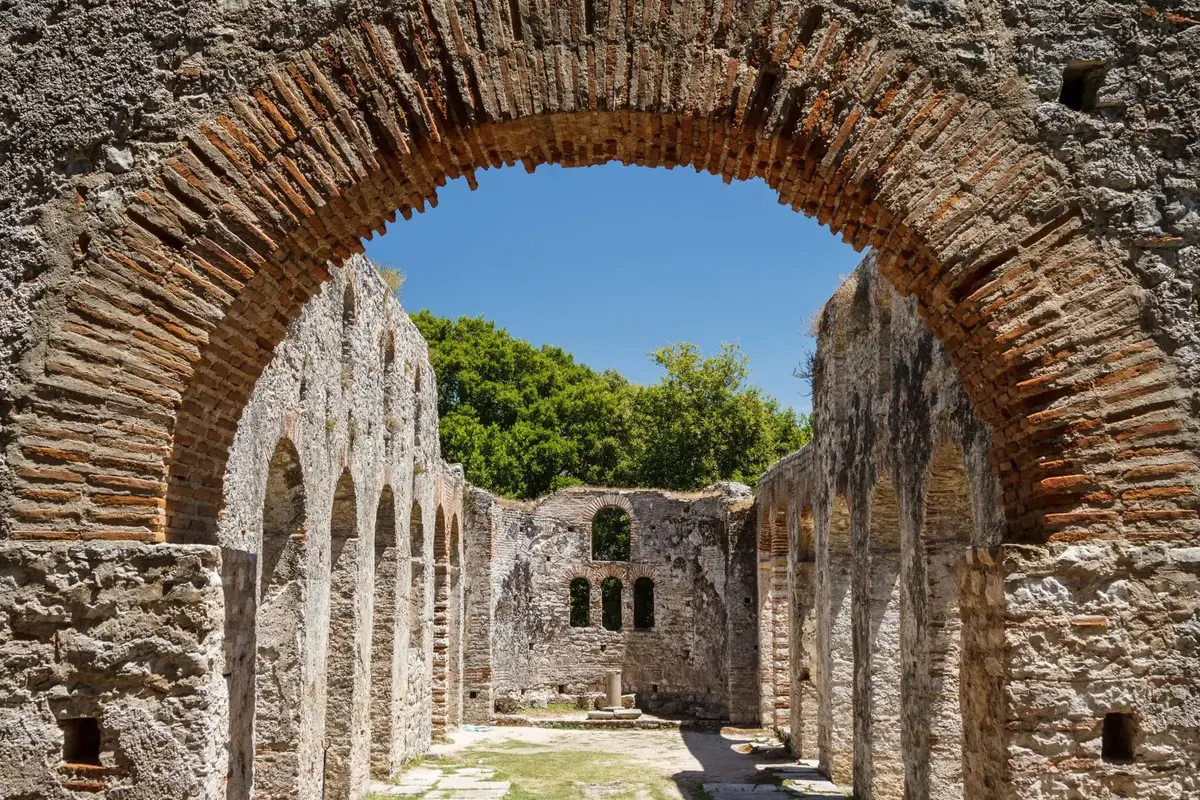
Butrint National Park is the most complete ancient city you can walk in Albania — 2,500 years of Greek, Roman, Byzantine, Venetian and Ottoman ruins wrapped in a lagoon-side forest. It’s also easy to reach from Saranda or Corfu, once you know the bus, the ferry, and the one timing trick that beats the crowds.
Butrint National Park at a glance: costs, hours, timing
Butrint National Park sits 11 miles (18 km) south of Saranda in southern Albania. Adult entry is 1,000 lek (about $11), the gate opens at 8:30 a.m. in summer, and you need roughly 2 hours to walk the full loop. The smartest move: arrive at opening or after 4 p.m. to skip the tour-bus crowds and the midday heat.
- Entry: 1,000 lek (~$11 / €10) for adults; 500 lek ages 12–18; free under 12; cash only
- Distance: 11 miles (18 km) south of Saranda; 3 miles (5 km) south of Ksamil
- Time needed: about 2 hours (1.5 to 3, depending on your pace)
- Cheapest transport: local bus from Saranda, ~200 lek (~$2.40)
- UNESCO status: Albania’s first World Heritage Site, inscribed 1992
Pro Tip: By 11 a.m. the 20-car lot is full and cars line the road back the better part of a mile. We walked straight in at 8:40 a.m. with spaces to spare.
How do you get to Butrint National Park?
The cheapest way to reach Butrint is the local bus from Saranda: it costs about 200 lek (around $2.40), runs roughly every 30 to 60 minutes, passes through Ksamil, and takes 30 to 40 minutes to the end of the line at the park gate. Driving the SH81 takes about 25 to 30 minutes, and a taxi runs 3,000 to 5,000 lek.
The bus is the no-brainer if you’re staying anywhere on the Riviera. It departs near Saranda’s port, by Friendship Park, and Butrint is the last stop — you can’t miss it, because everyone gets off when the road ends at the water.
- Bus from Saranda: ~200 lek (~$2.40), 30–40 min, pay the conductor onboard, Butrint is the final stop
- Bus from Ksamil: ~100 lek, ~15 min, same line
- Taxi from Saranda: 3,000–5,000 lek (~$30–50) one-way; 8,000–9,000 lek return if the driver waits a couple of hours
- Driving the SH81: 25–30 min, free on-site parking for roughly 20–25 cars plus overflow along the road
- Vivari Channel car ferry: 700 lek (€7, about $7.50) per car if you continue past the ruins
There’s no Uber here, and phone coverage drops to almost nothing at the ruins themselves — sort out your return ride before you lose signal.
Pro Tip: Don’t pay as you board the Saranda bus. Sit down — a conductor works the aisle collecting coins partway through the ride.
Bus vs. taxi vs. rental car vs. tour: which should you pick?
Staying in Saranda or Ksamil and watching your budget? Take the bus. Short on time or travelling as a group? A taxi or rental car earns its cost. Coming from Corfu? An organized tour is usually cheaper than going it alone, once you add up the ferry, transfers and entry fee.
| Mode | Cost | Time (one-way) | Best for |
|---|---|---|---|
| Local bus | ~200 lek (~$2.40) | 30–40 min | Budget travelers based in Saranda or Ksamil |
| Taxi | 3,000–5,000 lek (~$30–50) | 25 min | Groups and anyone short on time |
| Rental car | ~$20–25/day | 25 min | Flexible, multi-stop days on the Riviera |
| Organized tour | from ~€46 (Saranda), €30–58 (Corfu) | full day | Hands-off trips, especially from Corfu |
Pro Tip: The Hotel Livia restaurant opposite the bus stop is the de-facto waiting room. Grab a coffee and use the toilets (paper-stocked, unlike the ones inside) before the ride back.
How much does it cost to visit Butrint?
Adult entry to Butrint is 1,000 lek — about $11 (€10). Children 12 to 18 pay 500 lek, and under-12s are free; groups of 12 or more pay 800 lek each. Bring cash in lek, since euros are only sometimes accepted and cards often aren’t. That 1,000-lek rate is the figure listed on Albania’s official cultural-sites ticketing platform.
A word of warning: plenty of guides still quote an old 700-lek fee. It’s outdated. Here’s the full price list as it actually stands:
- Adult: 1,000 lek (~$11 / €10)
- Children 12–18: 500 lek
- Under 12: free
- Groups (12+): 800 lek each
- Albanian students: 300 lek
- Albanian pensioners: 500 lek
- Visitors with disabilities: 500 lek
Entry is free for everyone on four dates each year: 18 April, 18 May, 21 May and 29 September. If your trip overlaps one, you’ve saved your $11.
Pro Tip: Only pay the price printed on the ticket itself. A few visitors report being pointed toward a higher number on a sign — the real fare is the one on the ticket in your hand.
When is the best time to visit Butrint?
The best time to visit Butrint is spring (April to June) or autumn (September to October), when temperatures are mild and the tour buses thin out. In July and August, daytime highs near Saranda average around 88°F (31°C) with almost no rain, so arrive right at opening or after 4 p.m. to dodge both the heat and the Corfu day-trip crowds.
| Months | Avg high °F (°C) | Crowds | Verdict |
|---|---|---|---|
| Jan–Feb | ~54°F (12°C) | Low | Quiet, but short hours and some rain |
| March | ~59°F (15°C) | Low | Cool, calm, green |
| Apr–May | ~68–75°F (20–24°C) | Building | Ideal — mild with fewer buses |
| June | ~82°F (28°C) | High | Warm and busy; go early |
| Jul–Aug | ~88°F (31°C) | Peak | Hot and crowded — opening time only |
| September | ~81°F (27°C) | Easing | Excellent — warm sea, thinning crowds |
| October | ~72°F (22°C) | Moderate | Ideal — mild and calm |
| Nov–Dec | ~59°F (15°C) | Low | Quiet, shorter hours |
Hours shift with the season, so check the gate before a late visit:
- April 1 to October 31: opens 8:30 a.m., last entry 6 p.m., closes 8 p.m.
- November 1 to March 31: opens 9 a.m., last entry 3 p.m., closes 5:30 p.m.
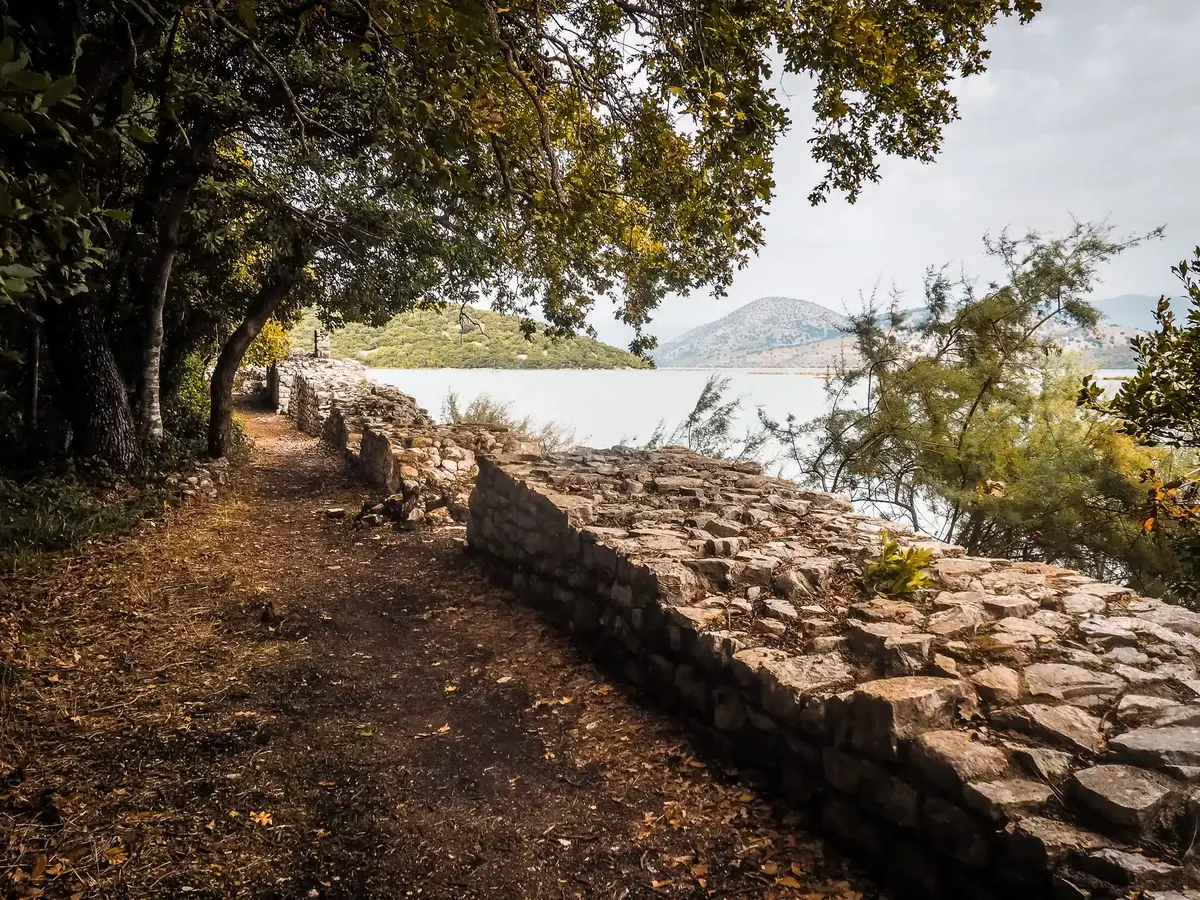
Even in May, the open stretch near the Roman forum bakes. The good news is that most of the loop runs under forest shade. The bad news is that the climb to the Venetian Castle has none — save it for when you’ve still got water and energy.
What to see at Butrint, and in what order
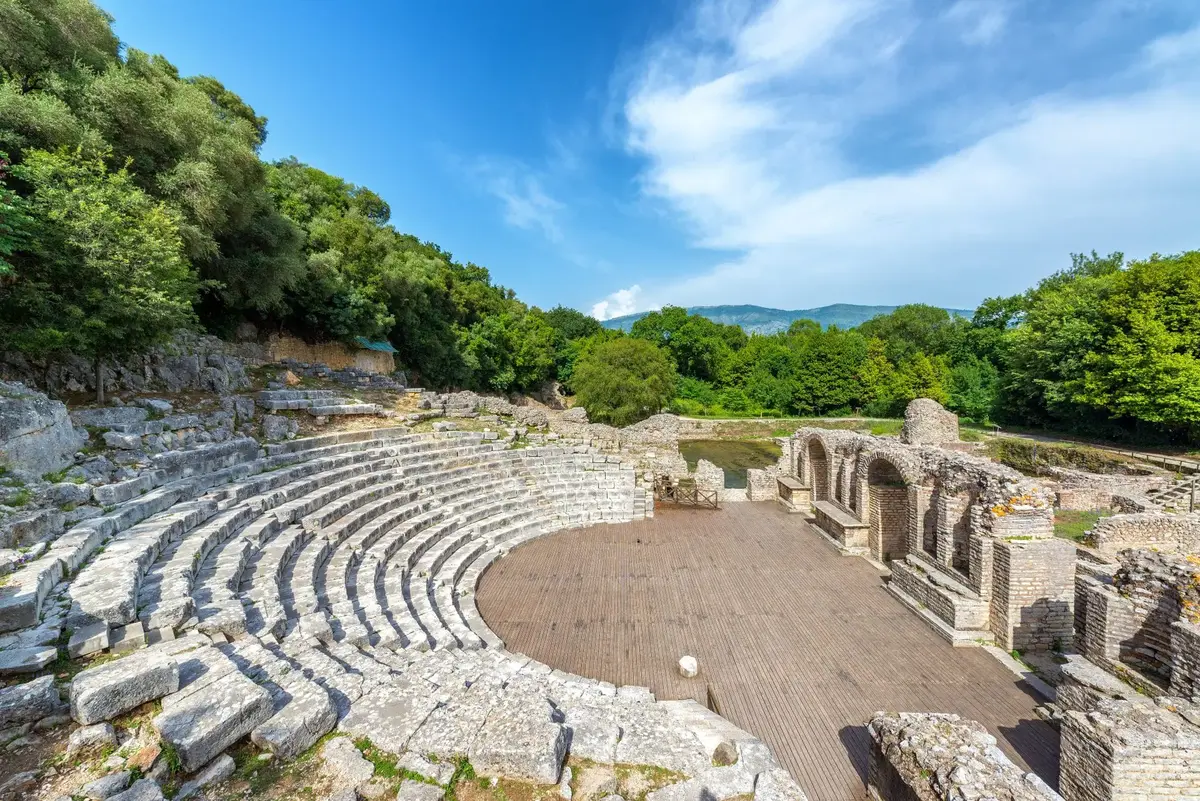
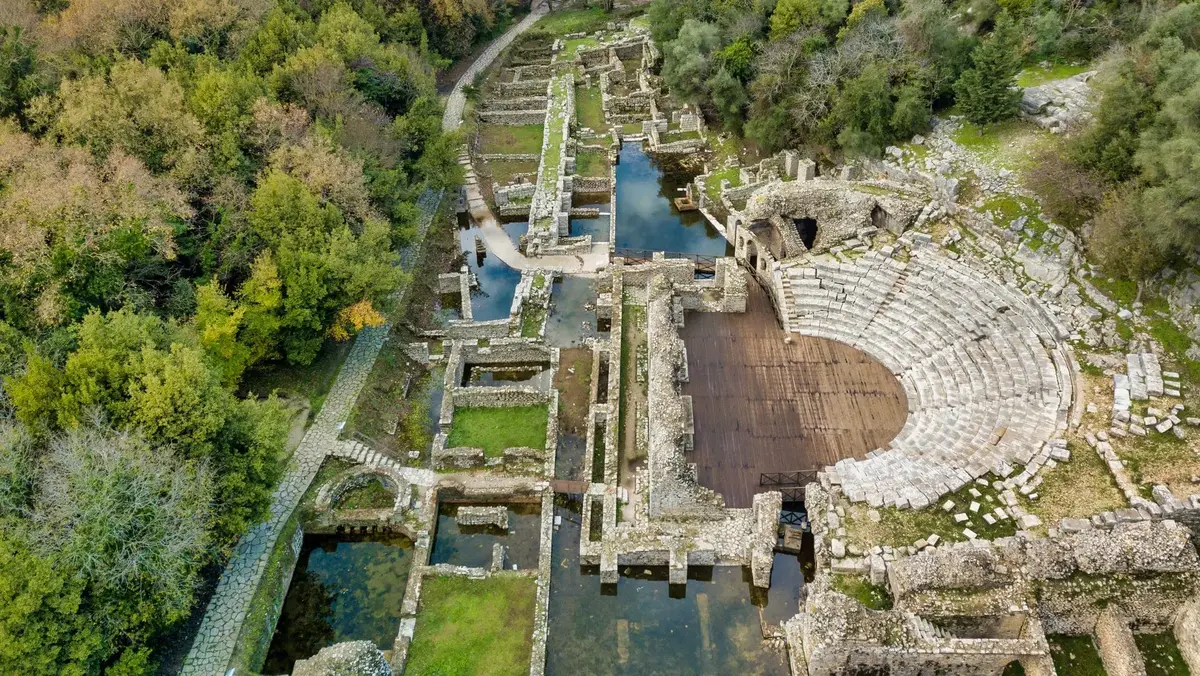
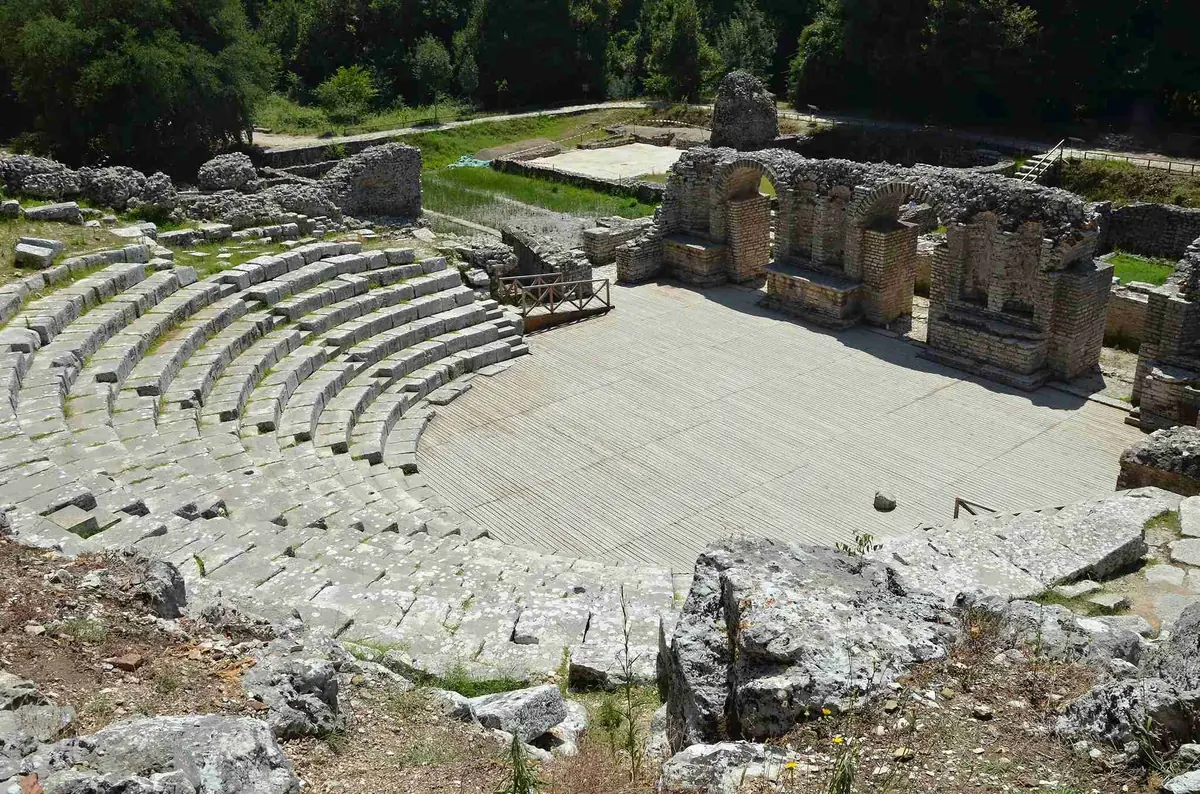
From the entrance, a shaded path leads first to Butrint’s showpiece: the 3rd-century-BC Greek theatre, cut into the acropolis slope. From there the circular route passes the Roman baths, the Baptistery, the Great Basilica and the Lion Gate before climbing to the Venetian Castle and its museum. Allow about 2 hours for the full loop.
Walk it in this order and you’ll hit the highlights without backtracking:
- Greek theatre — Hellenistic, built in the 3rd century BC; statues of Augustus and Livia were dug up here
- Sanctuary of Asclepius — the healing shrine the theatre originally grew around
- Roman baths — look down for the hypocaust, the underfloor heating system
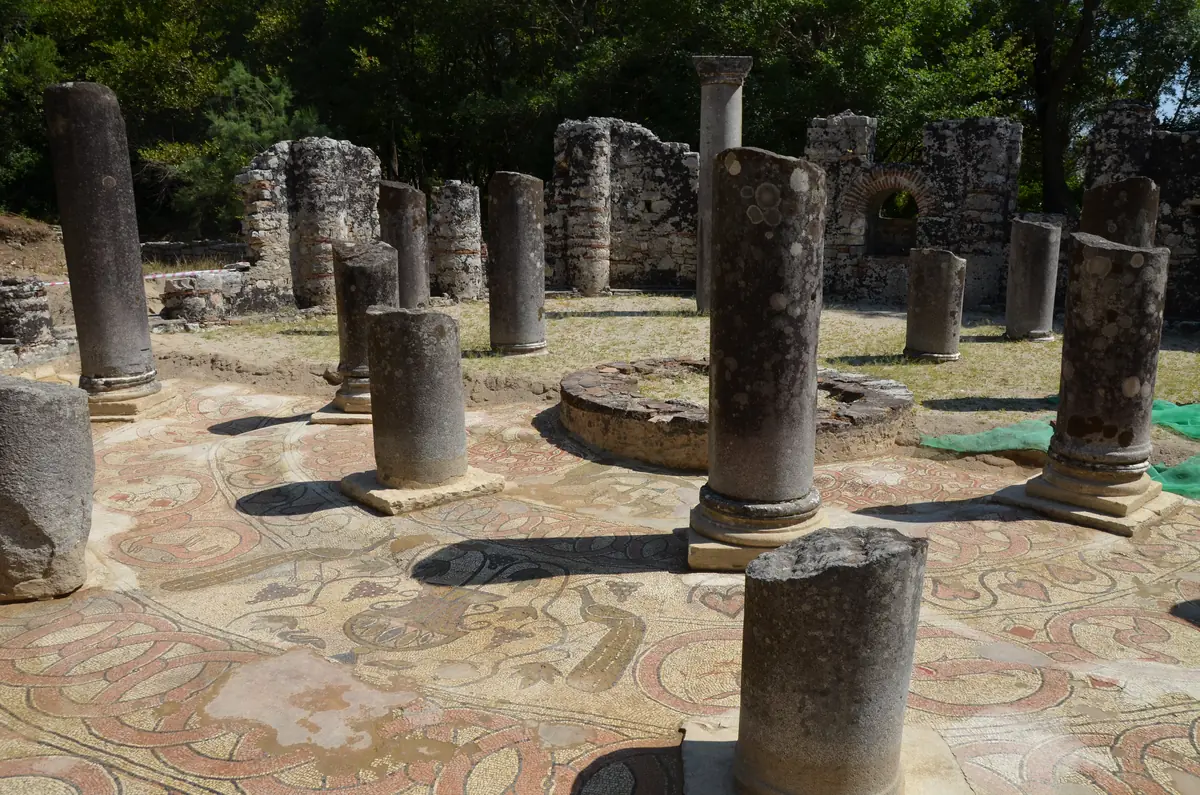
- Baptistery — 6th-century, about 48 feet (14.5 m) across, ringed by Egyptian-granite columns
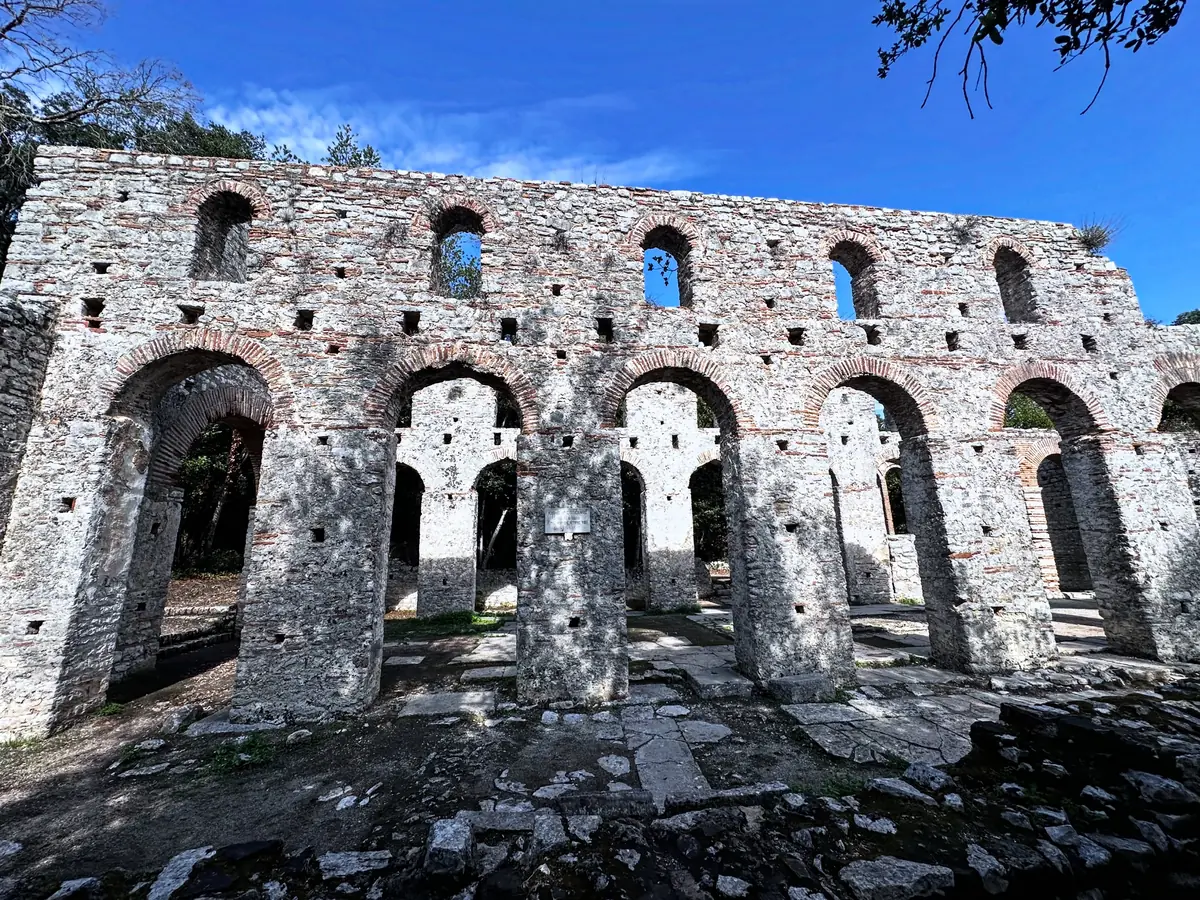
- Great Basilica — a 6th-century church with a mosaic you can actually see
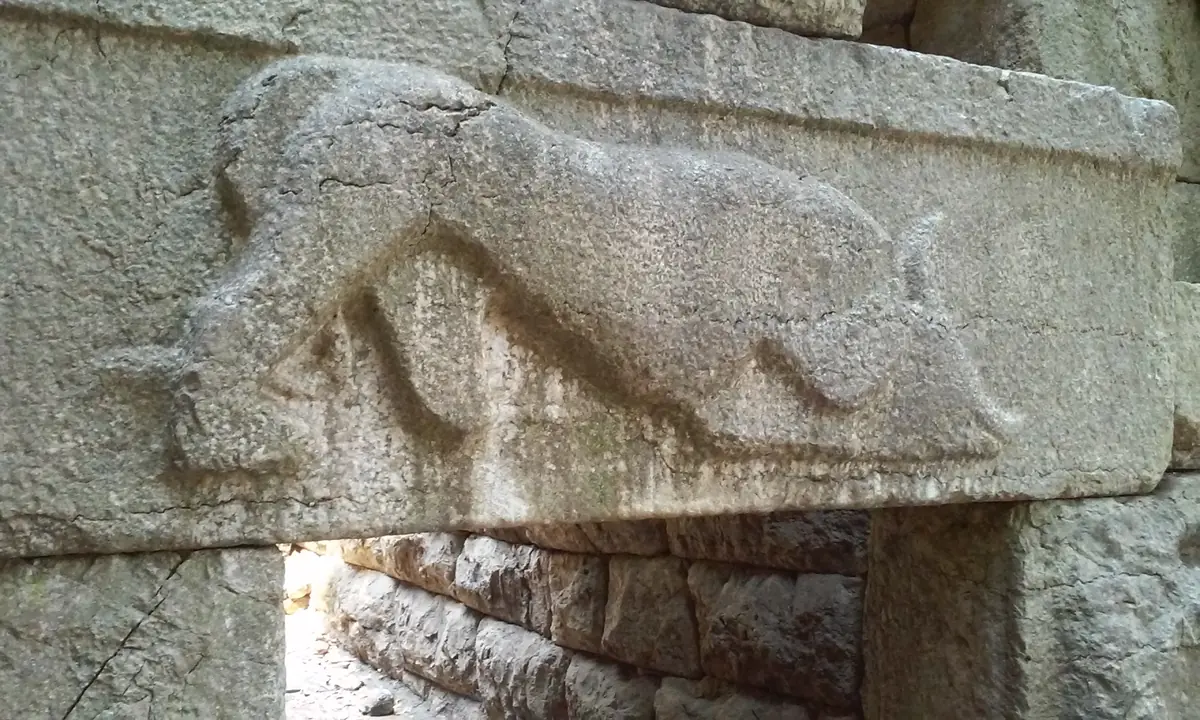
- Lion Gate — a carved lion devouring a bull above a passage barely 4 feet (1.2 m) high
- Triconch Palace — a grand Roman house from around AD 400
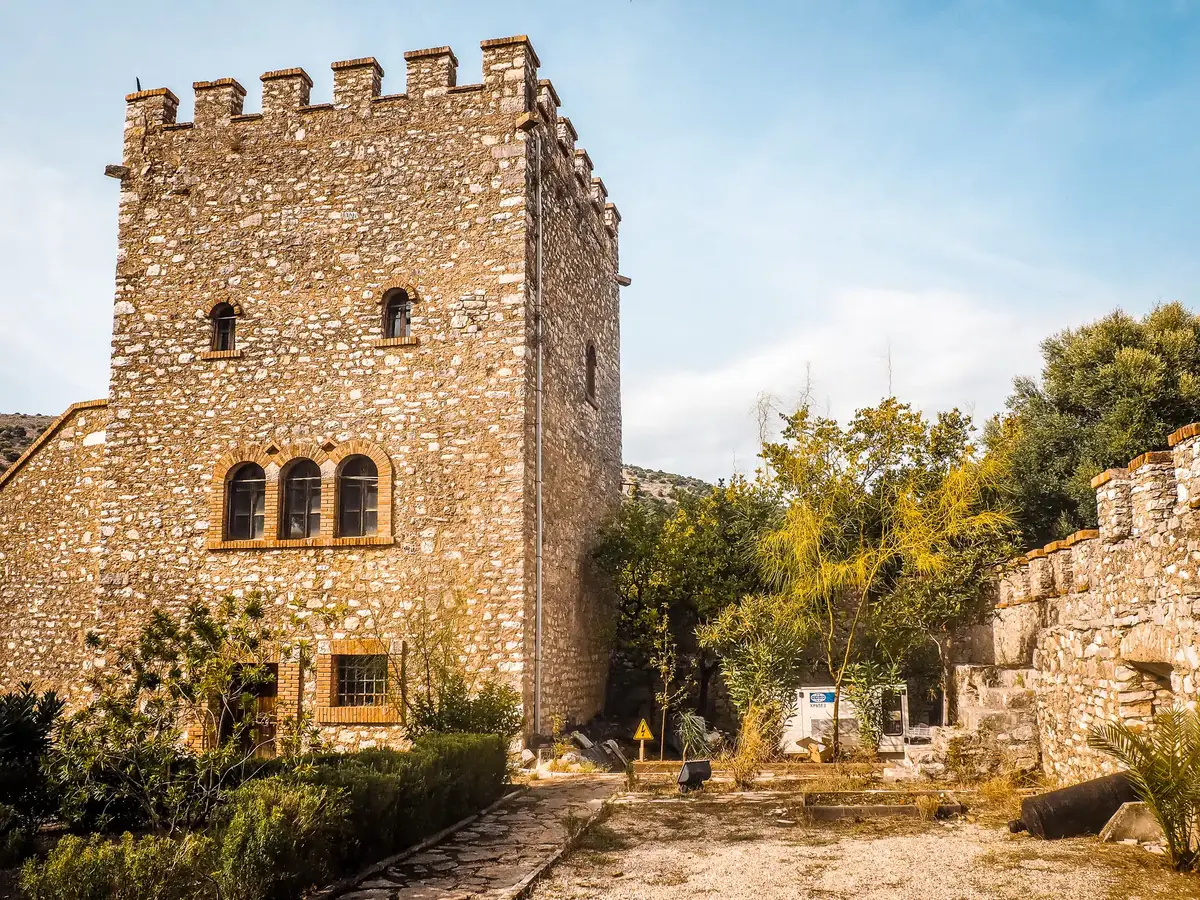
- Venetian Castle and museum — the hilltop finish, with views over the channel and lake
The theatre is the moment that stops most people. Its old stage has flooded into a shallow, plank-covered pond where turtles sun themselves while you sit in stone seats inscribed with the names of slaves freed here 2,000 years ago. The manumission records are still legible if you look.
Why you probably won’t see the famous Baptistery mosaic
The Baptistery’s celebrated 6th-century mosaic floor — the image on most Butrint brochures — is normally buried under a protective layer of sand and gravel. Because the lagoon’s water table rises and falls, leaving it exposed would destroy it, so it’s uncovered for only a few days every few years. Don’t plan your trip around seeing it.
When the mosaic is visible, it’s a marvel: seven concentric bands of peacocks and deer encircling the central font, eight rings in all — the Christian number of salvation. The rest of the year you’ll stare at what looks like a sandy gravel pit ringed by columns, with the masterpiece a foot beneath your shoes. The fix is simple: walk a minute to the Great Basilica, where a second mosaic survives in the open. That one you can count on.
Why is Butrint a UNESCO World Heritage Site?
Butrint became Albania’s first UNESCO World Heritage Site in 1992 because few Mediterranean ruins layer so many civilizations in one walkable space. Greeks from Corfu settled the hill in the 8th to 6th centuries BC; it grew into a Roman colony, a Byzantine bishopric, a Venetian stronghold and an Ottoman frontier post before marshes forced its abandonment in the late Middle Ages.
UNESCO describes the site as a microcosm of Mediterranean history, with traces of human activity reaching back tens of thousands of years. It’s also a protected Ramsar wetland, which is why the ruins come wrapped in forest and water rather than the dry rubble you get elsewhere.
The myth gives it extra weight. Virgil’s Aeneid casts Butrint as a “Troy in miniature,” founded by the Trojan exiles Helenus and Andromache and visited by Aeneas himself. The name traces back to buthrotos, meaning “wounded bull.” Julius Caesar and Augustus turned it into a Roman colony, and the Italian archaeologist Luigi Maria Ugolini began the modern excavations in 1928. The UK-based Butrint Foundation has helped care for the site in the decades since.
Can you do Butrint as a day trip from Corfu?
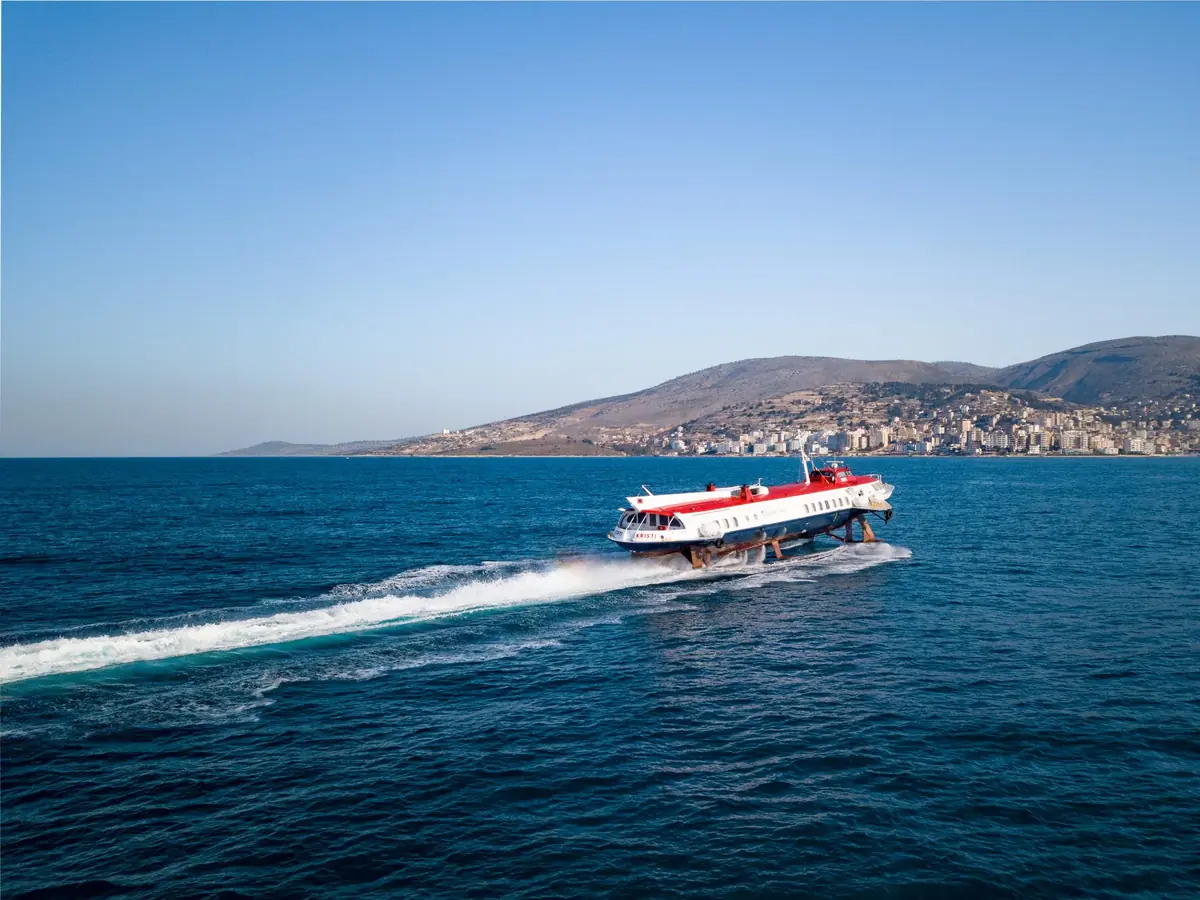
Yes — Butrint is an easy day trip from Corfu. Fast ferries cross from Corfu to Saranda in about 30 minutes (tickets from around €15 each way) with operators like Finikas Lines and Ionian Seaways; from Saranda port it’s a short bus or taxi to the ruins. One catch worth circling: Corfu runs an hour ahead of Albania.
Crossings run year-round, up to ten times a day in the busy months. From there you’ve got two ways to do it:
- Packaged tour from Corfu: ~€30–58, usually including the ferry, coach, guide, entry and lunch
- Saranda-based tour: from ~€46, often bundling Butrint with the Blue Eye and Lekuresi Castle
- Do it yourself: ferry + Saranda bus + entry, which sounds cheapest but rarely is
That last point is the one most guides skip. For Corfu visitors, the DIY route is often false economy. Once you stack the ferry, transfers, entry, and a port tax of roughly €20 that’s frequently charged separately, a packaged day tour often costs the same or less — and it removes the real risk of the time-zone trap leaving you stranded for the last ferry home. Remember too that you’ll need your passport, since this is an international border crossing.
Pro Tip: That ~€20 port tax isn’t always in the tour price. Several travelers only discover it once they’re already on the boat — ask before you book.
Is Butrint National Park worth visiting?
Butrint is well worth visiting — it’s the best-preserved and most atmospheric ancient site in Albania, and the forest-and-lagoon setting sets it apart from drier Mediterranean ruins. It won’t out-monument Pompeii or Ephesus, but the layered history, easy 2-hour loop and low 1,000-lek entry make it the standout cultural stop on the Albanian Riviera.
Set your expectations right and you’ll love it. This isn’t a place of towering monuments; it’s a place you walk slowly, where the ruins and the trees and the water blur together. Once the morning coach groups cleared out, we had the basilica almost to ourselves — that single quiet hour was worth the whole trip.
Visiting Butrint with kids, limited mobility, or limited time
Butrint’s main loop is mostly flat, shaded and stroller-friendly, but reaching the Venetian Castle and museum means climbing roughly 200 steps, and the Roman paving is uneven throughout. Wheelchair users and families with toddlers can still see the theatre, baths, baptistery and basilica, then skip the hilltop castle without missing the highlights.
A few honest logistics that scattered reviews bury:
- Steps to the castle/museum: roughly 200, with no shade on the climb
- Surface: uneven Roman paving across the whole site — closed-toe shoes help
- Toilets: two blocks (entrance and castle), often with no paper, so bring tissues
- Water: not always sold on the loop, especially off-season — carry your own
- Kids: free entry under 12
Pro Tip: We were charged nearly £5 for two bottles of water at the gate kiosk. Fill up before you arrive.
Where to stay and what else to do nearby
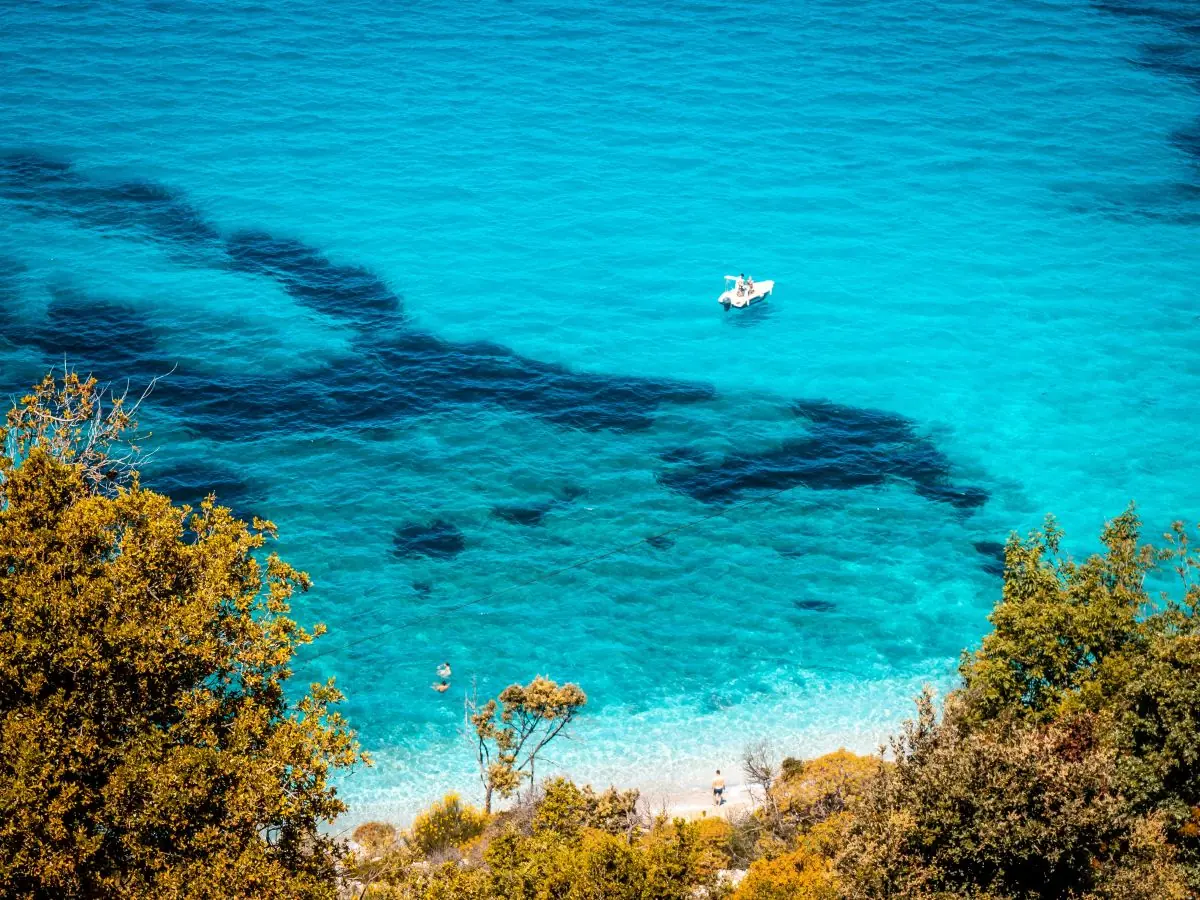
Most visitors base themselves in Ksamil (about 3 miles north, known for turquoise beaches) or Saranda (the Riviera’s main town, 11 miles north, with the most hotels and the Corfu ferry). Pair Butrint with the Blue Eye spring, Lekuresi Castle and a Ksamil beach afternoon for a full, varied day in southern Albania.
Here’s how the pieces fit into one day:
- Ksamil: ~3 miles (5 km) north — the swim-and-lunch stop
- Saranda: ~11 miles (18 km) north — hotels, restaurants and the Corfu ferry
- Blue Eye (Syri i Kaltër): a vivid natural spring inland, an easy add-on
- Lekuresi Castle: sunset views over Saranda and the bay
- Ali Pasha Castle: the triangular fort out in the lagoon, reached by a small boat across the channel
From the Venetian Castle ramparts you can see straight across the Vivari Channel to Ali Pasha’s lonely triangular fort sitting out in the lagoon — a good reminder of how much more there is within a few miles of the gate.
The bottom line on Butrint National Park
TL;DR: Butrint delivers 2,500 years of history in a two-hour, mostly-shaded loop for about $11 — the cultural high point of the Albanian Riviera and an easy half-day from Saranda, Ksamil or Corfu. Go at opening or late afternoon, bring cash and water, and don’t expect to see the buried Baptistery mosaic. For everything else, it’s an easy yes.
Planning a southern Albania trip soon — are you basing yourself in Ksamil, Saranda, or day-tripping over from Corfu? Tell me your setup and I’ll point you to the smartest way in.