The things to do in Tirana aren’t always what the guidebooks list first. After multiple trips through Albania’s capital, I know which spots justify your time, which three I’d skip, and what nobody tells US travelers about prices, ride-hailing apps, and the year-long visa-free stay. Real walking times and honest friction points below.
The 8 must-see things to do in Tirana
The must-see things to do in Tirana center on the pedestrianized core and two Cold War museums. Prioritize Skanderbeg Square, Bunk’Art 1, the Pyramid’s exterior climb, the Dajti cable car, House of Leaves, Et’hem Bey Mosque, Blloku, and Pazari i Ri. Two full days covers this list comfortably on foot.
- Skanderbeg Square — the pedestrianized civic heart
- Bunk’Art 1 — a 106-room nuclear bunker-turned-museum
- Pyramid of Tirana — climb the exterior for city views
- Dajti Ekspres — the longest cable car in the Balkans
- House of Leaves — the former Sigurimi secret-police HQ
- Et’hem Bey Mosque — rare Ottoman interior frescoes
- Blloku — the once-forbidden quarter, now the nightlife hub
- Pazari i Ri — the restored New Bazaar
Is Tirana worth visiting?
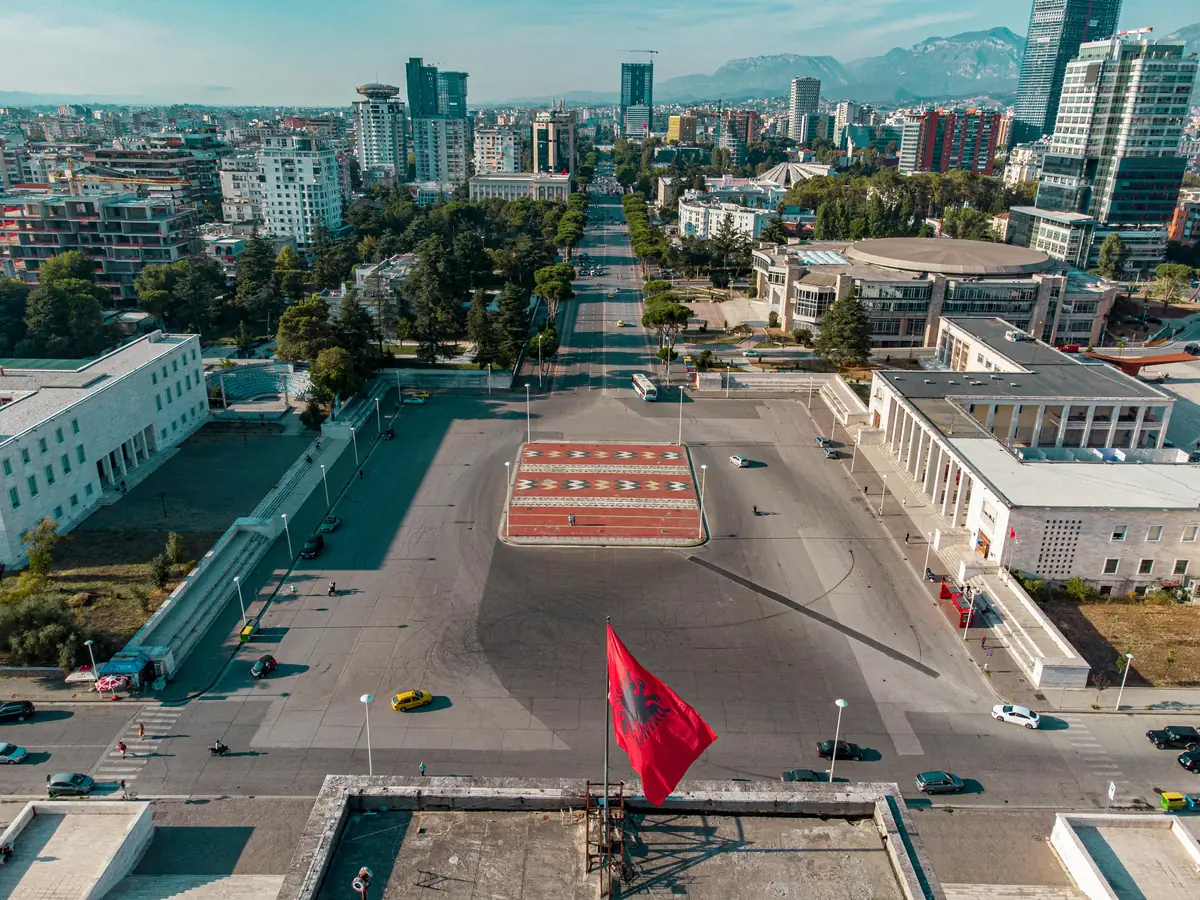
Yes — Tirana rewards travelers who value a rough-edged, honest European capital over a polished one. You get Ottoman mosques, 1920s Italian urban planning, brutalist communist architecture, and bold color-block modernism stacked inside a compact, walkable center. Two to three days covers it comfortably, and the value is real: a full restaurant meal with wine runs roughly 1,200-1,800 ALL ($15-22), against $45-60 for the same meal in Rome.
What separates Tirana from the usual European capitals is the density of first-hand communist history you can physically walk into. Bunk’Art 1 and 2 are actual Cold War bunkers the public wasn’t meant to see. The Pyramid was a personal monument to a dictator. Blloku was closed to non-elites within living memory. These aren’t plaques — they’re buildings you enter.
Pro Tip: If you’re already routing through Rome, Istanbul, or Vienna, the Tirana detour is cheap and quick. Direct flights from TIA to those hubs run $80-150 one-way and take under two hours.
The 13 best things to do in Tirana
1. Skanderbeg Square — start here
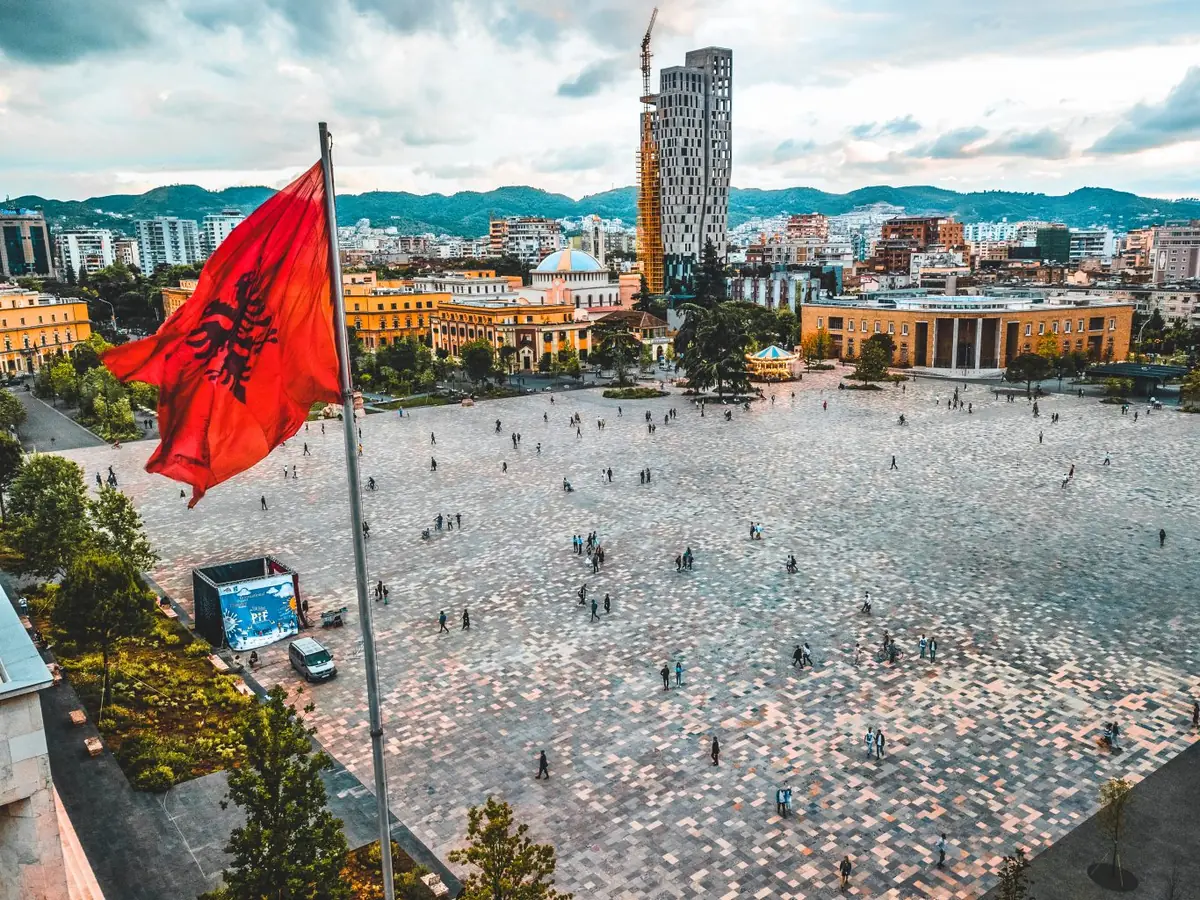
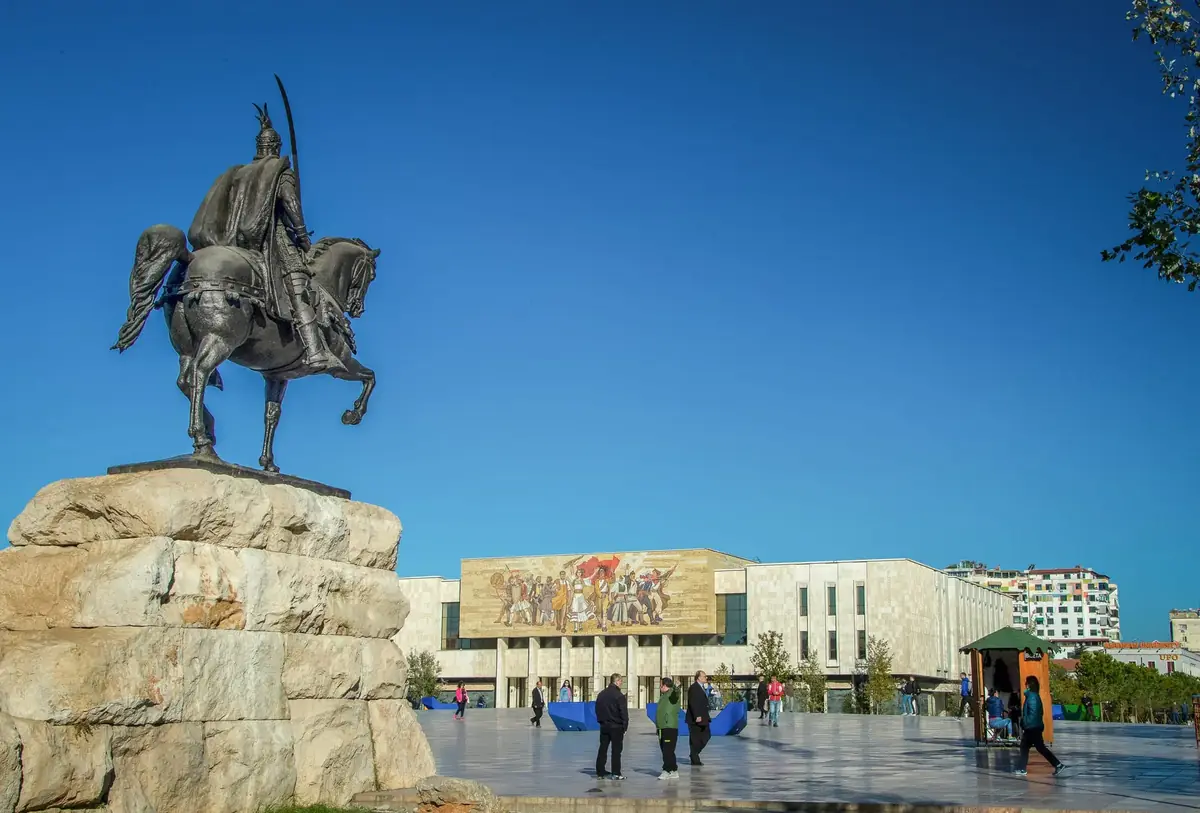
The square is the first thing you’ll hear about and the first place to actually go. Pedestrianized in a 2017 redesign, it’s a 40,000-square-meter plaza paved with stones from every region of Albania in a symbolic mosaic. At its center: the 1968 equestrian statue of Gjergj Kastrioti — Skanderbeg — the 15th-century national hero who held off the Ottomans from his fortress in Krujë.
Go twice: once in the morning when it’s empty and you can actually see the floor pattern, and once after 8 p.m. when families bring kids to run through the micro-fountains that double as rain drainage. The evening xhiro — the ritual evening stroll — is a real thing here, not a tourist brochure line.
The square won the European Prize for Urban Public Space, and you can feel why. It slopes gently up toward the center, about 6 feet (2 m) of elevation across the plaza, with non-slip stone that handles rain well. Surrounding it: the National History Museum with its iconic mosaic façade, the Opera, the Clock Tower, and Et’hem Bey Mosque. One planning note that trips people up — the museum is closed for a full restoration under the EU4Culture programme, with reopening currently targeted for 2028. The mosaic is still visible from the square, though scaffolding covers sections at various stages of the work.
- Location: Sheshi Skënderbej, central Tirana
- Cost: Free
- Best for: First-timers, evening people-watching
- Time needed: 30-45 minutes (longer at sunset)
2. Bunk’Art 1 — the Cold War bunker you shouldn’t skip
Bunk’Art 1 is the single most substantial thing to do in Tirana. It’s a 5-story, 106-room nuclear bunker — roughly 32,000 square feet (3,000 sq m) of ventilated concrete — that Enver Hoxha had built into a hillside below Mount Dajti, meant to shelter the regime’s top brass through a Cold War apocalypse that never came. You enter through a road tunnel bored into the rock, past blast doors, and keep descending. Today it’s a museum covering the Italian occupation through the end of communism, with art installations wedged between reconstructed command rooms.
The interior stays cool and damp year-round, even when the city is pushing 95°F. Your footsteps echo down corridors the length of a city block. In one room, you walk through a recreated socialist-era apartment; further in, you reach Hoxha’s own office and the assembly hall where the leadership planned to govern the ruins. It earns the two hours you’ll spend there — and bring a layer, because most people underdress for it.
Pro Tip: Pair Bunk’Art 1 with the Dajti cable car on the same day — the tunnel entrance is a two-minute walk from the cable car’s lower station, and the same bus serves both. Do Bunk’Art first when you’re fresh, Dajti second when you want to be outdoors.
To get there without a taxi: city bus L11 — locals still call it the Porcelan line — from the Biblioteka stop on Rruga Ludovik Shllaku, behind the National Opera. The fare is 40 ALL (about $0.50), paid in cash to the conductor on board, and the ride runs 20-45 minutes depending on traffic. Get off at the stop marked Dajti Ekspres; say the name rather than trusting a route number, because Tirana renumbers its lines. A taxi from the center runs 700-1,000 ALL ($9-12). There’s no food near the bunker, so carry water.
On tickets: a combined Bunk’Art 1 + Bunk’Art 2 ticket brings each museum to about 800 ALL, so the pair costs roughly 1,600 ALL versus 1,800 ALL bought separately. That’s a saving of about $2.50 — the real benefit is that the combo stays valid for 72 hours, letting you do the central bunker on arrival evening and the mountain one two days later. Buy it only if you genuinely intend to do both.
- Location: Rruga Fadil Deliu, beside the Dajti cable car base
- Cost: 900 ALL (~$11), or about 1,000 ALL with the audio guide — cash only; bring your own headphones
- Hours: Daily, roughly 09:30-17:30 in summer and 09:30-16:30 in winter
- Best for: History travelers, architecture fans, anyone with two free hours
- Time needed: 2 hours minimum, plan 2.5
3. Bunk’Art 2 — the shorter, sharper companion
Bunk’Art 2 is the central-city companion to Bunk’Art 1: smaller, quicker, and narrower in focus. It sits on Rruga Abdi Toptani opposite City Hall, beside the Clock Tower and a three-minute walk from Skanderbeg Square, inside a 24-room bunker originally built for the Ministry of Internal Affairs.
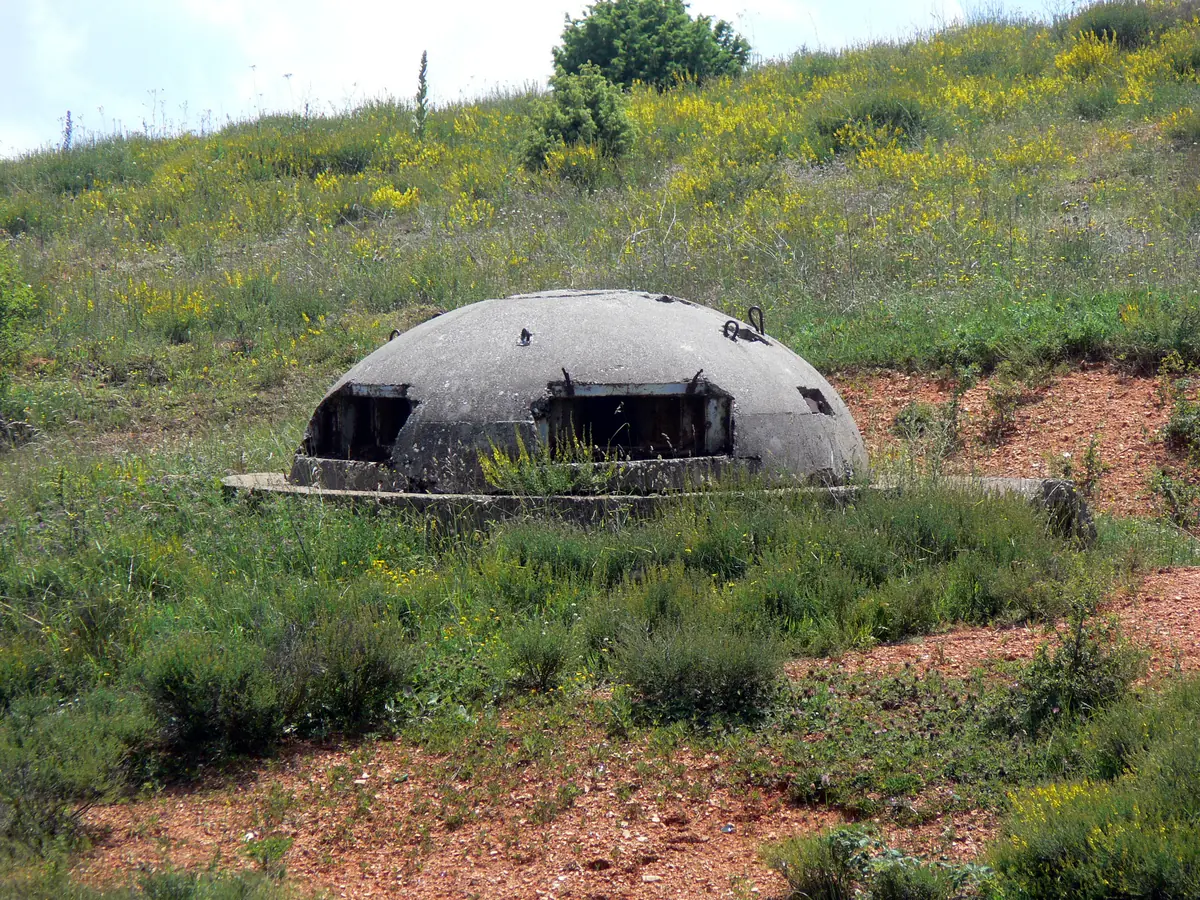
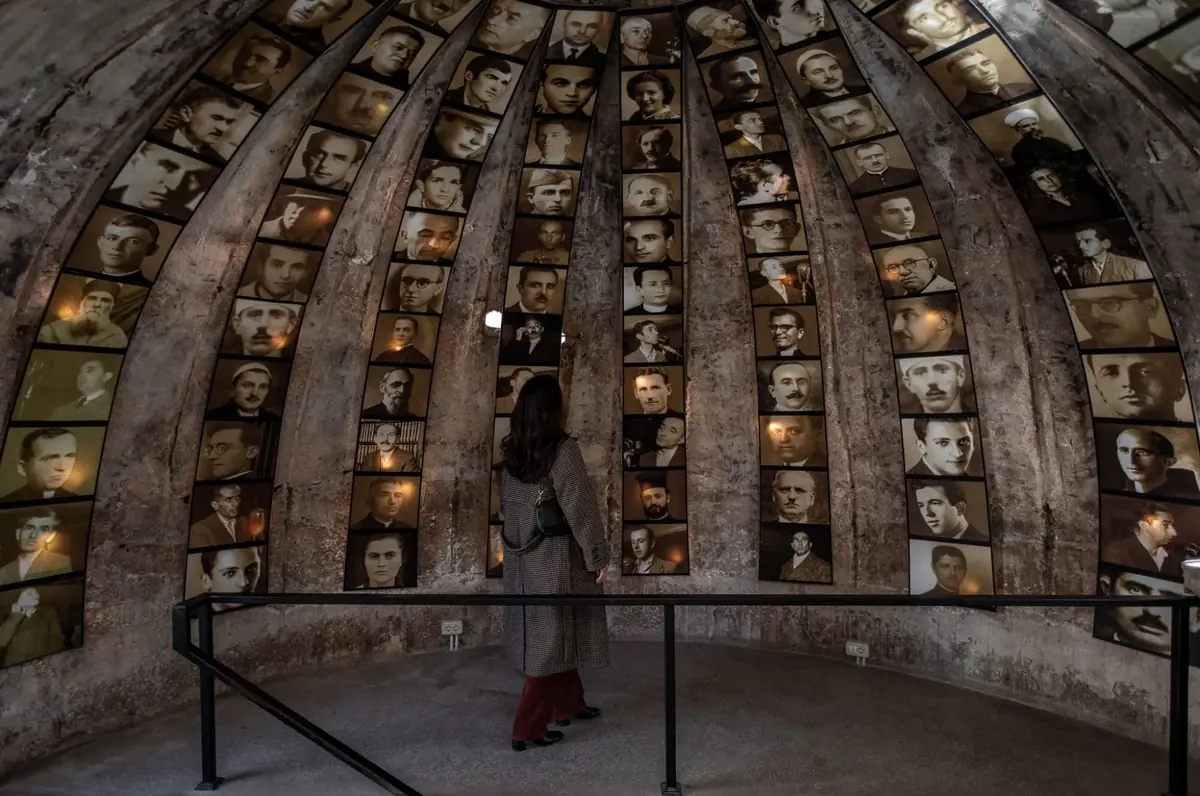
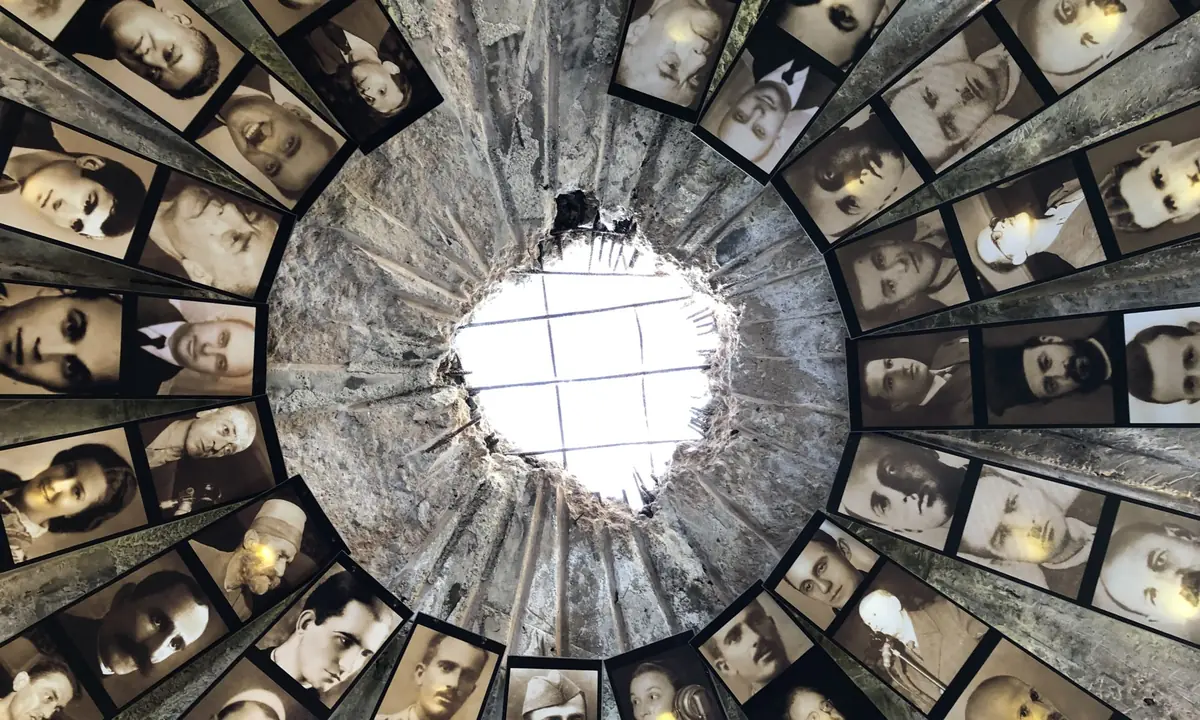
The entrance alone justifies the stop: a purpose-built concrete dome shaped like one of the country’s mushroom bunkers, lined inside with lit portraits of people killed under the regime. You walk down the stairs beneath them. Below, the exhibition drills into one subject — surveillance, political persecution, and the Sigurimi secret police. Bugging equipment, interrogation rooms, informer files, the machinery of a sealed border. It hits harder per minute than its bigger sibling.
If you can only do one, take Bunk’Art 1 for the scale and Bunk’Art 2 for the story. If you’re claustrophobic, Bunk’Art 2 is the easier of the two to face — not because the subject is lighter, but because it’s one level down and an hour of your time instead of five floors under a mountain.
- Location: Rruga Abdi Toptani, central Tirana
- Cost: 900 ALL (~$11), cash only
- Hours: Daily, roughly 09:30-18:30
- Best for: Visitors short on time, anyone who’s already done Bunk’Art 1
- Time needed: 60-90 minutes
4. Pyramid of Tirana — climb the outside, skip the inside
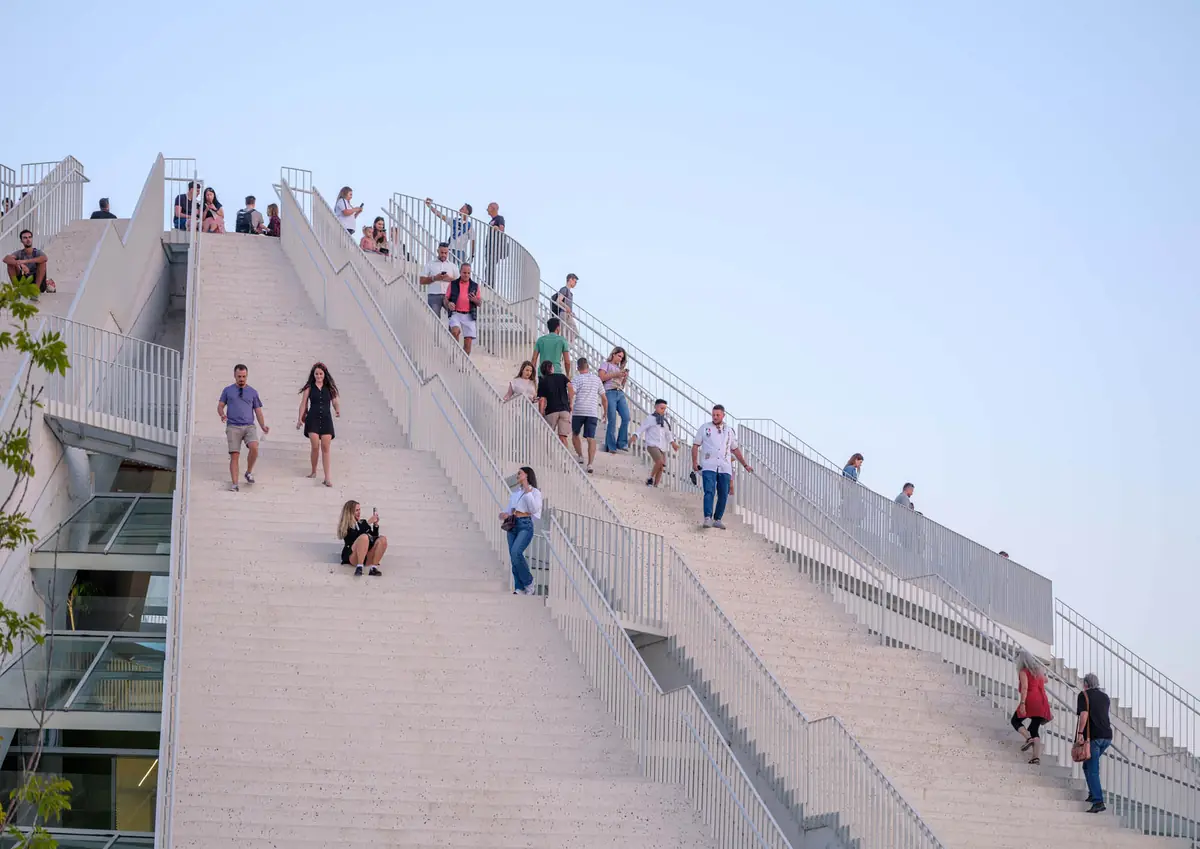
The Pyramid is the strangest building in the Balkans. Opened in 1988 as the Enver Hoxha Museum — designed by his daughter — it outlived the regime by three years and then spent decades in various stages of decay, reuse, and graffiti. After a renovation by Dutch studio MVRDV, completed in 2023, the exterior reopened as a set of broad terraced stairs you can now climb, all day, every day, for free.
Climb it at golden hour. The city lays out below you — minarets, tower cranes, the Dajti ridgeline to the east, Skanderbeg Square’s lights glowing to the north. It’s the best free view in the city. The interior now houses TUMO Tirana, a free tech school for teenagers, plus colorful modular boxes for startups and cafés — worth a 10-minute poke around if you’re curious, but the exterior climb is the real experience.
The stairs are steep and uneven near the top. Wear grippy shoes, not flat-soled dress sneakers. Kids slide down the smooth side panels — they’ll want to. Adults have been known to join them.
- Location: Bulevardi Dëshmorët e Kombit, 8 minutes south of Skanderbeg Sq
- Cost: Free (exterior); the TUMO interior is also free but keeps school hours
- Best for: Sunset, architecture nerds, travelers on a zero budget
- Time needed: 30-60 minutes
5. Dajti Ekspres — the cable car up Mt. Dajti
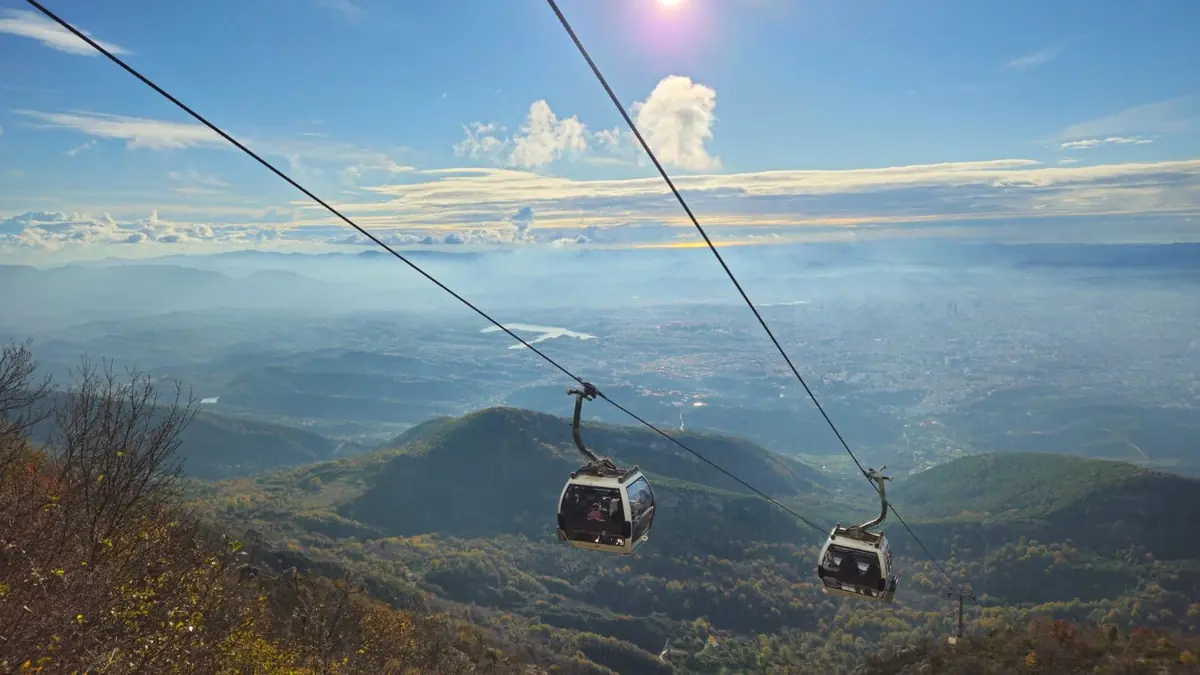
The Dajti Ekspres is a 4,354-meter (2.7-mile) Austrian-built gondola — the operator calls it the longest cable car in the Balkans — running from the eastern edge of Tirana up onto the shoulder of Mt. Dajti at roughly 3,445 feet (1,050 m). Thirty eight-seat cabins slide into the station about every 80 seconds, so queues move fast even on a busy Sunday. The ride takes about 15 minutes over the outskirts, a reservoir, and scrubby hillside before the beech forest takes over.
At the top: the Ballkoni Dajtit restaurant with its wide panoramic terrace, the Dajti Tower Belvedere hotel, and an adventure park with rope courses, mini-golf, and a playground. One thing the marketing skips — the cable car does not reach the 1,613 m summit, which carries the national broadcast antennas inside a military-restricted zone. Even in August the ridge runs about 18°F (10°C) cooler than the city, so bring a light layer.
Pro Tip: Dajti is closed on Tuesdays for maintenance — the one exception being a Tuesday that falls on a public holiday. This catches out at least half the travelers I’ve spoken to who showed up confused at a locked gate. Check before you go, and check the weather too.
Walk five minutes past the restaurant terrace and the mountain improves sharply: open meadows where families picnic and horses graze, then forest tracks climbing toward the crest. The proper walk from the top station is Maja e Tujanit, a 3.3-mile (5.3 km) round trip with about 1,400 feet of climb, two and a half to three hours with stops — and the payoff is the turquoise sliver of Lake Bovilla in its gorge on the far side. Food at the top is overpriced for what it is: a coffee runs 250-350 ALL, a pizza 900-1,200 ALL. If you’re hungry, eat before you ride.
- Location: Eastern edge of Tirana below Linza (bus L11 to the Dajti Ekspres stop)
- Cost: ~1,400-1,500 ALL adult return ($17-18.50), cash
- Hours: Mon-Fri 09:00-18:30, Sat-Sun 09:00-19:00; closed Tuesdays
- Best for: Half-day escape, families, Bunk’Art 1 combo, ridge walkers
- Time needed: 3-4 hours with time at the top
6. House of Leaves — the surveillance museum
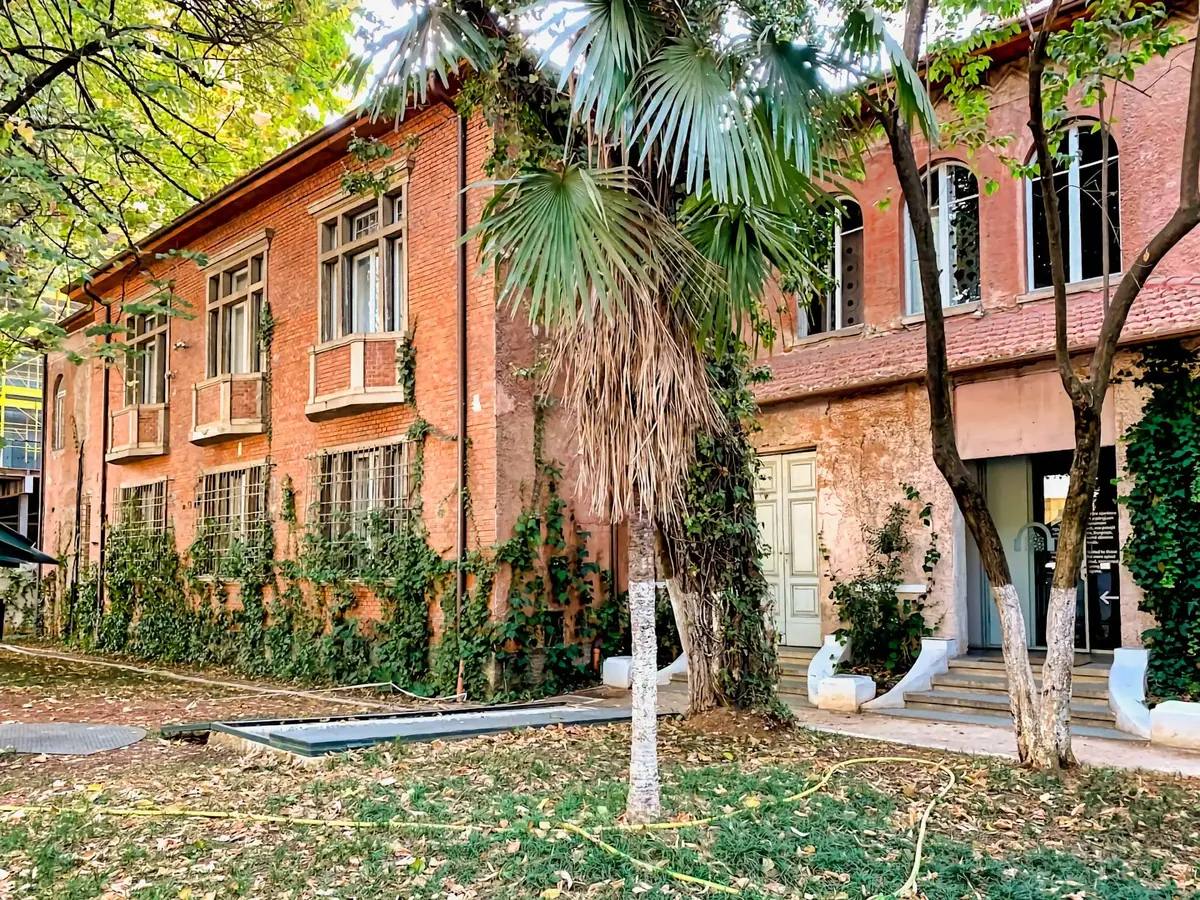
The House of Leaves is the smaller, quieter counterpart to Bunk’Art 2. It occupies a 1931 villa — built as a private obstetrics clinic, used by the Gestapo during the war, then handed to the Sigurimi — covered in creeping ivy that gives the building its name. Now it’s the Museum of Secret Surveillance, spread across more than 30 rooms.
The exhibits are deliberately cramped and low-lit. You walk through former interrogation and analysis rooms, see the actual bugging devices pulled from hotel rooms and phone booths, and read personnel files on ordinary citizens flagged for political suspicion. The emotional weight hits differently than Bunk’Art — this is less “epic scale” and more “this happened to a specific accountant named Fatmir in 1978.” Photography is not allowed inside, which is part of why it stays quiet.
It’s a 5-minute walk from Skanderbeg Square, it takes 90 minutes to 2 hours, and it pairs well with Et’hem Bey Mosque and the Clock Tower for a tight central-core morning. Bring cash — the desk doesn’t take cards.
- Location: Rruga Ibrahim Rugova, near Et’hem Bey Mosque
- Cost: 700 ALL (~$8.50), cash only; student and senior discounts at the desk
- Hours: Daily, roughly 09:00-19:00
- Best for: History travelers who already did Bunk’Art 1
- Time needed: 90 minutes to 2 hours
7. Pazari i Ri — the reworked New Bazaar
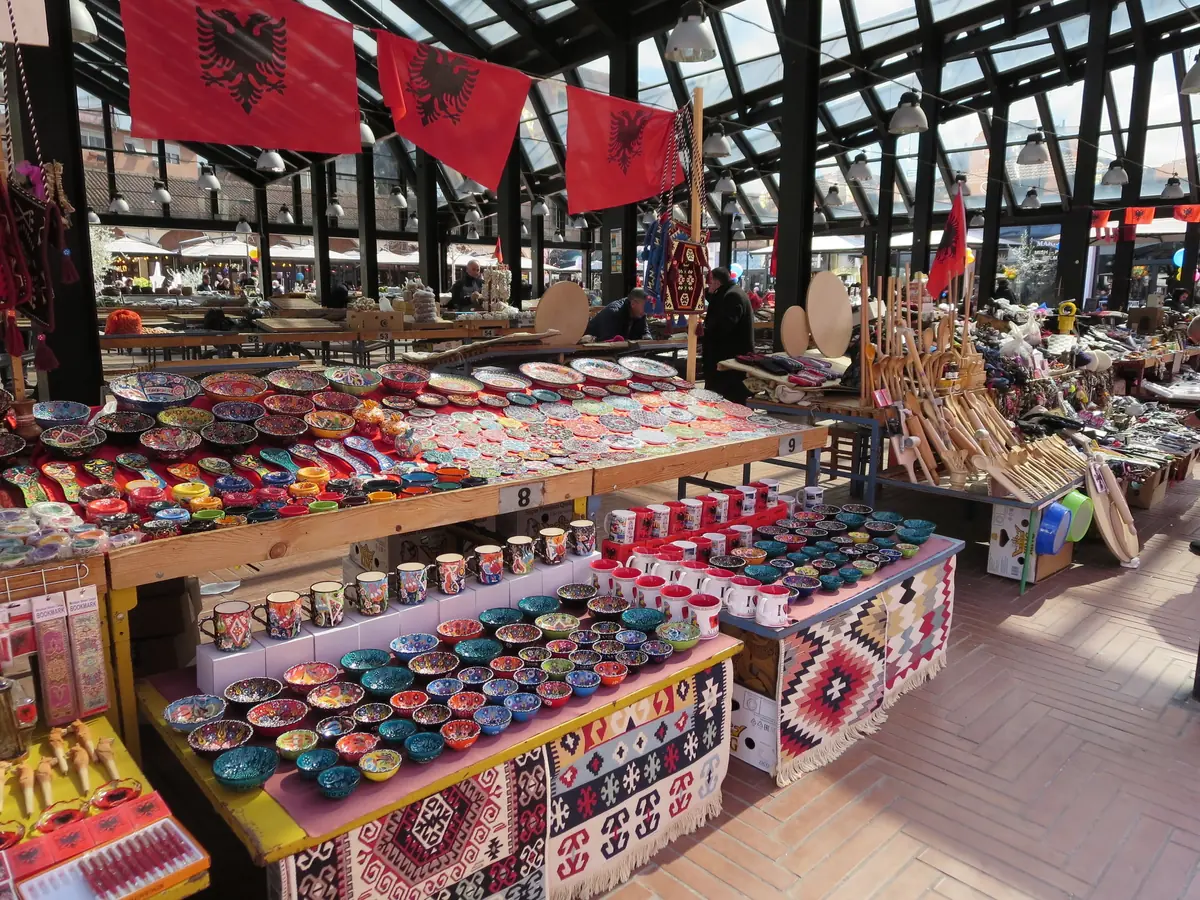
Pazari i Ri — the New Bazaar — is the best morning in Tirana if you want to see how locals actually shop. It sits about a 7-minute walk northeast of Skanderbeg Square, in a restored market square with colorful façade paintings and rows of vendors selling produce, olives, cheeses, honey, cured meats, spices, raki, and loose tobacco the way you’d buy vegetables.
Go before 8 a.m. on a weekday. That’s when the genuine trading happens — vendors restocking, elderly Albanian women haggling over feta, the smell of fresh byrek coming out of the corner bakery. By 10 a.m. it’s half tourists; by noon it’s mostly tourists. The vendors know which is which and adjust prices accordingly.
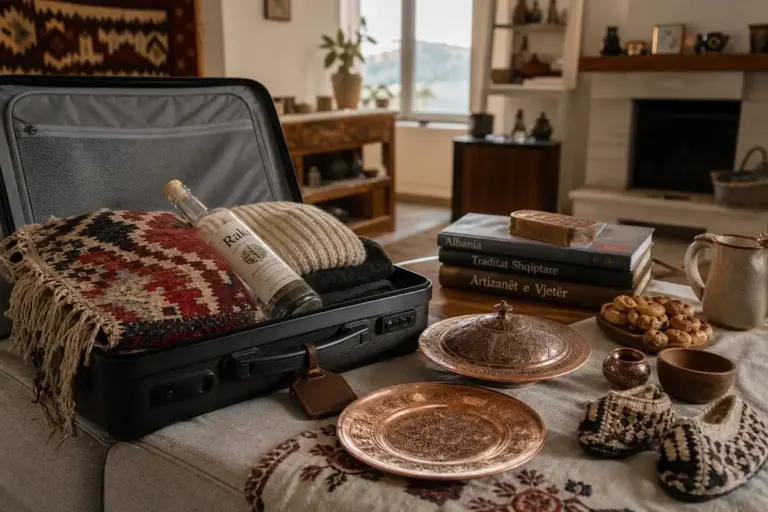
A half-kilo of local olives runs 200-300 ALL. A wedge of sharp mountain cheese: 300-500 ALL. The knitted wool house socks — worn as indoor slippers across Albania — are the best cheap souvenir in the city at 500-700 ALL a pair. Bring cash; most stalls don’t take cards. The streets just off the market are also where you’ll find zgjidhni spots — buffet-style lunch counters where you point at what you want behind the glass and pay 300-450 ALL for a full plate.
- Location: Pazari i Ri, 7-min walk NE of Skanderbeg Square
- Cost: Free to browse; budget 300-800 ALL for a market breakfast
- Best for: Early risers, food travelers, souvenir hunters
- Time needed: 45-90 minutes
8. Et’hem Bey Mosque and the Clock Tower
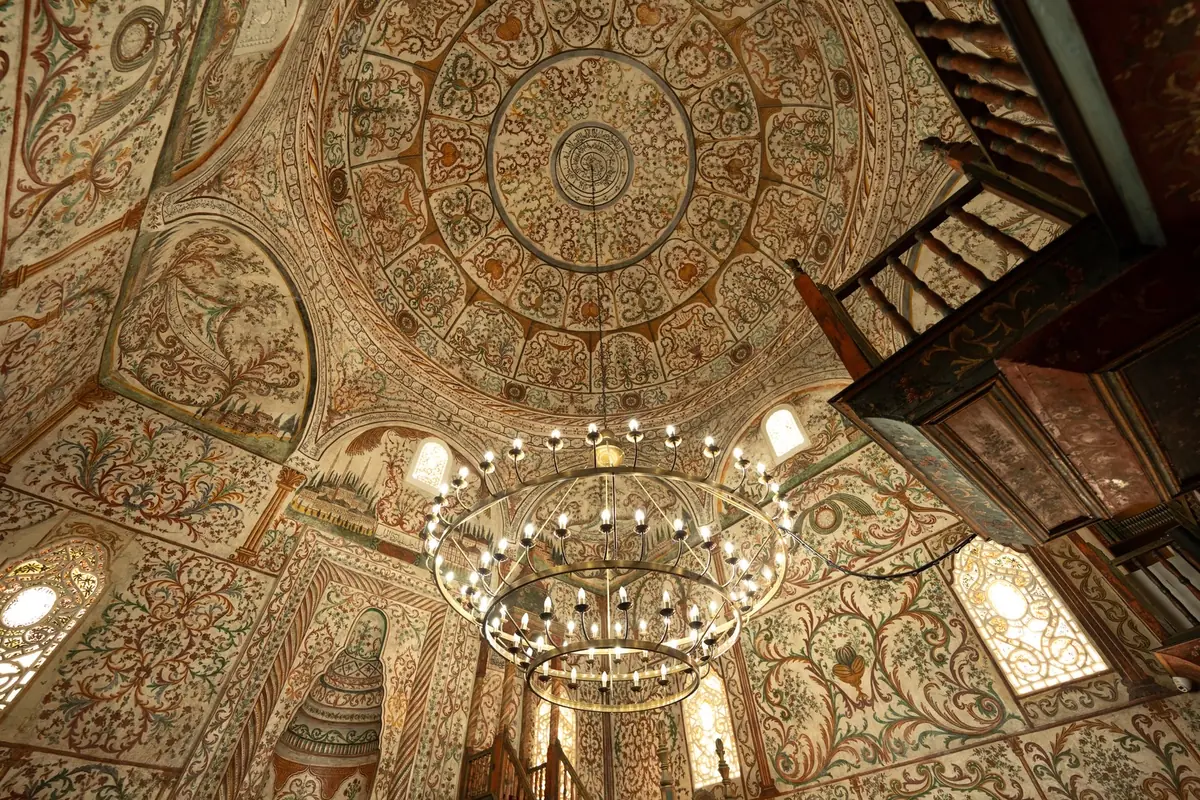
The Et’hem Bey Mosque is a small Ottoman mosque begun around 1791 by Molla Bey and completed about 1821 by his son, Haxhi Et’hem Bey. It stands beside the Clock Tower on the southeastern side of Skanderbeg Square, facing the National History Museum. What makes it unusual is the decoration: frescoes of trees, rivers, bridges, and waterfalls covering the walls, ceiling, and portico — rare representational imagery in an Islamic place of worship. It survived the 1967 state atheism campaign that closed or demolished most of Albania’s religious buildings.
The mosque’s best story isn’t architectural. In January 1991, with the regime still nominally in charge, 10,000 people walked in carrying flags to pray. The police didn’t intervene. That morning is widely treated as the moment religious freedom returned to Albania, and it’s worth knowing before you step inside.
Entry is free (a small donation is appreciated), and you remove your shoes at the door. Women are given a head covering if needed. Visiting works around the five daily prayers — early morning is the calmest window and the best light on the frescoes — and access is limited around Friday midday. Take your time with the ceiling; it’s painted in a way you have to lie back slightly to appreciate.
Next to the mosque stands the Clock Tower, begun in 1822 and raised to its present 115 feet (35 m) in 1928, when it gained four Venetian-style clock faces. The climb is 90 narrow spiral steps and costs 200 ALL, cash. Honestly, it’s not worth prioritizing if you’ve already done the Pyramid or plan to do Dajti — the surrounding towers now block much of the view, and the opening hours are erratic because it’s volunteer-staffed. If the door is open and you’re passing, go up.
- Location: SE side of Skanderbeg Square, beside the Clock Tower
- Cost: Mosque free (donation); Clock Tower 200 ALL (~$2.50), cash
- Best for: History travelers, architecture photography
- Time needed: 30-45 minutes (add 20 if climbing the tower)
9. Blloku — the forbidden quarter turned nightlife hub
Blloku is a 10-12 minute walk southwest of Skanderbeg Square and the single most-transformed neighborhood in the city. Within the last 35 years it went from a restricted communist enclave — you needed a pass to enter — to the nightlife, café, and boutique core of Tirana. Hoxha’s former villa still stands on Rruga Ismail Qemali (exterior viewing only).
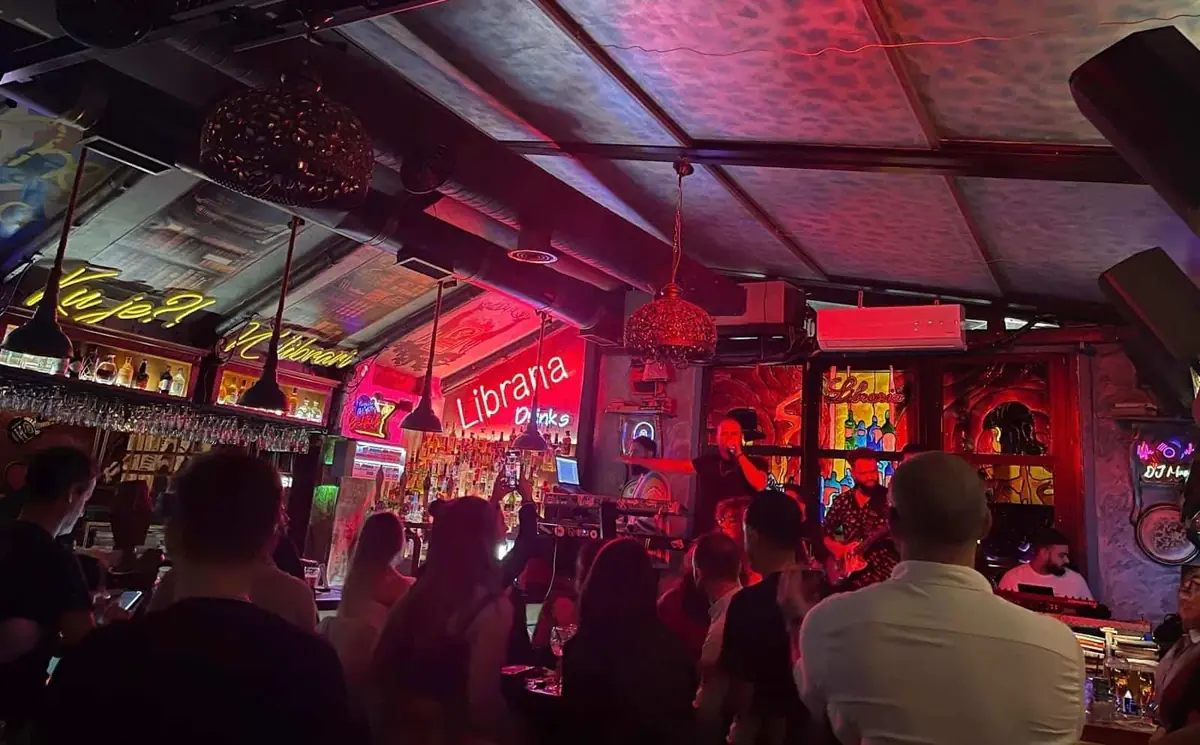
Come twice. Once by day for coffee on a café terrace, where a macchiato runs 80-120 ALL — barely a dollar for a drink that would cost $4 in Rome, and nobody will rush you out of the chair. Once at night for the bar strip through the neighborhood’s interior streets: Radio Bar on Rruga Ismail Qemali, open since 2009 and lined with 150-plus vintage Albanian radios, is the anchor; Picoteo does Spanish-style tapas and cocktails; Artigiano runs one of the better aperitivo scenes in the city.
One more that’s worth the short walk out of Blloku: Komiteti Kafe-Muzeum, behind the Pyramid on Rruga Papa Gjon Pali II, with 3,000-plus communist-era objects filling a room styled like someone’s 1970s living room and more than 25 varieties of raki behind the bar.
Skip Pepper Lounge and Tao Lounge Tirana. Locals I’ve talked to consistently flag them as overpriced tourist traps. The better bars sit one block off the main drag.
- Location: SW of Skanderbeg Square, 10-12 min walk
- Cost: $1-2 coffee; $5-9 cocktails; $12-25 dinner
- Best for: Nightlife, dinner, people-watching, boutique shopping
- Time needed: 2-4 hours (go twice, day and night)
10. Grand Park and the Artificial Lake
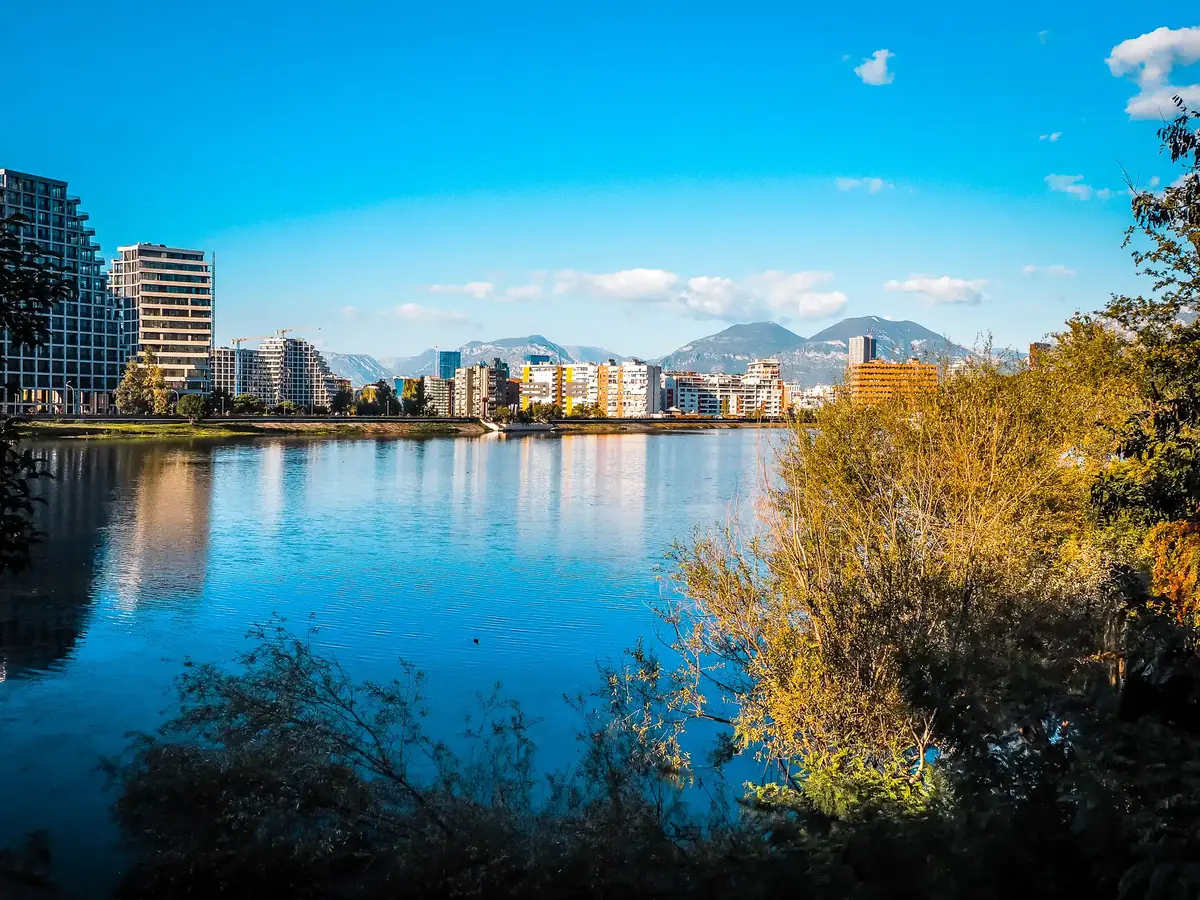
The Grand Park (Parku i Madh) sprawls across roughly 570 acres (230 hectares) south of the center — about a 20-25 minute walk from Skanderbeg Square, or a short taxi ride. Inside sits the Artificial Lake (Liqeni Artificial), dug in the 1950s, with running and walking paths looping its perimeter.
Weekend mornings: Tirana’s running community. Weekend afternoons: families, wedding photography, couples paddling rented boats. The Presidential Palace — the former royal residence — sits at the park’s edge (exterior only). The lakefront cafés charge slightly more than equivalent spots in the center, but the shade and views earn the markup.
This is also where Mullixhiu sits, at the park entrance by the lake dam — Bledar Kola’s slow-food kitchen of reimagined Albanian peasant cuisine, from a chef who cooked at Noma and Fäviken before coming home. It’s the best-value fine dining I’ve eaten anywhere in Europe: the seven-course “Metamorphosis” tasting menu runs about €30 (roughly $35) per person, dinner only, and à la carte plates land at €8-15. Book ahead; walk-ins on a weekend are a gamble.
- Location: Shëtitorja Lasgush Poradeci, 20-25 min walk south of Skanderbeg Sq
- Cost: Free to enter; cafés from 150-300 ALL ($2-4)
- Best for: Morning runs, shade, a Mullixhiu dinner
- Time needed: 1-2 hours (3+ with a meal)
11. Namazgah Mosque — the largest in the Balkans
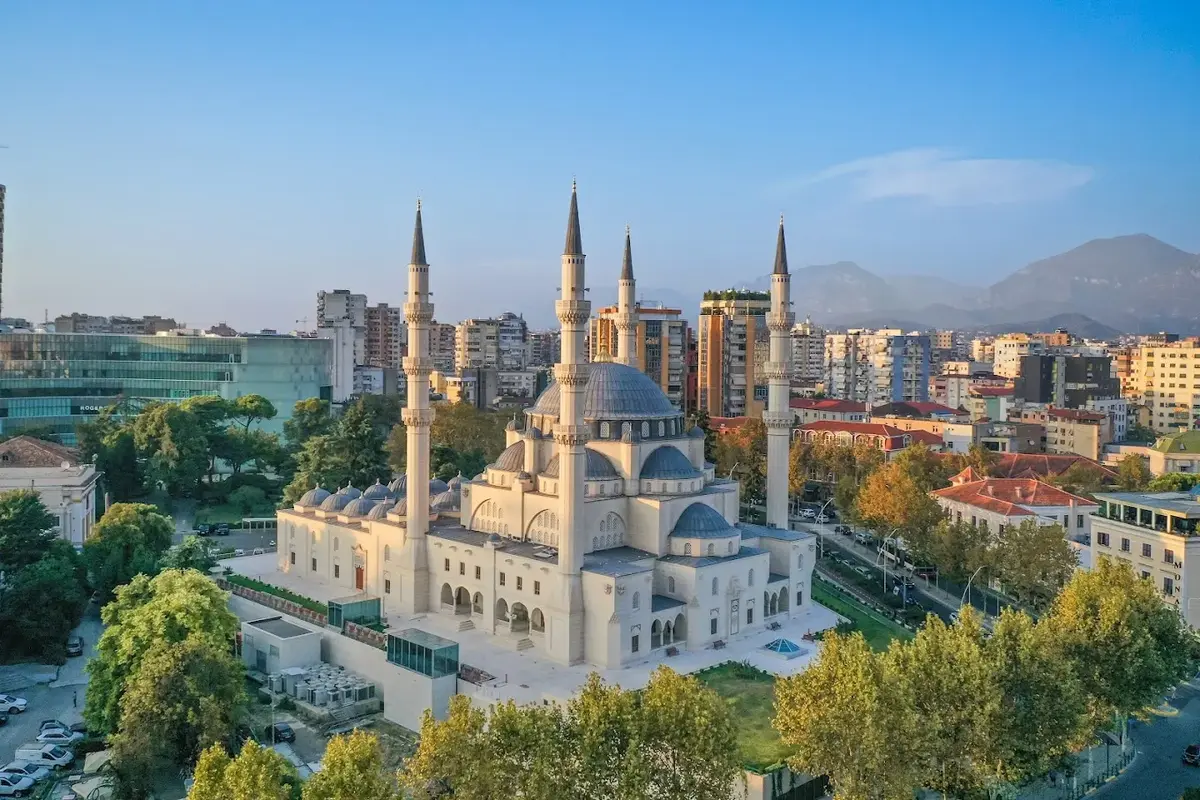
The Great Mosque of Tirana — Namazgah — is the newest major landmark in the city, and its scale is genuinely startling in a capital this compact. Turkish-funded through the Diyanet agency at a cost of around €30 million and inaugurated in October 2024, it sits beside the parliament, a five-minute walk east of Skanderbeg Square, with four 165-foot (50 m) minarets and a 100-foot (30 m) central dome. Capacity runs to roughly 10,000 worshippers, making it the largest mosque in the Balkans.
Visitors are welcome outside prayer times and there’s no entry fee — donations are voluntary and, unlike at some older sites, nobody pushes them. Modest dress is required: long sleeves, long trousers or skirt, head covering for women, shoes off at the door. Men use the main floor and women the upper gallery, which is worth knowing in advance. The interior is blue and white under an enormous dome, and the contrast with the tiny 18th-century Et’hem Bey Mosque nearby makes the visit worthwhile even if you’ve already done one mosque.
Pro Tip: Go within an hour of sunset, then take the elevator to the rooftop café at the MonarC Hotel across the street on George W. Bush Street. It isn’t signposted, it’s usually near-empty, and it puts you at eye level with the minarets — the best free photograph in central Tirana.
- Location: Beside the parliament, 5-min walk east of Skanderbeg Square
- Cost: Free
- Best for: Architecture fans, sunset visits
- Time needed: 30-45 minutes
12. Tanners’ Bridge and the old Ottoman quarter
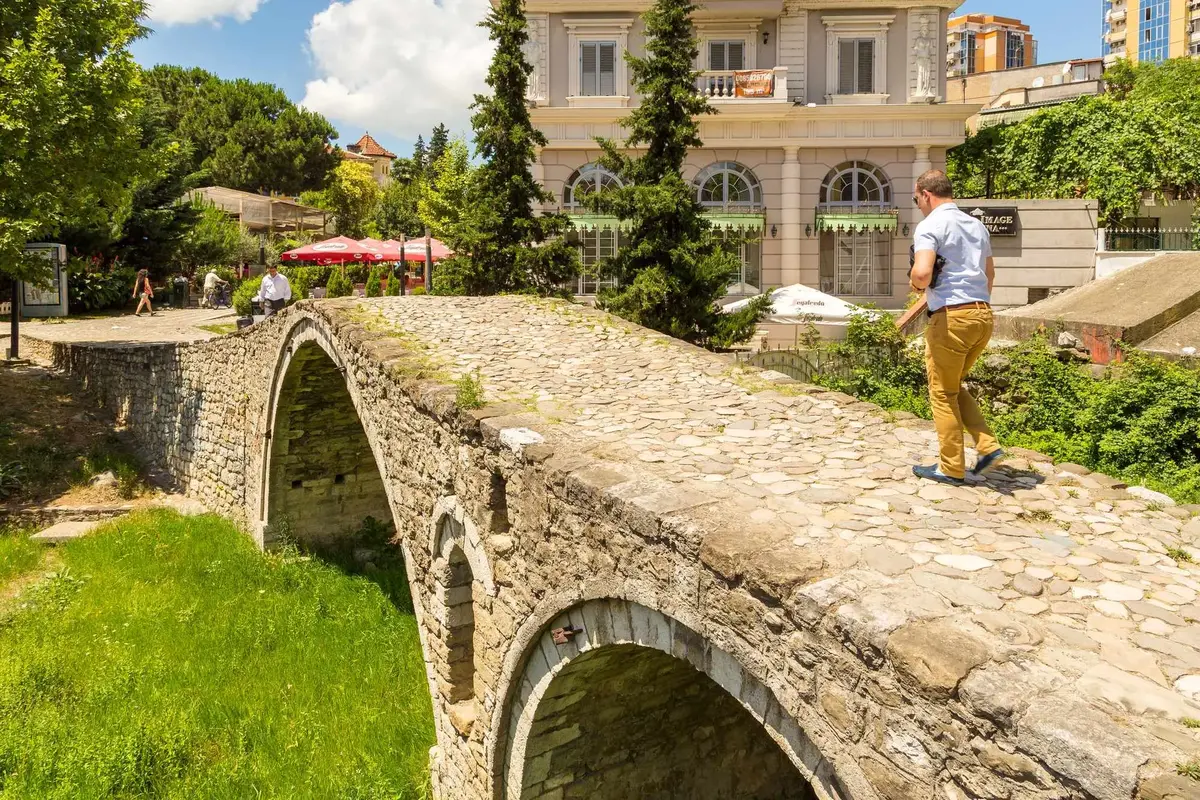
Tanners’ Bridge (Ura e Tabakëve) is easy to walk past without noticing — an 18th-century stone footbridge just east of Skanderbeg Square, on what was once the route tanners used to cross the Lana River. The river has since been diverted, so the bridge now arches over a dry stone channel surrounded by cafés.
It’s one of the last physical relics of Ottoman-era Tirana, when the city’s economy ran on leather and wool processing. You can walk across it in 30 seconds. The real reason to come is what’s around it: a short stretch of narrow streets lined with small wine bars, artisan shops, and low-slung old buildings you otherwise won’t see in a city this heavily rebuilt. The Tirana branch of Mrizi i Zanave — Albania’s best-known agrotourism kitchen, whose original sits an hour north near Lezhë — is on Bulevardi Zhan D’Ark a few steps away, and it’s a far easier reservation than the farm.
Combine Tanners’ Bridge with Pazari i Ri — they’re a 5-minute walk apart, and together they cover the old-Ottoman side of central Tirana in one compact loop.
- Location: 5-min walk east of Skanderbeg Square
- Cost: Free
- Best for: Quick photo stop, Pazari i Ri pairing
- Time needed: 15-30 minutes
13. Postbllok Memorial — a piece of the Berlin Wall
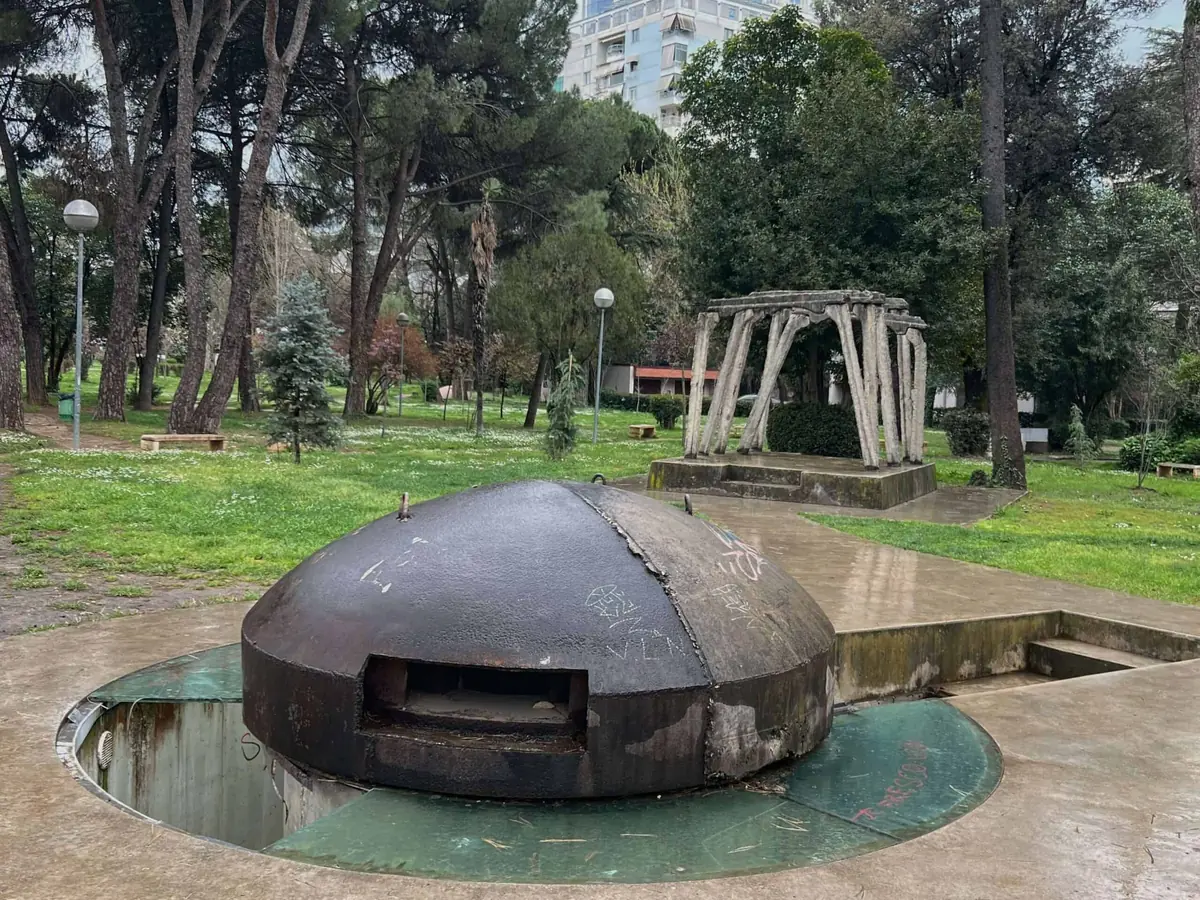
Postbllok is the most politically charged small space in Tirana and the one most guidebooks skip. It sits on the north edge of Blloku, right where the checkpoint once stood that kept ordinary Albanians out of the communist elite’s neighborhood. Today it’s an open-air memorial made of three elements: an original concrete Hoxha-era bunker, a chunk of the Berlin Wall given to Albania by Germany, and mine-shaft pillars rescued from the Spaç political prison.
The memorial is small — you’ll spend 15 minutes here, maybe 20 — but the triangulation of the three objects is the point. The bunker is what Hoxha built to keep the world out; the wall fragment is what separated the world; the pillars are where dissenters were worked to death. It’s one of the most effective compact memorials I’ve stood in front of anywhere in Europe.
Free, open 24/7, no ticket booth, no gate. Combine it with a walk into Blloku or a stop at Komiteti Kafe-Muzeum, a few minutes away behind the Pyramid.
- Location: North edge of Blloku, Rruga Ismail Qemali
- Cost: Free, 24/7
- Best for: History travelers, a 20-minute stop on a Blloku walk
- Time needed: 15-20 minutes
What to skip in Tirana (3 honest calls)
The National Archaeological Museum
The collection itself is genuinely important — Illyrian, Greek, and Roman pieces from across Albania, housed on Mother Teresa Square near the university — but the museum is presented poorly for foreign visitors. Limited English signage, dated display cases, and opening hours that visitors regularly find don’t match the posted ones. Entry runs around 400 ALL. Unless you’re an archaeology specialist or reading Albanian, your time is better spent at House of Leaves or Bunk’Art. Give this one a pass.
The Pyramid interior
The Pyramid’s exterior climb is mandatory. The interior isn’t. After the MVRDV redesign, the inside became home to TUMO Tirana — a free tech school for teenagers — plus a set of modular colorful boxes housing cafés and startup offices. It’s not a museum, it’s a community center, and the 10-minute wander inside tells you nothing about the building’s dictator-monument history. Climb the outside. Skip the inside.
Pepper Lounge and Tao Lounge Tirana
Two Blloku venues that hit the top of English-language search results for “best bars Tirana” and that locals I’ve talked to consistently flag as overpriced and oriented toward expats and tourists rather than quality. The drinks cost roughly double what you’ll pay at Radio Bar, Komiteti, Picoteo, or Artigiano a block or two over. There’s also a reliable local rule for spotting the pattern: if a menu is printed in four languages with photos of every dish, or the prices are displayed in euros rather than lek, that restaurant has already decided you’re a tourist.
Best day trips from Tirana
The best day trips from Tirana are Berat (a full day), Krujë (a half day), and the Bovilla Lake hike (a half day with driving time). All three are under a 2.5-hour drive one-way. Krujë and Berat can be done by intercity bus or furgon with no booking; Bovilla effectively needs a car, a taxi deal, or a prepaid tour, because there’s no public transport to the trailhead.
Krujë — the half-day Skanderbeg fortress
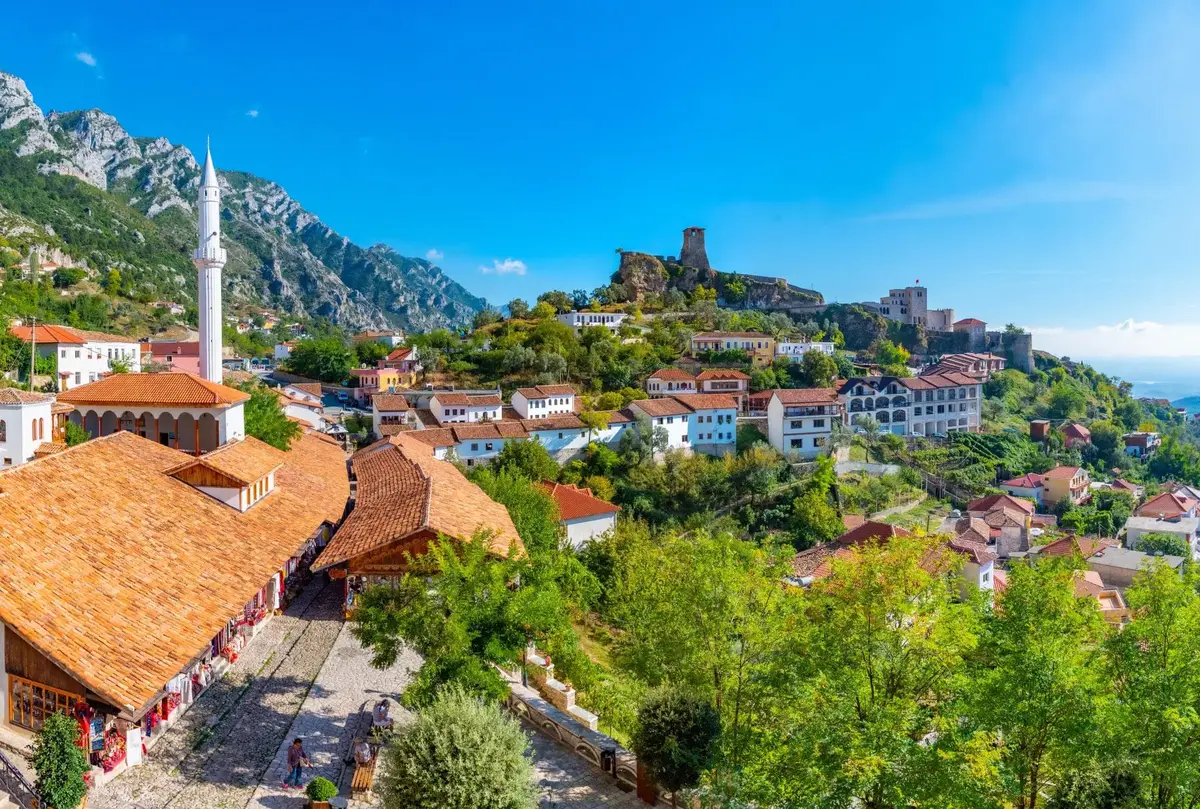
Krujë sits 20 miles (32 km) north of Tirana, 45-60 minutes by car up a switchbacking road, and delivers the biggest historical payoff for the smallest time investment. The 15th-century hilltop castle is where Skanderbeg held off the Ottomans for 25 years, and the ridge gives you views across the plain to the sea. Inside the walls: the Skanderbeg Museum (strong on militaria, weak on English) at around 500 ALL, and a small ethnographic museum in an old Ottoman house that’s better for atmosphere. The castle grounds and the 400-year-old Old Bazaar are free to wander, though a small castle ticket of about 200 ALL is sometimes collected at the gate.
- Transport: Bus/furgon from Tirana’s regional terminal, 200-300 ALL one-way, ~1 hour
- Tour cost: $30-55 per person half-day including transport
- Best for: Tight schedule, final-day travelers before an afternoon flight out of TIA (the airport is on the way back)
Berat — the full-day UNESCO stop
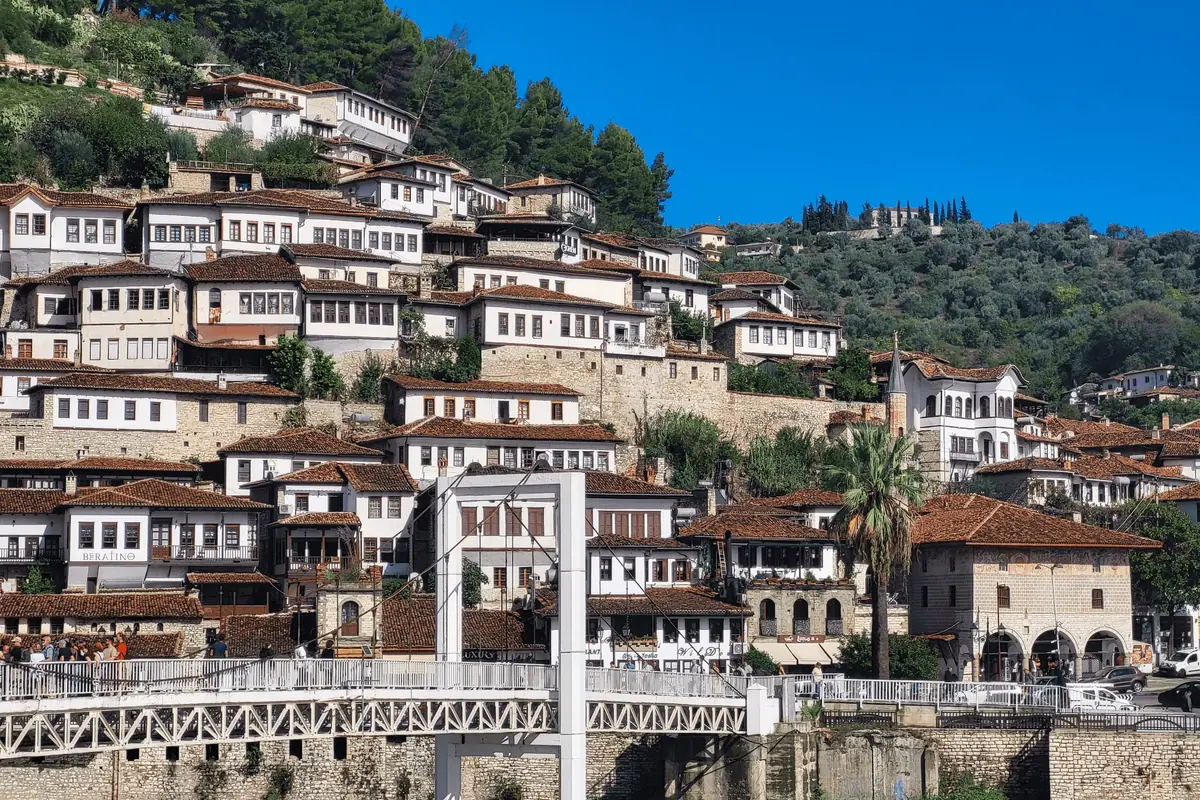
Berat sits about 62 miles (100 km) south of Tirana, 2 to 2¼ hours each way by car or bus. It’s the “City of a Thousand Windows” — two facing hillsides of white Ottoman houses stacked with near-identical rows of shuttered windows, split by the Osum river into the Mangalem and Gorica quarters, with an inhabited castle on top where families still live inside the medieval walls. Most guides call it the single best day trip from Tirana, and they’re right.
Two tactical notes, and the second one matters more than anything else on this page. One: do the castle climb first thing when you arrive — it’s 25-30 minutes uphill on cobblestones that are slick when wet — then save the Ottoman-quarter walk and the Onufri Icon Museum for the afternoon light. Two: the last bus back to Tirana leaves Berat around 4 p.m., with a few furgons running slightly later but nothing you should bank on. Take the 6-7 a.m. departure out and you’ll have seven or eight good hours. Miss that return and you’re paying $60-plus for a taxi or staying the night.
- Transport: Bus or furgon from Tirana’s combined South & North Terminal, 400-700 ALL ($5-9), ~2 hours, around 20 departures a day
- Tour cost: $60-95 per person full-day ($80+ with lunch)
- Best for: Anyone with a full day, photography travelers, UNESCO hunters
Bovilla Lake and Mt. Gamti — the hiker’s pick
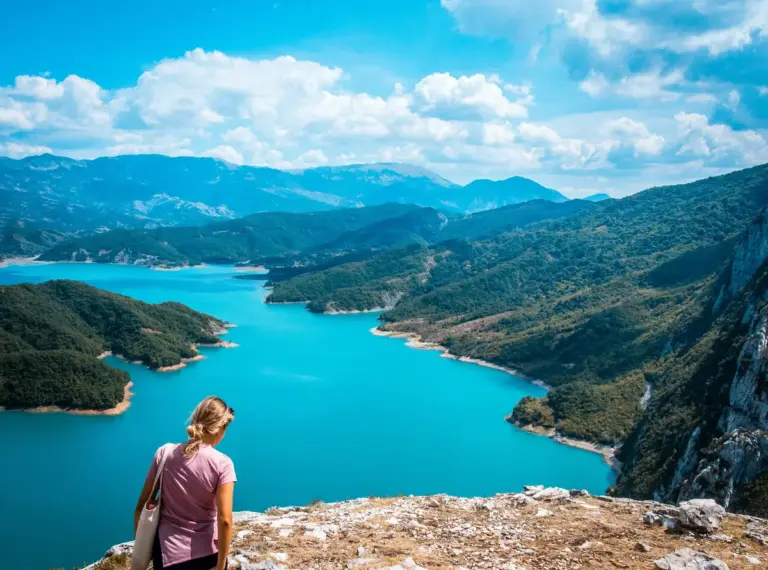
Bovilla Lake sits about 15 miles (25 km) northeast of Tirana, roughly a 40-minute drive, and feeds the city’s water supply. The Mt. Gamti hike above it is a steep 30-45 minute climb that ends at a narrow canyon ridge with a sharp drop and the full emerald spread of the reservoir below; the round trip runs about two hours. It’s become the most-photographed non-coastal spot in Albania.
The trail is unsigned in places. There’s no ticket booth, no rescue service, and no fence at the viewpoint — treat the edge seriously. Go early to beat heat and crowds, and wear proper shoes; this is a short mountain walk, not a stroll. Most travelers prepay a driver plus hike for $40-65; self-driving works but the last couple of miles of gravel road will rattle a rental car.
- Transport: No public transport; prepaid half-day tour, taxi deal, or self-drive
- Tour cost: $40-65 per person
- Best for: Hikers, photography travelers, fit visitors with half a day
How do you get from Tirana airport to the city?
Tirana International Airport (IATA: TIA, “Nënë Tereza”) sits roughly 11 miles (17 km) northwest of the city center, and you have three realistic options. The Rinas Express airport bus runs hourly, around the clock, for a flat 400 ALL (about $5), taking 30-45 minutes. The official taxi rank out front runs about 2,200-2,500 ALL ($27-31). A local ride-hailing app — Clust is the one to install — typically quotes 1,200-1,800 ALL ($15-22) and has a signposted pickup zone.
The bus is the smart call for solo travelers arriving in daylight. It drops you behind the National Opera, right off Skanderbeg Square, within 5-10 minutes’ walk of most central hotels — and you can pay the driver in lek or euros. The taxi is the right call for groups of two or more, late-night arrivals, or anyone with heavy luggage. There is no airport train: a Tirana-Durrës-Rinas rail link with an airport spur is under construction, with passenger service projected for a few years out, and those dates have slipped before.
Pro Tip: The pirate-cab scam at TIA is real. Ignore anyone who approaches you inside the terminal offering a ride — those cars are usually unmetered and run two to three times the going rate. Walk out to the marked official rank, agree the fare before your bags go in the trunk, or use an app. And if someone is collecting you by car, tell them to time their arrival: the “Kiss & Fly” drop-off zone is free for a few minutes, then charges in bands up to about 1,000 ALL.
How many days do you need in Tirana?
Two to three days is the right answer for most US travelers. Two full days cover Skanderbeg Square, one of the Bunk’Arts, the Pyramid, Blloku, Pazari i Ri, and a half-day Dajti cable car trip. Add a third day for Berat or Krujë. One day works only in a pinch; four days is worth it if Tirana is your base for multiple day trips.
If you only have 24 hours, here’s the tight list: Skanderbeg Square and Et’hem Bey in the morning, Bunk’Art 2 (central, 90 minutes) at midday, the Pyramid climb at golden hour, dinner at Oda or Era, and drinks in Blloku. Skip Dajti, skip Bunk’Art 1, skip Grand Park — save them for a return trip. And don’t plan that dinner for 6:30 p.m.; Tirana eats late, and you’ll have the room to yourself until about 8:30.
Is Tirana safe for tourists?
Yes — Tirana is safe for tourists by European standards. Violent crime against visitors is rare. The US State Department rates Albania Level 2 (“Exercise Increased Caution”) — the same rating it gives France, Germany, Italy, and Spain — citing organized crime networks that do not target tourists. Real risks: petty theft in crowds, phone snatching on busy buses, taxi overcharging at the airport, and chaotic traffic (always use crosswalks, even when locals don’t). It’s worth enrolling in the State Department’s STEP program before you fly, since the embassy in Tirana occasionally issues short-term security alerts.
Solo female travelers I’ve talked to consistently rate Tirana as feeling safer than the southern Albanian Riviera — the opposite of what generic safety lists imply. Stick to Blloku or the Skanderbeg-central area for accommodation, use a licensed taxi app after midnight rather than flagging a car on the street, and apply normal urban-awareness rules: eye contact, confident pace, drink-watching in bars.
LGBTQ+ visitors: homosexuality is legal and there’s anti-discrimination legislation, but public affection still draws stares. There’s no open gay-bar scene in Tirana, though Blloku’s café-bar culture is relaxed and mixed — Radio Bar and Komiteti are the kind of easygoing, mainstream venues where nobody looks twice.
How expensive is Tirana actually?
Tirana is one of the most affordable capitals in Europe — dining out costs roughly 60-70% less than in Western European capitals. Three budget tiers, USD per person per day:
- Shoestring: $30-50/day. Hostel dorm $15-25, street byrek and local beer, city bus and walking, one paid museum per day.
- Mid-range: $60-110/day. Three-star hotel $55-95, sit-down lunches and dinners, taxi apps for long distances, 2-3 paid museums.
- Luxury: $140-300+/day. Four or five-star hotel ($150-260), Mullixhiu or Padam dinners, private day-trip drivers, full-day guided tours.
Specific benchmarks that matter: a macchiato runs 80-120 ALL ($1-1.50), a portion of byrek 60-150 ALL, a cheap restaurant meal 600-800 ALL ($7.50-10), a full meal with wine 1,200-1,800 ALL ($15-22), Bunk’Art entry 900 ALL ($11), the Dajti cable car 1,400-1,500 ALL round trip ($17-18.50), a city bus 40 ALL ($0.50), the airport bus 400 ALL ($5), an airport taxi $27-31. Prices have climbed steadily as tourism has boomed — Albania now takes in more than 12 million visitors a year against a population of 2.8 million — so book shoulder-season hotels to lock in the best value.
When is the best time to visit Tirana?
May, June, September, and early October are the sweet spots: daytime highs of 68-82°F (20-28°C), long daylight hours, fewer crowds, and hotel prices well below the July-August peak. September in particular hits every marker — warm without the heat, post-summer lull on attractions, a city returning to its rhythm after locals vacation elsewhere. These are also the best months on Mt. Dajti, when the air is clear enough to see the Adriatic from the ridge.
July and August are hot. Average highs of 87-92°F (31-33°C), a record of 109°F (43°C), and a city that half-empties as residents decamp to the coast. If you’re coming then, lean into the coastal day trip potential, take the cable car for the ten-degree drop in temperature, and don’t try to walk to Bunk’Art 1 in the afternoon heat.
November through March is wet and mild, with January averaging a 54°F high and about 8 inches of rainfall across the month. Hotel prices bottom out. December adds Christmas markets on Skanderbeg Square. Snow in the city is rare; Mt. Dajti gets dusted and the cable car ride becomes a short winter-views expedition — though check the operator’s status before you make the trip out.
What should you eat in Tirana?
The dishes worth tracking down
Albanian food is Balkan Mediterranean with strong Ottoman and Italian cross-currents. Before the shortlist, one structural thing worth knowing: lunch is the main meal here, eaten between 1 and 2:30 p.m., and dinner doesn’t start until 8:30 or 9. Nobody will bring your check until you ask, and dishes are meant to be ordered several at a time and shared.
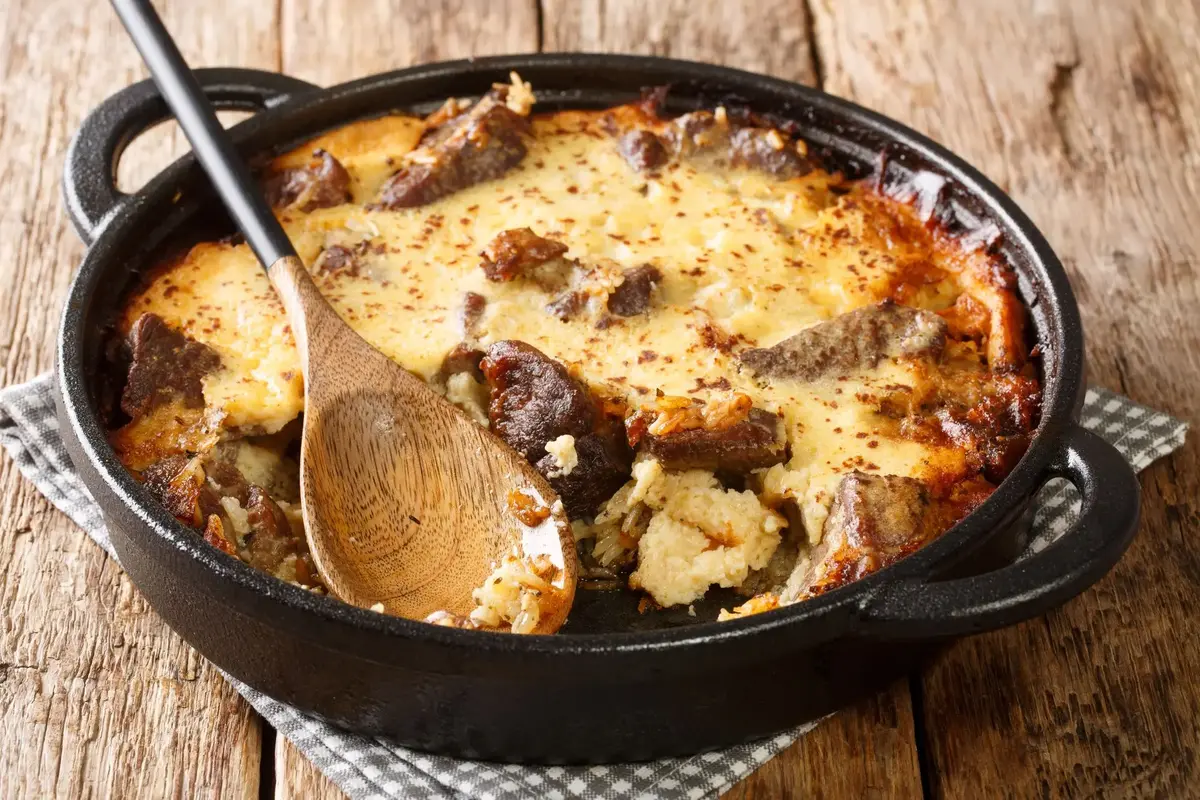
- Tavë kosi: the national dish — lamb (or chicken) baked in a clay pot under a yogurt-and-egg custard. Order it at Oda.
- Byrek: flaky phyllo pie with cheese, spinach, meat, or pumpkin. The 60-150 ALL corner-bakery version is usually better than the restaurant one; pair it with dhallë, the salted yogurt drink.
- Fërgesë: a skillet of peppers, tomatoes, and white cheese, sometimes with liver — a Tirana specialty, not found everywhere.
- Qofte: grilled minced-meat rissoles served with bread and yogurt. Order them at any zgara (grill) spot.
- Sufllaqe: the Albanian gyro — pita, meat, fries, garlic sauce, 250-400 ALL ($3-5). The best quick dinner in the city, and the spots stay open past 2 a.m.
- Raki: clear grape brandy at 40%+. You’ll be offered it as a welcome shot; the polite move is to accept at least one.
- Albanian macchiato: small espresso with foamed milk, 80-120 ALL at any neighborhood café.
Where locals actually eat
- Oda: the traditional room-style tavern near Pazari i Ri, famous for tavë kosi and fli. About $9-16 per person; better at lunch than dinner.
- Era: Blloku stalwart with Albanian-Mediterranean menus and a terrace worth arriving early for. Roughly $7-14 per person.
- Tek Zgara Tironës: the no-website, no-Instagram grill joint where working Tirana eats. Mixed grill platter and a shopska salad, $6-11 per person, cash only.
- Mullixhiu: Bledar Kola’s tasting-menu kitchen at the edge of Grand Park. Seven courses for about $35 per person. Book ahead.
- Salt: modern Mediterranean in Blloku with a strong seafood and cocktail program, around $21-37 per person.
- Artigiano: Italian-Albanian cooking with a wood-fired oven and homemade pasta, in Blloku and in a restored 1940s villa. About $12-21 per person.
- Kripë dhe Piper: the default answer for seafood in Tirana — grilled catch of the day, generous portions, $9-16 per person.
- Uka Farm: 20 minutes from the center toward the airport at Laknas — farm-to-table agriturismo from the Uka winemaking family. Around $35-60 for two, wine tasting extra.
- Komiteti Kafe-Muzeum: less about dinner, more about the raki sampling — 25+ varieties in a communist-era living-room setting behind the Pyramid.
Tipping is simple: round up or leave 5-10% at sit-down restaurants, and round to the nearest 100 ALL at cafés. Nobody expects 20%, and cash tips are preferred even when you pay the bill by card.
Money, taxis, and SIM cards — the stuff that trips people up
Cash still runs this city, though less than it used to. Carry Albanian lek in small denominations. Cards work at most mid-range and higher hotels, Blloku restaurants, supermarkets, and chain stores — and card acceptance is expanding fast under a phased national rule that now requires hotels and transport operators to take electronic payments, with all other businesses following. What hasn’t changed: cash is still king at Bunk’Art 1 and 2, House of Leaves, the Clock Tower, city buses, market stalls, byrek shops, and most small cafés. Roughly 70% of consumer transactions in Albania are still made in cash, per the Bank of Albania.
On the exchange rate: the US dollar buys roughly 80-82 lek. Watch out for older guides quoting 100-110 ALL to the dollar — those numbers are years out of date and will make everything look about 25% cheaper than it actually is.
Here’s the one that catches nearly every American traveler: there is no Uber and no Bolt in Albania. Neither company operates here, at the airport or anywhere else, so the app you’re used to will show no cars. Install a local one before you fly. Clust is the closest thing to Uber for foreign visitors — English interface, card payment, upfront fares, English-speaking drivers in tourist cities, and a designated pickup zone at TIA. Patoko typically runs 15-20% below street-taxi rates in Tirana. Vrapon has the widest geographic coverage if you’re continuing to Berat, Shkodra, or Gjirokastër. Speed Taxi is a traditional licensed fleet and a useful late-night backup. Hailed street taxis are often more expensive and may skip the meter — agree a price before you get in.
SIM cards are cheap and quick. There are two networks: Vodafone Albania (the stronger coverage, particularly in the mountains) and One Albania, which absorbed ALBtelecom. Tourist bundles run roughly 1,500-2,900 ALL ($18-36) for 15-100 GB over 15-21 days, set up at an airport kiosk after baggage claim or any downtown shop with your passport. Travel eSIMs from the usual providers are an easy alternative at $5-25 and activate the moment you land. One genuinely useful detail: an Albanian SIM works without roaming fees across Kosovo, North Macedonia, Montenegro, Serbia, and Bosnia under the Western Balkans roaming agreement — though not in the EU.
Pro Tip: Bring a stack of US dollars or euros as a backup. Exchange rates at downtown Tirana bureaux are often better than ATM withdrawals once you factor in foreign-transaction fees — and when an ATM offers to charge you in dollars, always decline and take the lek rate. Avoid street money changers; counterfeit notes do circulate.
Do Americans need a visa for Albania?
No. Under a bilateral agreement, US citizens can enter Albania visa-free and stay up to one year without a residence permit — the most generous allowance in Europe for US passport holders, and confirmed by the US Embassy in Tirana. You don’t apply in advance and there’s no visa on arrival. The passport officer stamps you in and you’re done. This causes real confusion because most of Europe runs on the 90-day Schengen rule; Albania isn’t in Schengen, has its own policy, and time spent here doesn’t count against your Schengen days.
What you actually need:
- A US passport valid for at least 3 months beyond your intended stay (6 months recommended)
- Proof of onward travel if asked (rare)
- Travel insurance is not legally required but strongly advised — and check that your policy names Albania, since some “worldwide” plans exclude it
Two practical warnings. First, border officers don’t always apply the one-year rule automatically; some default to a 90-day stamp. Glance at what you were given before you leave the hall, because Tirana airport now runs electronic gates that log entries and exits, and overstays carry fines of €100-500 plus a potential multi-year entry ban. Second, the year isn’t renewable by hopping across a border — once you’ve used it, you must spend 90 days outside Albania before starting a new visa-free period.
Flights to Tirana from the US route through Istanbul, Rome, Vienna, Munich, Frankfurt, Zurich, or London. There are no nonstop scheduled flights from US hubs to TIA — the only transatlantic nonstop is a seasonal Toronto service — so plan on one connection. JFK, EWR, or ORD to TIA via a European hub runs 11-14 hours total one-way, $550-900 round trip in shoulder season, with West Coast departures closer to 16-21 hours.
Tirana earns 2-3 days of your Balkan itinerary. Stay in Blloku or near Skanderbeg Square, prioritize Bunk’Art 1 and the Pyramid’s exterior climb, eat tavë kosi at Oda, drink raki at Komiteti, take the Rinas Express bus from the airport for $5, and install a local taxi app before you fly. Skip the Archaeological Museum, the Pyramid interior, and the two Blloku tourist-trap lounges.
The single most under-known fact: Americans can stay visa-free for a full year. The most over-quoted stale facts, in order: Bunk’Art tickets at 500 ALL and Dajti at €8 — both now roughly double those figures — the old 100-lek-to-the-dollar exchange rate, and the advice to “just use Bolt,” which won’t help you at all, because Bolt doesn’t operate anywhere in Albania. Budget and plan accordingly.
What’s the first thing you’d add to your Tirana list — a Bunk’Art visit, a Berat day trip, or an evening in Blloku? Drop it in the comments.