Albania hands US passport holders a rare deal in Europe: 365 days inside its borders, visa-free, with zero Schengen days burned. A Digital Nomad Albania setup gets you Blloku rent for the price of a Brooklyn parking spot, fiber that outruns most of Manhattan, and a Mediterranean coast the crowds haven’t wrecked yet. Here’s the honest US-first breakdown.
The short answer for US nomads
Albania lets US citizens stay one year visa-free under DCM 124/2022, sits outside Schengen, and offers a renewable Unique Permit (Lejë Unike) for remote workers who can show foreign income of roughly €450 per month. Expect $1,250–$1,900 monthly living costs in Tirana, median fixed internet around 93 Mbps down, mobile medians that run even faster, and a permit that clears in 30–60 days through the e-Albania portal.
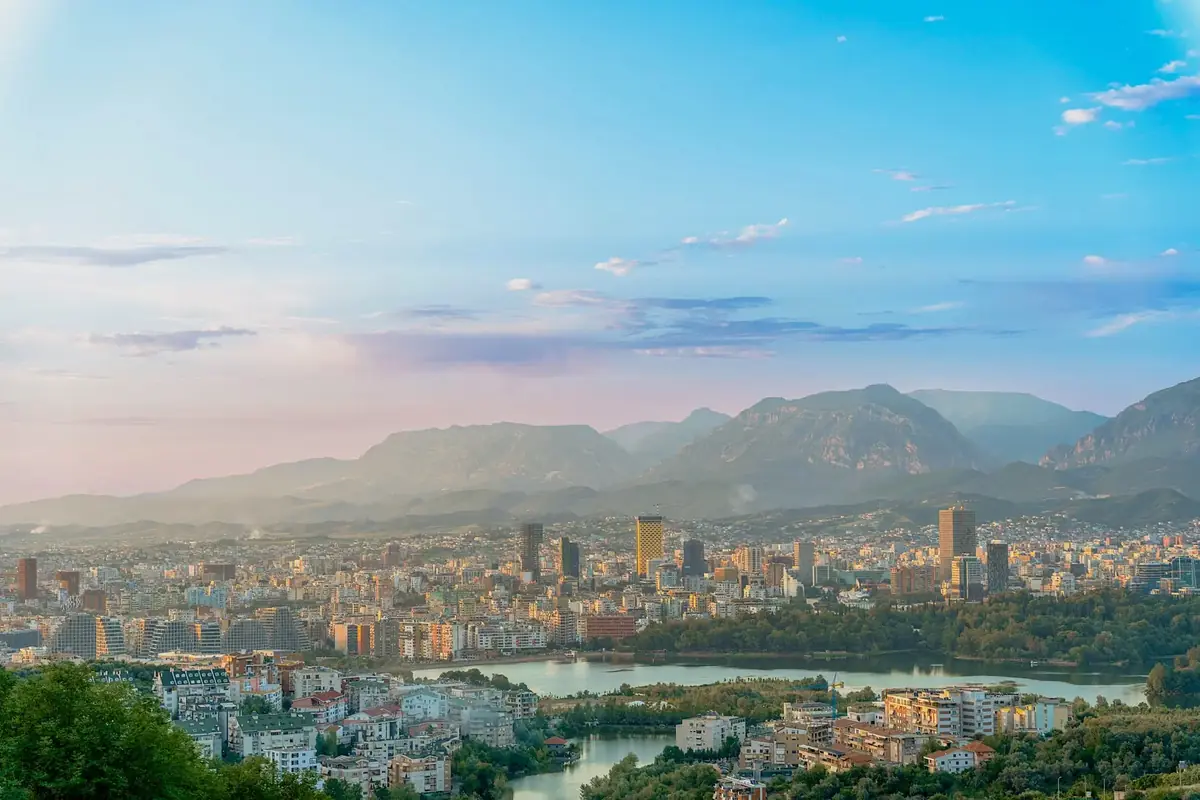
Why does Albania work so well for US remote workers?
For American nomads, Albania’s value is structural, not scenic. A one-year visa-free stamp, non-Schengen status that preserves your 90-in-180 quota elsewhere, sub-$2,000 monthly budgets in Tirana, and fiber that actually delivers solve the four problems Americans hit hardest in Europe: legality, cost, infrastructure, and flexibility.
The Schengen carve-out is the single most useful fact here, and it’s the one most guides bury. If you’ve already spent 60 Schengen days in Portugal or Spain, Albania is the pressure-release valve. Your clock doesn’t tick. You work, you plan your next move, and you don’t count days on a spreadsheet.
There’s a shelf life on that advantage, and nobody talks about it. Albania has opened all 33 EU accession chapters, cleared the interim rule-of-law benchmark on Chapters 23 and 24, and Tirana is targeting the close of negotiations within a couple of years and full membership around 2030. Analysts call 2030 ambitious but not impossible. Whenever accession lands, Schengen alignment follows, and the 365-day American carve-out becomes a 90-in-180 like everywhere else. If the non-Schengen loophole is why you’re coming, you’re on a clock measured in years, not decades.
The other pieces fit together cleanly. Tirana gets roughly 300 sunny days per year. English is widely spoken in the capital and on the coast among anyone under 40. Albania has the highest café-and-bar density per capita in Europe. And Tirana’s airport has gone from a regional afterthought to one of Europe’s fastest-growing, clearing 11.6 million passengers in a country of 2.4 million people, with flights to Istanbul, Rome, Munich, Vienna, London, and dozens of other hubs leaving several times a day.
Pro Tip: Book a one-way ticket into Tirana if you’re on day 85 of your Schengen allowance. The border officer processed my passport in under a minute and didn’t ask a single question about onward travel. Your US passport does the heavy lifting.
Which legal path actually fits most Americans?
Americans have three legal routes into Albania: the default 1-year visa-free stay under DCM 124/2022, the Type D long-stay visa (rarely needed), and the Unique Permit for Remote Workers, which runs on a 1+1+5 renewal structure. For most US nomads staying under a year, the default visa-free route beats the permit — no paperwork, no tax residency trigger, no €30,000 insurance requirement.
Here’s how the three paths compare:
- Path A — Visa-free (DCM 124/2022): 365 days from entry, no application, no cost. The US Embassy in Tirana confirms you generally don’t need to register with the border and migration authority for stays under a year. You must leave Albania for 90 consecutive days to reset the clock.
- Path B — Type D Long-Stay Visa: Rarely needed by Americans since the visa-free right covers a full year. Filed through e-visa.al, and mostly useful if you plan to work for an Albanian employer or need the permit route without the visa-free year.
- Path C — Unique Permit for Remote Workers (Lejë Unike): A combined residence-and-work card filed through e-Albania. Structure is 1+1+5 — one year, a one-year renewal, then eligibility for a five-year permit, which is a genuinely fast track to settled status. Processing typically runs 30–60 days against a 12-week legal maximum.
The contrarian take: most Americans overthink this. If you’re not committing to Albania past two years, Path A is almost always the correct answer. The Unique Permit makes you an Albanian tax resident if you cross 183 days — and while Albania’s tax regime is unusually kind to freelancers (more on that below), the visa-free route doesn’t force the question at all.
One quirk worth knowing: border officers don’t always apply the one-year rule automatically, and some default to a 90-day stamp out of habit. If you’re planning a long stay, politely reference the bilateral arrangement at entry.
Pro Tip: The upload systems on both e-Albania and e-visa.al silently reject any file larger than 5 MB and anything that isn’t PDF or JPG. Compress every bank statement and convert iPhone HEIC photos to JPG before you start the application. I lost two hours figuring that out.
Does Albania have a digital nomad visa?
Yes, functionally. Albania offers the Unique Permit for Remote Workers (Lejë Unike) under Law No. 79/2021, operational since 2022. It isn’t branded as a “digital nomad visa,” but the law explicitly covers what it calls digital mobile workers, and it functions identically. Applicants need a contract with a foreign employer or clients, remote income of at least €450 per month, €30,000 in health insurance coverage, a clean criminal record, and proof of accommodation.
The permit follows the 1+1+5 pattern: one year to start, a one-year renewal, and from the third year a five-year permit. After five continuous years you’re eligible for permanent residency — a clearer path than most comparable Balkan programs offer.
One constraint people miss: the remote-worker permit only authorizes work for clients and employers established outside Albania. Take on local Albanian clients and you’re in a different permit category with different rules.
- Core documents: passport, passport photo (47×36 mm — not 50×50), FBI background check, proof of remote employment or freelance contracts, 6 months of bank statements, health insurance certificate, and a signed Albanian rental contract
- Processing fee: 4,500 ALL (~$56)
- Biometrics: collected in person at the Regional Directorate of Border and Migration Police once you’re in the country
- Dependents: partners and children can be added, but each adds a proportional income requirement
Pro Tip: The passport-photo rules are stricter than they look. The photo shop on Rruga Myslym Shyri near Komiteti knows the exact spec the portal accepts — five minutes, 300 ALL (about $3.70). Don’t waste a submission on a US passport photo.
How much do you actually need to earn to qualify?
The published threshold for digital mobile workers is €450 per month (roughly 44,000 ALL, or about $525) in foreign-sourced income. Separately, a benchmark of roughly $9,800 per year — about $815 per month — circulates widely across immigration consultancies as the practical bar reviewers look for. Both numbers are lower than most Americans expect, and neither is the whole story.
The honest version: the reviewer is looking at patterns, not a magic number. Consistent monthly deposits from a clear employer or freelance pipeline matter more than a headline figure. Strong applications show steady USD or EUR transfers landing every month — not crypto, not cash deposits, not a single lump sum three weeks before you file.
- Published floor: €450/month (~$525) in documented foreign remote income
- Widely cited practical benchmark: roughly $9,800/year (~$815/month)
- Strong application: $13,000–$20,000/year arriving as regular, traceable monthly transfers
- Dependents add-on: expect a proportional uplift per adult and per child
- What gets challenged: gaps in the deposit history, income routed through platform wallets, and contracts that don’t name you personally
Pro Tip: Twelve months of Wise USD-to-ALL deposits averaging around $2,100 sailed through on my application. The reviewer never questioned the source, but a two-month PayPal gap got flagged and cost me another three weeks. Stick with Wise, Revolut, or direct bank transfers, and don’t let a month go blank.
How long can Americans actually stay in Albania visa-free?
US passport holders can enter Albania visa-free and stay up to 365 days under DCM 124/2022 — one of the most generous policies in Europe, matched only by Georgia. Albanian law requires your passport to remain valid for at least three months beyond your intended departure, though most US airlines enforce the global six-month rule. To reset the clock, you have to leave Albania for ninety consecutive days.
That 90-day exit requirement is the part most guides skip. You can’t just do a border run to Montenegro for a weekend and come back. The clock only resets if you’re out of the country for a full 90 days.
- Entry: Visa-free on arrival with a US passport, no advance registration or e-visa
- Max stay: 365 days per entry
- Passport validity rule: at least 3 months beyond planned departure (Albanian law); most US airlines enforce the global 6-month rule
- Reset rule: 90 consecutive days out of Albania required before re-entering visa-free
- Police registration: not required for stays under one year, per the US Embassy in Tirana
- Proof of entry: increasingly electronic — save your boarding pass
Pro Tip: My arrival was recorded entirely electronically. The border officer never touched ink, and the US Embassy now warns Americans that passports often aren’t stamped at all. Save the boarding pass from your flight into Tirana as backup proof of your entry date — immigration can look it up in their system, but you want your own paper trail if you ever have to defend your timeline.
How much does Digital Nomad Albania really cost? (Real USD numbers)
A solo US nomad needs roughly $1,250–$1,900 per month for a comfortable Tirana lifestyle — rent, food, coworking, and socializing included. Tirana has gotten meaningfully more expensive: a one-bedroom in the centre now runs about $690–$990, and Numbeo puts a single person’s non-rent costs near $765 a month. Sarandë runs cheaper off-season and far higher in July. Berat and Shkodër still undercut Tirana by 30–40 percent. The Lek trades in the low 80s to the dollar.
Here’s the city-by-city USD breakdown, using current Tirana crowd-sourced pricing and long-let market rates elsewhere — if you’re budgeting a shorter trip rather than a month on the ground, the daily cost of travel in Albania works out differently:
| Item (USD, monthly unless noted) | Tirana | Sarandë | Berat | Shkodër |
|---|---|---|---|---|
| 1BR city centre | $690–$990 | $250–$500 (off-peak) | $230–$360 | $230–$400 |
| 1BR outside centre | $430–$740 | $220–$400 | $180–$280 | $180–$300 |
| Groceries (1 person) | $250–$340 | $230–$310 | $200–$270 | $200–$270 |
| Inexpensive meal out | $6–$12 | $7–$14 | $5–$9 | $5–$9 |
| Cappuccino | $1.70–$3.30 | $1.80–$3.50 | $1.20–$2.20 | $1.20–$2.20 |
| Local draft beer at a bar | $2.50–$5 | $2.80–$5.50 | $2–$3.50 | $2–$3.50 |
| Utilities (1BR) | $70–$160 | $60–$140 | $60–$130 | $60–$140 |
| Home fiber (60 Mbps+) | $17–$27 | $17–$27 | $15–$25 | $15–$25 |
| Comfortable monthly total | $1,250–$1,900 | $1,050–$2,000 | $850–$1,300 | $850–$1,350 |
A few things the numbers don’t capture:
- Short-term Airbnb rent runs 30–60% higher than a long-let signed in person. Local Facebook groups such as “Qira apartamente Tiranë” are where the real deals live, and it’s worth weighing up where to stay in Tirana before you commit to a neighborhood
- Summer rent on the Riviera spikes hard — a Sarandë studio that goes for $300 in October can hit $1,800 in August, and genuine long-lets are nearly impossible to find in peak season
- Winter utilities climb toward the top of the range in older Blloku flats because most buildings use pure electric heating and have no gas
- Older Soviet-era buildings rent 40–100% below new-build stock, but expect heating and sound-insulation problems
- A monthly Tirana transit pass costs about $20, and a single ride is under 50 cents — most nomads still walk everywhere
Pro Tip: My November electricity bill in a 485-square-foot (45 m²) Blloku flat came to 14,200 ALL (~$175) — almost triple the July bill — because the building has no gas and every radiator is electric. Every American I know underestimates winter utilities by at least 30 percent.
Where’s the fastest Wi-Fi — and where should you actually work?
Albania’s median fixed broadband now sits near 93 Mbps down and 46 Mbps up on Ookla’s Speedtest Global Index, ranking around 77th worldwide. Here’s the twist most guides miss: Albanian mobile is faster than Albanian fiber. Median mobile download speeds run past 110 Mbps and place the country around 37th globally — meaning your phone hotspot is a legitimate primary connection, not just a backup.
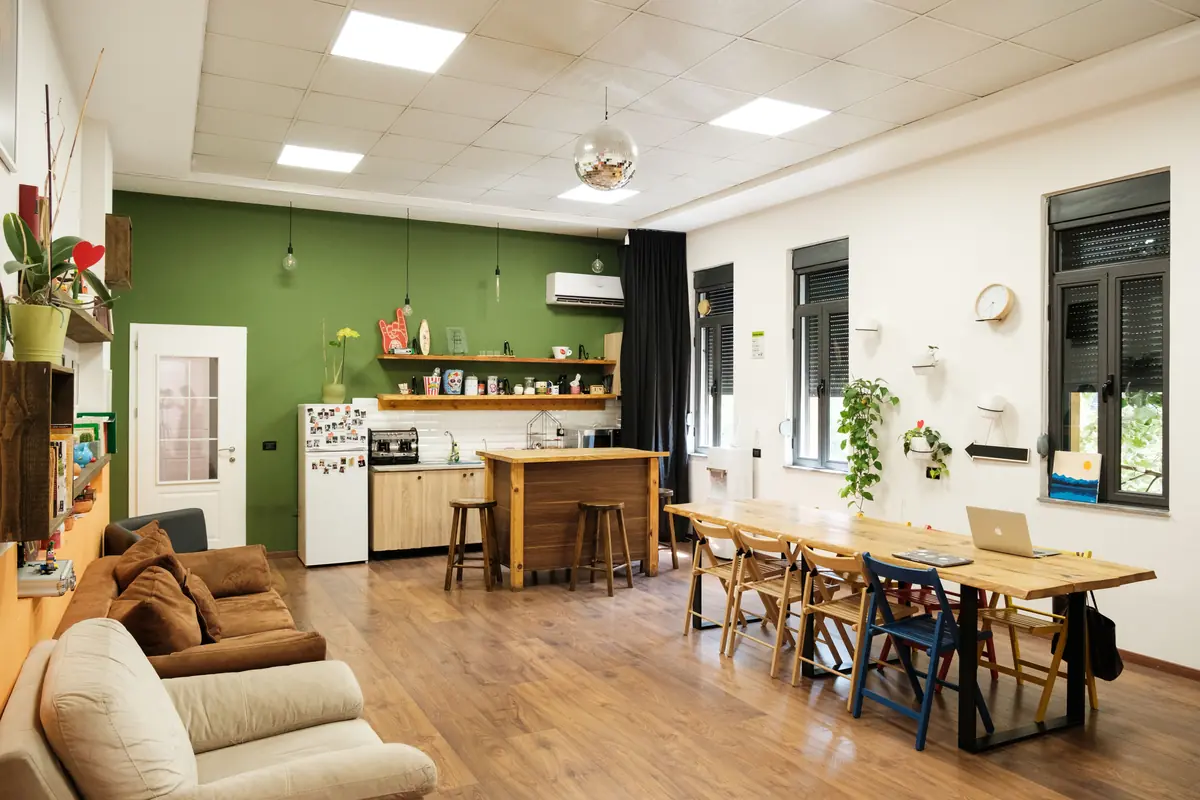
Tirana anchors the coworking scene, but the coast is no longer a dead zone. Sarandë and Vlora both have dedicated spaces now, which corrects the received wisdom that you have to base in the capital to get a desk.
| Coworking | Day pass | Monthly | Notes |
|---|---|---|---|
| Coolab (Tirana, Blloku-adjacent) | ~$12 | ~$175–$210 | Quietest of the Tirana spaces, phone booths, height-adjustable desks |
| Dutch Hub (Tirana) | from ~$7 | from ~$175 | Cheapest day rate in the city; meeting rooms up to 25 people |
| Innospace (Tirana, Blloku) | ~$18 | ~$175 | 24/7 access, private offices available |
| Destil Creative Hub (Tirana) | ~$2.40/hr, ~$11 daily cap | from ~$175 | Café-coworking hybrid in a 1938 villa; book the day rate in advance or you’ll be billed hourly |
| Saranda Coworking | Day, week and month tiers | On request | 24/7 keycode access, sea view, advertised at up to 480 Mbps down |
| Coworking Vlora | from ~$12 | On request | 1 Gbps fiber, printing and lockers included, open seven days |
For café work in Tirana, five spots consistently deliver on both speed and atmosphere:
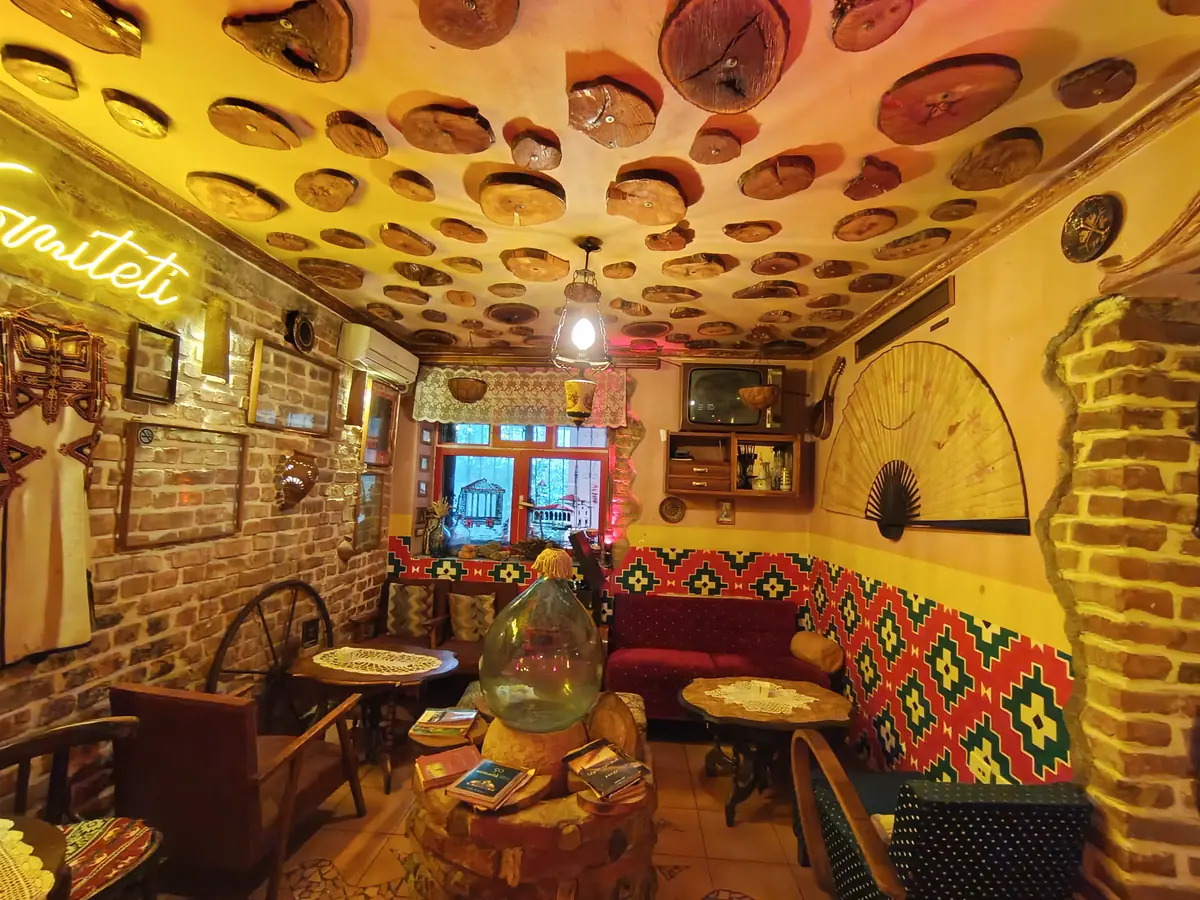
- Komiteti Café & Museum — quiet back room after 2 PM, ~90 Mbps, best raki menu in the country
- Mulliri Vjetër (Sami Frashëri side) — pulled 137 Mbps on a weekday afternoon, but too loud for calls after 11 AM
- Sophie Caffe (Rruga Ismail Qemali) — calmest of the Blloku cafés, ~85 Mbps, fewer nomads competing for outlets
- Mon Cheri (multiple Tirana locations) — consistent Wi-Fi, calls workable in the back
- Nouvelle Vague — French-style, standing tables, decent mornings for focused work
Mobile connectivity is where Albania quietly overdelivers. There are only two networks — Vodafone Albania and One Albania — and both sell the same tourist SIM and eSIM packs: 40 GB with 1,000 minutes for 15 days at 2,300 ALL (about $28), or 100 GB with unlimited minutes for 21 days at 2,900 ALL (about $36). Vodafone has the edge in the mountains; One is competitive in Tirana. Neither includes EU roaming, but the data works across Serbia, Bosnia, Montenegro, Kosovo, and North Macedonia, which makes a Balkan loop painless. For home fiber, Digicom, Abissnet, and ALBtelecom compete hard in Tirana, with Digicom averaging the fastest broadband speeds in the country.
Pro Tip: The One Albania shop inside Tirana airport arrivals had no queue at 6 AM. The Vodafone counter had fifteen people ahead of me at midnight. If you land late, grab One Albania and switch later if coverage disappoints. Both now sell eSIMs at the airport counters, which skips the physical swap entirely.
Which Albanian cities work best for digital nomads?
Tirana is the year-round base, Sarandë is the seasonal beach option with a real coworking space now, Berat is the cheap UNESCO hideaway, and Shkodër opens the Albanian Alps. Himarë quietly beats Ksamil for anyone who values signal over spectacle. Vlorë has become the genuinely underrated middle ground. Theth and Valbona are hiking escapes, not workable remote bases — save those for a two-week Albania road trip between contracts.
Tirana — the unavoidable default
Start in Blloku for the social nomad scene, Pazari i Ri for foodies who want to walk to morning market, or Komuna e Parisit for a quieter setup near Grand Park with families and joggers at the entry gates by 7 AM. Rruga Myslym Shyri splits the difference on price and noise.
- Location focus: Blloku, Pazari i Ri, Komuna e Parisit, Rruga Myslym Shyri, 21 Dhjetori
- Cost: $1,250–$1,900/month comfortable
- Best for: Year-round base, social nomads, the only real coworking density in the country
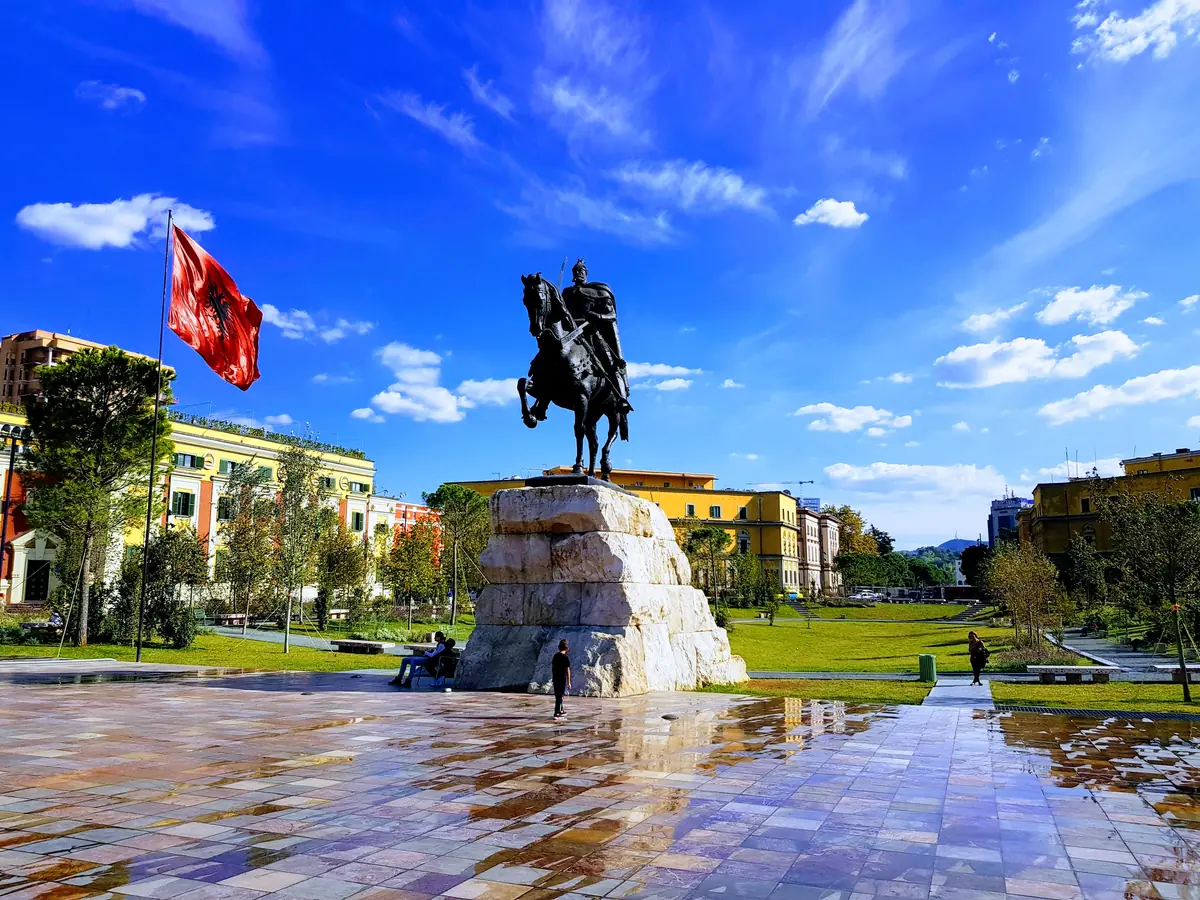
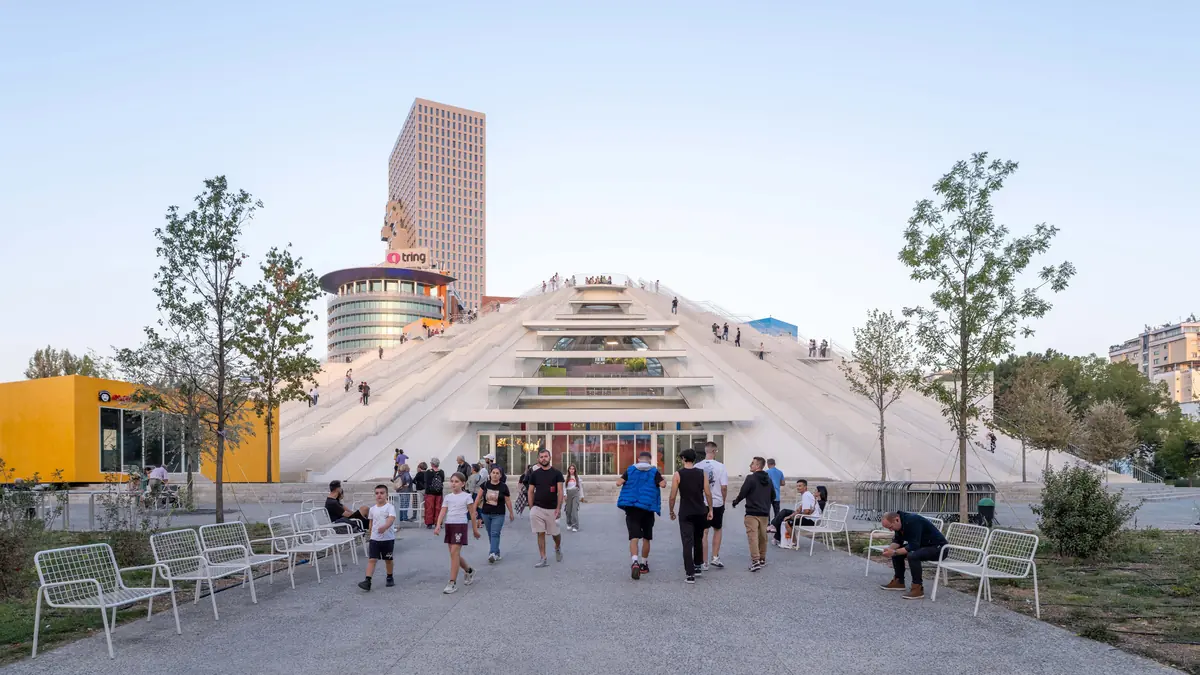
- Landmarks worth your time: Skanderbeg Square, the Bunk’Art bunker museums, Pyramid of Tirana, Grand Park — and plenty more things to do in Tirana on your days off
The friction: construction noise is constant, August heat pushes past 90°F (32°C) with patchy AC in older buildings, stray dogs are a fact of life, and traffic borders on theatrical. There is still no Starbucks anywhere in the country. Local chains like Mulliri i Vjetër and Mon Cheri have held the line entirely.
Sarandë and the Ksamil trap
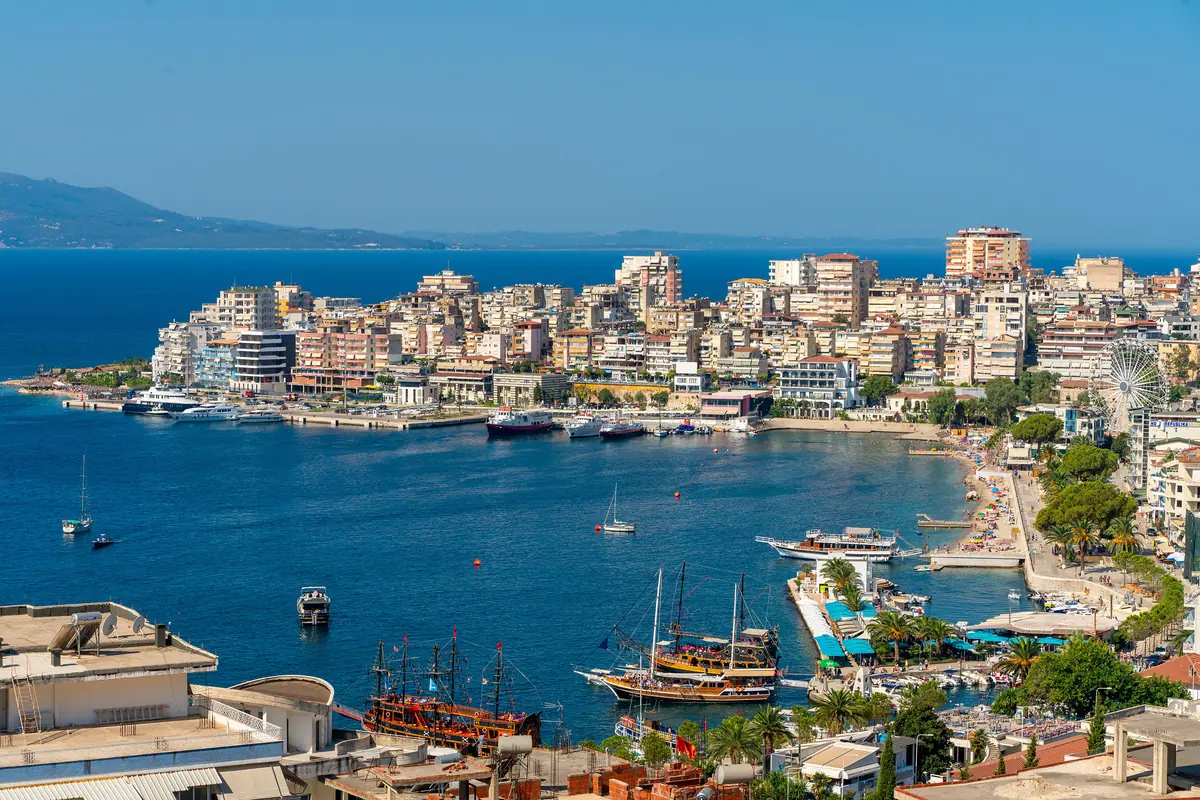
Sarandë rent runs $250–$500 off-peak and multiplies in July. The Corfu–Sarandë ferry is the best-kept logistics secret on this coast: high-speed hydrofoils cross in about 30 minutes, tickets run roughly €15–€36 ($18–$42), and in peak season the two operators between them run up to 22 sailings a day. It’s the easiest Schengen hop in the country, and the town now has a dedicated 24/7 coworking space with sea views.
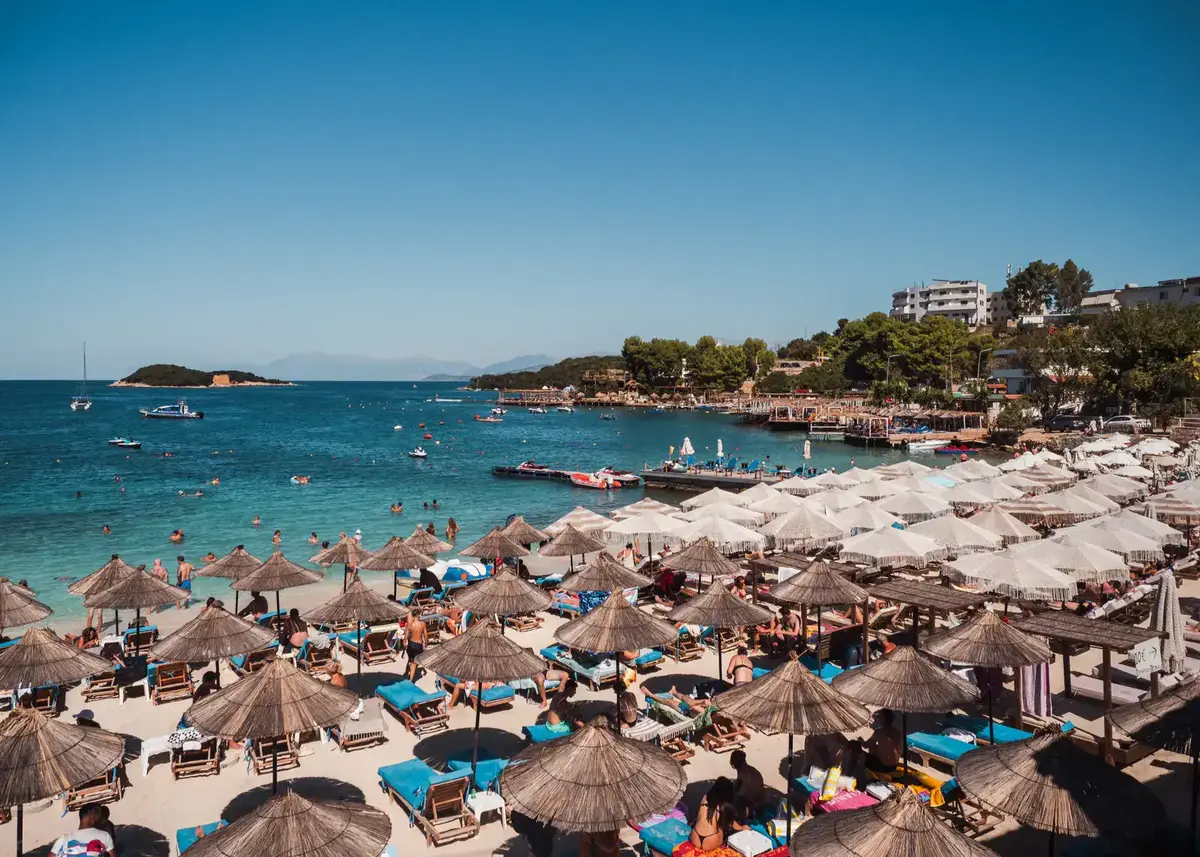
Contrarian take: Ksamil is overrated. Marketed as “the Maldives of Europe,” it was actually built in the 1960s with zero heritage architecture. Two sunbeds and an umbrella run 1,000–2,000 ALL ($12–$25) off the main strip and 2,000–4,000 ALL ($25–$50) in the centre, with premium cabanas reaching 7,000 ALL ($86). Menu prices climb the moment they hear English. What almost nobody tells visitors: Albanian law keeps every beach publicly accessible, so the sand past the last row of umbrellas is free — walk five minutes or arrive before 10 AM and you don’t pay anything. Better still, go in May, September, or early October, or skip Ksamil entirely for Himarë.
- Location: Kodra, Qendër, Rruga Butrinti
- Cost: $1,050–$2,000/month (wide swing based on season)
- Best for: 3–8 week coastal stays in shoulder season
- Time sink: Butrint National Park, the Blue Eye (Syri i Kaltër) spring
Pro Tip: Corfu runs an hour ahead of Albania and every ferry timetable is printed in local time. I watched two Americans miss the last boat back because they read the Corfu departure board on Albanian time. Book an afternoon crossing, not the last one, and set your phone to the destination clock.
Berat — UNESCO on a budget
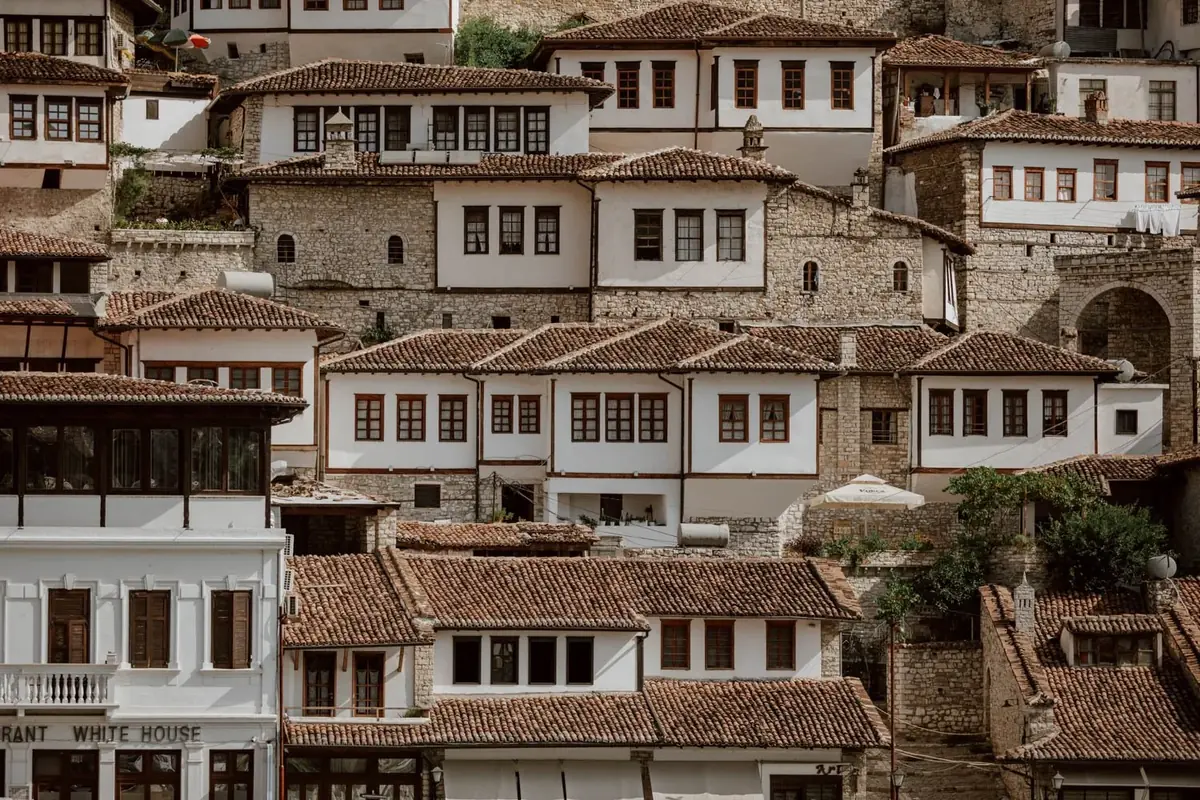
Rent runs 30–40 percent below Tirana, and the bus from the capital covers 75 miles (120 km) in 2h15m–2h45m for 400–500 ALL (about $5–$6). Berat splits into the Mangalem and Gorica quarters on either side of the Osumi river, connected by a 780-foot (237 m) Ottoman bridge.
- Location: Mangalem (white-walled houses climbing the hill), Gorica (quieter, lower rents)
- Cost: $850–$1,300/month
- Best for: 1–3 week stays, writers, anyone wanting cheap and beautiful
- No coworking — café-and-apartment setup only
The Onufri Icon Museum inside Berat Castle justifies a day. The castle itself is still a living neighborhood with families in homes inside the walls, which you won’t find at UNESCO sites elsewhere in the Balkans.
Pro Tip: Homemade Food Lili is a family dining room behind a plain door on the castle road. Book 24 hours ahead by phone or you’re eating at a tourist taverna instead. Lili’s grandmother still runs the kitchen.
Shkodër — gateway to the Alps
The 2-hour bus from Tirana covers 60 miles (96 km) for around 300 ALL (~$3.70). Shkodër is the launch point for the Komani Lake ferry to Valbona and the Theth–Valbona mountain pass hike that draws serious trekkers from May through October.
- Location: city centre, lake-adjacent neighborhoods
- Cost: $850–$1,350/month
- Best for: Hikers, cyclists, anyone basing themselves to tackle the Albanian Alps
- Key landmarks: Rozafa Castle, Lake Shkodër (the largest in the Balkans), the Marubi photo archive
The contrarian caveat: winter air pollution is a real issue. Local environmental monitoring has found roughly half of Shkodër’s measurement points exceeding EU PM10 standards in winter months, driven by wood-burning household heating. If you have asthma or young kids, skip December through February.
The Riviera beyond the hype
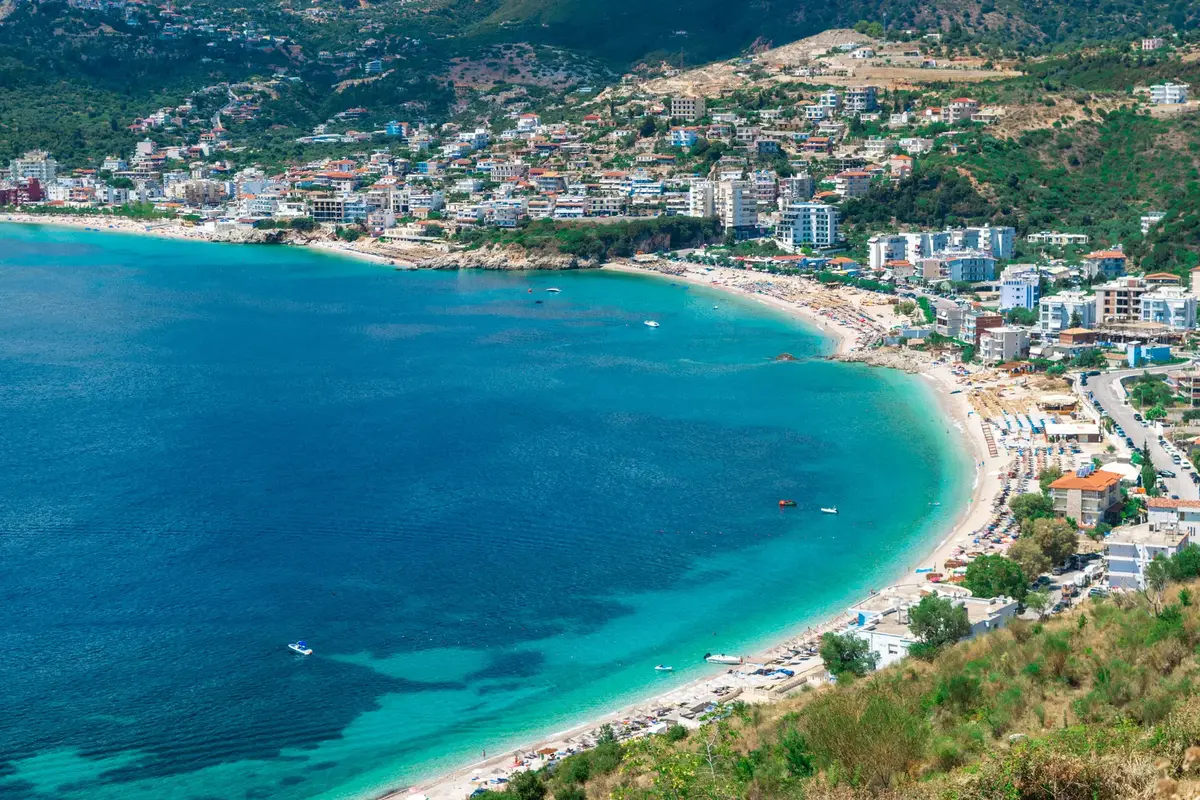
On the Albanian Riviera, Himarë beats Ksamil on almost every metric an actual nomad cares about — authenticity, rent, beach access, local scene — and sunbeds on its town beach run about half Ksamil’s centre pricing. Vlorë has quietly become the smartest coastal base: it’s a real year-round city with a Lungomare promenade, an economy that doesn’t shut down in October, and the coast’s best-equipped coworking space. Dhërmi hosts Kala Festival in the first full week of June, which turns a sleepy fishing village into one of Europe’s most-loved boutique dance events for seven days — it sells out months ahead, and the only legitimate late entry is the official fan-to-fan resale waitlist. Theth and Valbona have essentially no connectivity — treat those weeks as disconnect time, not work time.
Is Albania safe — or is the Taken stereotype real?
Albania ranks 36th on the Global Peace Index, up seven places in the latest edition — safer than Italy, the UK, and Sweden, and far safer than the United States at 134th. Violent crime against tourists is statistically rare. The Taken movie stereotype is a cultural artifact, not a threat profile. The real danger is on the roads.
The Institute for Economics & Peace’s index measures societal safety, political stability, and conflict exposure across 163 countries. Albania’s score of 1.725 puts it ahead of most of southern Europe. The US State Department rates Albania Level 2, “exercise increased caution” — the same tier as France, Germany, Italy, and Spain — with the country summary citing organized crime rather than any threat aimed at visitors.
- Violent crime against tourists: rare, statistically far below US rates
- Petty theft: occasional in Tirana’s tourist-dense blocks (Skanderbeg, Blloku)
- Scams: taxi overcharging at the airport (use Speed Taxi, VrapOn, or Patoko apps) and beach-club price improvisation in Ksamil
- Real threat: Albanian drivers. The country logs roughly 190 road deaths a year in a population of 2.4 million — about 80 per million inhabitants, nearly double the EU average of 46 — and INSTAT attributes 86–94% of accidents to driver behavior
- Worth doing: enroll in the State Department’s STEP program before you fly, so the Tirana embassy can reach you if a security alert goes out
Arben Bajraktaraj, the Albanian actor who played one of the villains in the original Taken film, later fronted a self-aware “Taken by Albania” tourism campaign. The country’s sense of humor about the stereotype is part of the charm — and with well over 12 million annual visitors now arriving in a country of 2.4 million, the stereotype is losing badly.
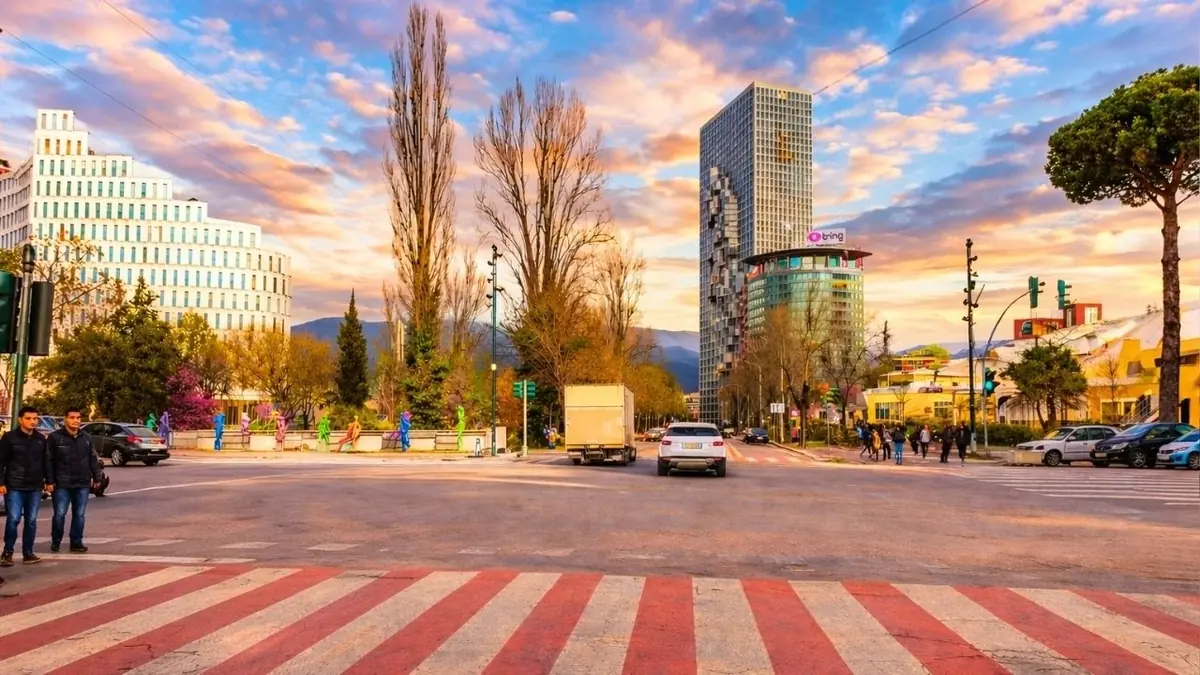
Pro Tip: A shopkeeper in Berat chased me half a block to return the 500 ALL note I’d dropped. That’s a representative story, not an outlier. The real risk is the guy in a Benz who won’t stop for the zebra crossing outside the Pyramid of Tirana — cross assertively or wait for a local to go first.
What’s the US tax trap nobody warns you about?
The US and Albania have no tax treaty and no Social Security totalization agreement. If you stay under 183 days and keep your “center of vital interests” outside Albania, you avoid Albanian tax residency. Cross that line and Albania can tax your worldwide income. Americans can still use the Foreign Earned Income Exclusion and the Foreign Tax Credit, but self-employment tax double-exposure is real.
Here’s the part almost every guide gets wrong, and it flips the calculus: Albania’s income tax is not a flat 15–23%. Employment income is taxed at 13% up to about 2,040,000 ALL and 23% above that. But registered self-employed individuals and small businesses with annual gross income under 14 million ALL (roughly €120,000) pay a 0% income tax rate, legislated to run through 31 December 2029. For a freelancer or consultant billing foreign clients, Albania is one of the most tax-friendly places in Europe — not one of the more expensive ones.
That doesn’t make it free. The 0% rate applies to Albanian income tax only. Your US obligations don’t move, and the missing totalization agreement is where Americans get hit.
- No treaty: the US and Albania have never signed one, so there’s no treaty relief to fall back on
- 183-day rule: the simplest test for Albanian tax residency
- Albanian income tax: 13%/23% on employment income; 0% on registered self-employment and small-business income under 14 million ALL through end-2029
- Social contributions still apply to registered self-employed people even at the 0% income tax rate — budget roughly 180,000 ALL (~$2,200) a year
- US self-employment tax: 15.3%, and Americans pay it with no totalization relief
- FEIE: currently around $132,900 per qualifying person, indexed annually — claimed on Form 2555, and it does not reduce self-employment tax
- FBAR: required annually if your foreign accounts total more than $10,000 combined at any point (FinCEN Form 114)
- Forms to know: Form 2555 for the FEIE, Form 1116 for the Foreign Tax Credit
The practical split: nomads on Path A who stay under 183 days per calendar year bounce to a second base (Greece, Italy, Montenegro) for the difference and never trigger the residency question. Anyone planning to settle should look hard at registering locally — the 0% window through 2029 is generous enough that the paperwork often pays for itself, provided a cross-border accountant confirms it works with your US filing position.
Pro Tip: My US CPA charges $150 extra every April because of the Albanian filings. Hire someone who has actually filed for a US nomad in a non-treaty country — generalists miss the self-employment tax trap, and they’ll also miss that the Albanian 0% rate doesn’t generate a foreign tax credit, because there’s no foreign tax paid to credit.
Albania vs. Portugal, Georgia, Montenegro, and Bulgaria — which wins?
Albania wins on cost, length of visa-free stay, non-Schengen flexibility, and — surprisingly — freelance tax treatment. Portugal wins on community and direct US flights. Georgia ties Albania on the 1-year visa-free rule but lacks the Mediterranean. Montenegro wins on scenery; Bulgaria wins on EU infrastructure. For a first international stint as an American, Albania’s risk/reward ratio beats the rest of this group. Tirana figures below are current market rates; the other capitals are indicative city-centre ranges.
| Factor | Albania | Portugal | Georgia | Montenegro | Bulgaria |
|---|---|---|---|---|---|
| US visa-free stay | 365 days | 90/180 (Schengen) | 365 days | 90 days | 90/180 (Schengen) |
| Schengen-free? | Yes | No | Yes | Yes | No |
| How long that lasts | EU candidate, all chapters open, membership targeted around 2030 | Already in | Candidate, progress stalled | Accession front-runner | Already in |
| 1BR capital city (USD) | $690–$990 | $1,400–$1,900 | $500–$900 | $600–$1,000 | $600–$900 |
| Internet for remote work | Solid (~93 Mbps median fixed; mobile faster still) | Excellent, dense fiber | Weakest of the group | Adequate, patchy on the coast in summer | Excellent, Europe-leading mobile |
| US tax treaty | No | Yes | No | No | Yes |
| Nonstop from North America | Toronto only, weekly, summer season | Yes, multiple US cities | No | No | No |
| English prevalence (capital) | High | Very high | Medium | High | Medium |
The honest breakdown by situation:
- If you’ve never lived abroad and want infrastructure polish plus community: Portugal
- If you’ve already burned your Schengen days and need a legal base: Albania or Georgia
- If you want the cheapest option with real scenery: Albania (Berat or Shkodër)
- If you’re a registered freelancer optimizing for tax: Albania, while the 0% small-business window lasts
- If you want EU banking and healthcare: Bulgaria
- If you want a short luxury-adjacent coastal stay: Montenegro
Pro Tip: I spent six months in Tbilisi before moving to Tirana. Georgia’s wine wins and the food gap is real, but the 8-hour timezone gap from US clients broke my sleep in a way Albania’s 6-hour gap doesn’t. If you work US hours, Albania is objectively the better desk.
How do you actually get to Albania from the US?
There is still no nonstop flight to Albania from the US. Air Transat now flies Toronto–Tirana weekly on an A330 through the summer season — the first and only nonstop between North America and Albania — but from a US city you’ll connect via Istanbul (Turkish Airlines), Rome, Frankfurt, Munich, Vienna, Zurich, or London. Total travel time from JFK is 11–14 hours door to door. From LAX, 18–22 hours. Round-trip tickets run $375–$700 in shoulder season and $800–$1,200 in summer peak.
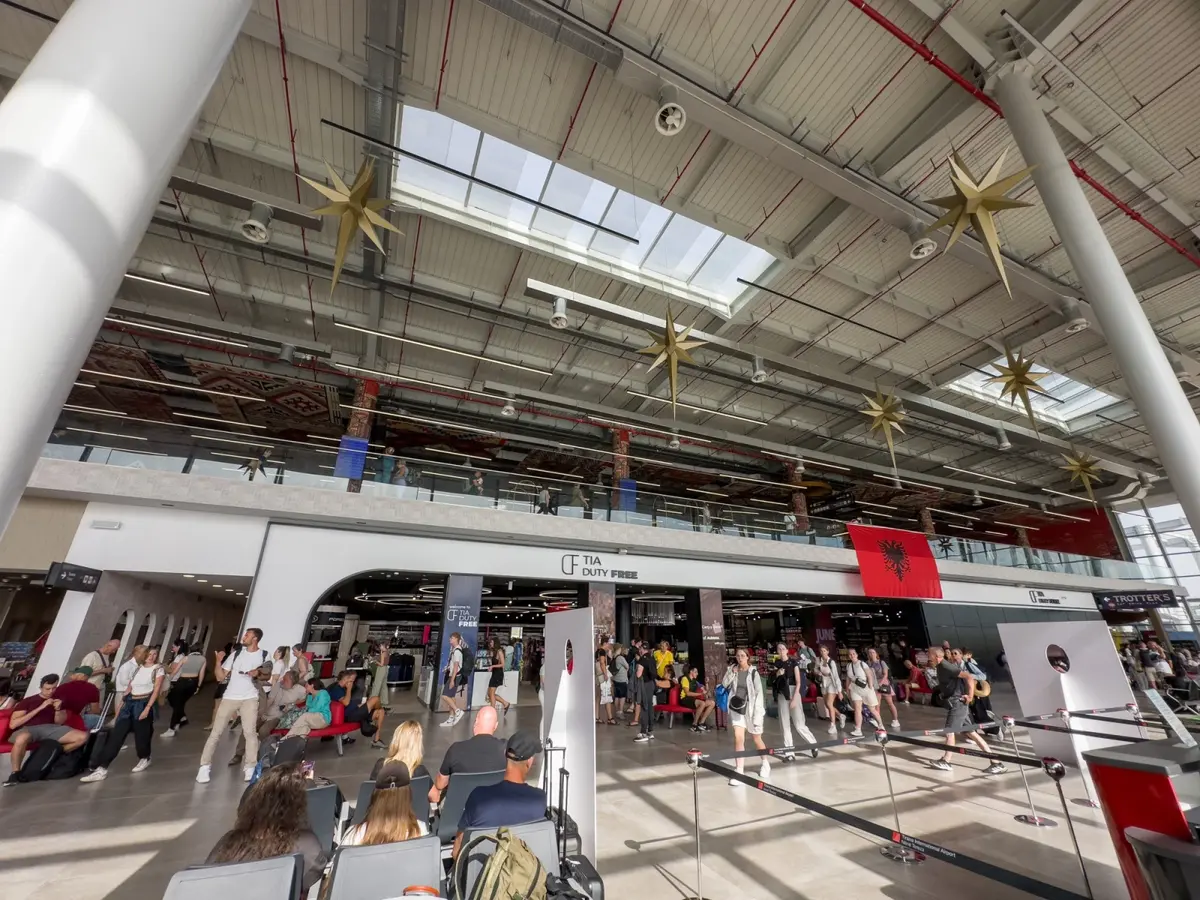
Tirana International Airport Nënë Tereza (IATA code: TIA) sits 10.5 miles (17 km) northwest of the city and handles essentially all of Albania’s international traffic — more than 11.6 million passengers a year and climbing, which makes it one of Europe’s fastest-growing airports. Getting into the city from the airport is straightforward:
- Luna airport shuttle: 400 ALL (~$5), runs 24/7, drops at Skanderbeg Square
- Speed Taxi or VrapOn from the airport: 2,500–3,000 ALL ($31–$37) to Blloku
- Rental cars: renting a car at TIA is easy, but plan for Albanian driving first (read the safety section)
Airline notes for US travelers:
- Turkish Airlines runs daily from JFK, IAD, EWR, ORD, LAX, and SFO via Istanbul — usually the fastest connection
- Lufthansa routes via Frankfurt or Munich — reliable, but the Frankfurt connection eats 3+ hours
- Ryanair now bases four aircraft at Tirana and flies 43 routes across Europe — the cheapest way to move once you’re on the continent
- Wizz Air runs its base at Tirana with a broad European network and has carried 25 million passengers in Albania
- Air Transat’s seasonal Toronto nonstop is the only one-stop-from-anywhere option worth routing through if you’re near the northern border
One planning trap: don’t build a trip around Vlora International Airport. The runway and terminal are effectively finished and it has an IATA code (VLO), but certification has not come through, charter contracts have been cancelled two seasons running, and the government has reportedly moved to terminate the concession over a shareholder dispute. Until flights are actually bookable and confirmed, Tirana is your only realistic gateway, and the Riviera is a 3–5 hour drive south.
Pro Tip: JFK–IST–TIA on Turkish routinely beats the Lufthansa Frankfurt routing by two hours because the Istanbul connection runs tight and Frankfurt almost never does. If you have a three-hour Istanbul layover, the IST lounge day pass is the cheapest upgrade you’ll make all year.
What about healthcare, banking, and the stuff that trips up foreigners?
American Hospital Tirana is the default for serious care. Private health insurance runs €30–€150 ($35–$175) per month depending on coverage. Opening a local bank account without a residence permit is hard — most nomads use Wise or Revolut and accept €5–€6 ATM fees per withdrawal. Tirana is card-friendly; the rest of Albania runs on cash. Keep small Lek bills.
Healthcare breakdown:
- American Hospital Tirana: internationally accredited, English-speaking, the default for anything serious
- Hygeia Hospital Tirana: Greek chain, solid reputation for maternity and cardiology
- German Hospital Tirana: private, English- and German-speaking, good for complex cases
- SafetyWing, Genki, Cigna Global: the three most common travel insurance picks for Albania among nomads here — and note the Unique Permit requires €30,000 in coverage, so check your policy states that limit explicitly
- Public system: free or near-free for residents, thin quality outside Tirana — most serious cases get referred to Bari or Athens
Banking reality:
- Wise and Revolut cover most of what a US nomad needs
- ATM fees in Albania run €5–€6 per foreign-card withdrawal — BKT and Raiffeisen machines tend to have the lowest
- Local accounts: BKT (Banka Kombëtare Tregtare) and Raiffeisen Bank Albania are the most foreigner-friendly, but you’ll need either a Unique Permit in hand or a long-term rental contract plus employer letter
- Cash culture: outside Tirana and the major coastal towns, expect to pay cash — keep 200 and 500 ALL notes on you
NIPT and the self-employment registry: you only need a NIPT (the Albanian tax identification number) if you’re registering as self-employed locally, opening a company, or hiring. Working remotely for foreign clients on the visa-free year doesn’t require it. Registering does unlock the 0% small-business rate, which is why the calculation has shifted for anyone staying long term — but it also brings filing obligations, mandatory social contributions, and an annual return due by 31 March, so don’t register casually.
Pro Tip: BKT on Bulevardi Dëshmorët e Kombit opened my account in 90 minutes with my passport and a signed Blloku rental contract — but only because I had the Unique Permit in hand. Without the permit, budget two weeks of bouncing between branches and expect at least one rejection.
When should you go — and when should you absolutely skip?
May, June, September, and early October are the nomad sweet spots and, not coincidentally, the best time to visit Albania generally: warm, swimmable sea, reasonable prices, half the crowds. August is the worst month — Tirana hits 90°F (32°C), Ksamil gets mobbed, and many Tirana cafés close for two weeks mid-month because owners take family vacations. Winter is cheap but coastal towns essentially shut down.
Month by month, with honesty:
- January–February: Cheapest stretch in Tirana. Coast is closed. Ski season runs in Dibër and Valbona if that’s your thing
- March–April: Tirana wakes up, Riviera still quiet, shoulder prices, occasional rain
- May: My favorite month. Tirana Jazz Festival hits late in the month, sea is swimmable by week three, rents haven’t spiked
- June: Peak sweet spot. Dhërmi’s Kala Festival in the first full week is the best boutique event in Albania — tickets go months in advance. Book Riviera rentals two months out
- July: Riviera gets expensive and crowded, and coastal towns can hit water and power cuts. Tirana is tolerable but hot
- August: Avoid unless you’re beach-only. Ksamil is theatrical chaos, Tirana cafés close, heat tops 90°F with weak AC in most older buildings
- September–early October: The second sweet spot. Fewer crowds, swimmable sea through mid-October, shoulder prices return, Corfu ferries still run all day
- November–December: Cheap, rainy, coastal towns empty, Tirana’s café culture hits its best stride because locals return
Temperature reality in Tirana:
- January avg high/low: 47°F / 35°F (8°C / 2°C)
- April avg high: 66°F (19°C)
- July avg high: 89°F (32°C)
- August avg high: 87–90°F (31–32°C); heatwaves have pushed temperatures past 99°F (37°C)
- October avg high: 69°F (21°C)
Pro Tip: I made the mistake of August in Ksamil once. €15 sunbeds, €10 club sandwiches, and the bathroom queue at one beach bar ran 40 deep. Go the first week of September instead — same water temperature, most of the crowds gone, and restaurants finally have time to cook properly.
What’s the ugly side of Digital Nomad Albania?
Every honest account needs the friction. Tirana is a permanent construction site and rents there have climbed fast. Driving is genuinely dangerous. Opening a bank account as a non-resident foreigner is painful. Outside Tirana, English is spoken far less widely. Shkodër’s winter air pollution exceeds EU standards roughly half the time. Hot water in older buildings is a daily coin flip. Amazon does not ship here. And the stray dog situation, despite improvements, is still noticeable in most neighborhoods.
The full honest list:
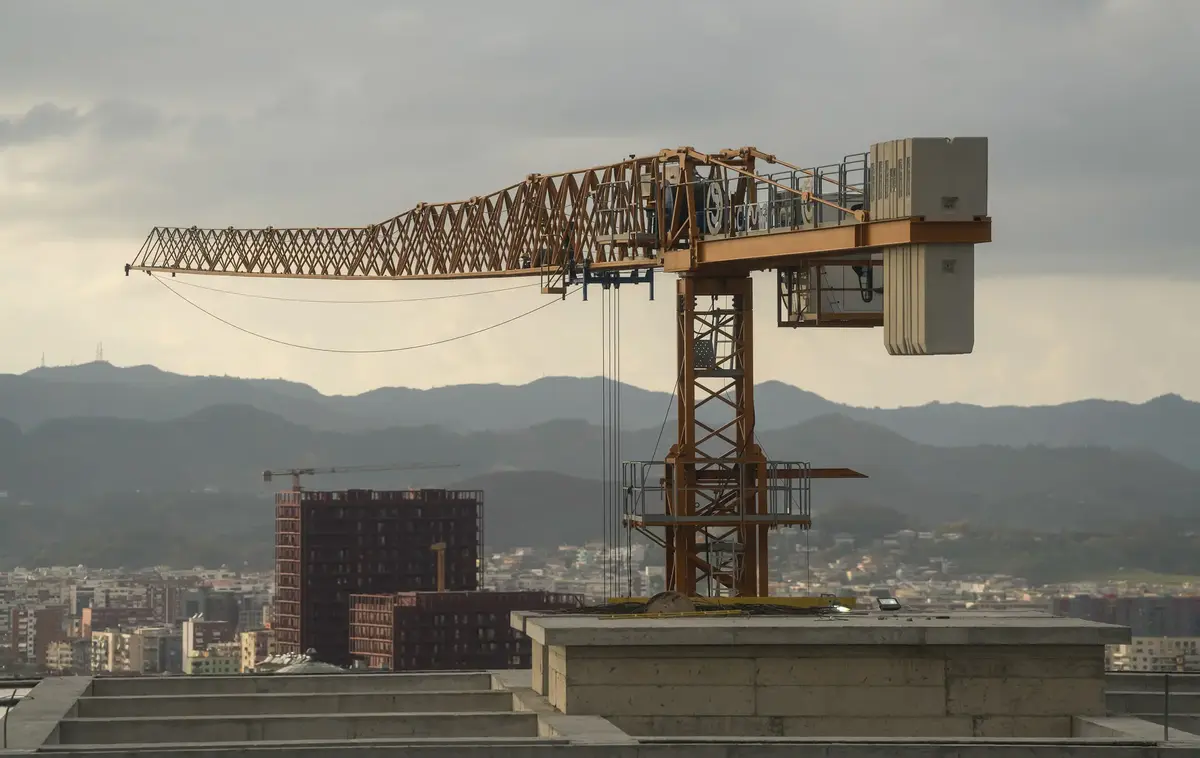
- Construction: Blloku and central Tirana have jackhammers running 7 AM–6 PM almost every weekday. Pick your rental by asking about the building next door, not just the flat
- Rising rent: Tirana is no longer the bargain it was three years ago. Central one-bedrooms have moved well past the numbers still quoted in older guides
- Driving: roughly double the EU road-death rate, with driver behavior blamed for the overwhelming majority of accidents. Don’t rent a car for your first two weeks
- Banking: covered above. Expect friction
- English gap: Tirana and the major Riviera towns are fine. Elsewhere — Berat, Shkodër, small coastal villages — basic Albanian or Google Translate become non-optional
- Winter air quality: Shkodër and parts of Tirana hit unhealthy particulate levels in December and January. Asthmatics should budget for an air purifier
- Supply chain: Amazon doesn’t ship directly. Forwarding services are the workaround, and both add 10–14 days plus customs
- Earthquake legacy: buildings in Durrës, Shkodër, and surrounding areas still carry façade cracks from the 2019 quake. Ask about structural repairs before signing a long lease
- Stray dogs: municipal handling has drawn criticism from animal-welfare groups. If you have children, vet your neighborhood on foot at different hours
- Hot water: older Blloku buildings use roof-mounted electric boilers with water tanks — if three people shower back to back, someone gets a cold one
Pro Tip: My rental’s water pump failed on day three. The landlord showed up with a wrench, a cigarette, and a bottle of Pepsi, and had it fixed in eleven minutes flat. That’s Albania in one image — stuff breaks, people fix it fast, the formal system barely matters.
Albania is the best US-nomad base in Europe if you value legality and cost over community and infrastructure polish. The 365-day visa-free rule plus non-Schengen status is structurally unmatched. Budget $1,250–$1,900 monthly for Tirana, expect around 90 Mbps median fiber and faster mobile, use Wise for banking, and forget the Taken stereotype — Albania now outranks most of Western Europe on the Global Peace Index. Skip August. Choose Tirana first, Himarë over Ksamil, and treat the Unique Permit as a long-game option rather than a first-trip requirement.
The single most valuable thing about Digital Nomad Albania for Americans is the structural freedom: you keep your Schengen days untouched, your passport does the work, and the cost is low enough to let you stay long without burning runway. Add the 0% tax rate on registered small-business income and it’s a combination Portugal can’t offer, Georgia matches on paper but underdelivers on Mediterranean lifestyle, and Montenegro can’t sustain past 90 days.
Two clocks are running, though, and both favor going sooner. Tirana rents are climbing every year, and EU accession — all chapters open, rule-of-law benchmarks cleared, membership targeted around 2030 — will eventually pull Albania into Schengen and end the 365-day carve-out. The version of Albania described here is the cheap, unhurried, non-Schengen version. It won’t stay that way indefinitely. If your months here are as much about the country as the desk, the wider Albania travel guide covers the regions and routes this one skips.
The only wrong move is treating Albania like a brochure. Come with real expectations about construction noise, winter utility bills, and the fact that Amazon doesn’t exist here. Come with a backup ATM card because fees stack fast. And come in May or September, not August.
What’s the one thing about Digital Nomad Albania that would actually break the deal for you — the construction noise, the US tax paperwork, the August heat, or something else?