The Albanian Riviera is the cheapest stretch of Mediterranean coast left in Europe — and the only one where a US passport gets a 365-day visa-free stay. I drove the SH8 from Vlorë to Ksamil and back, paid the sunbed tabs, and kept the receipts. Here’s what actually works for a US planner.
What is the Albanian Riviera and where exactly is it?
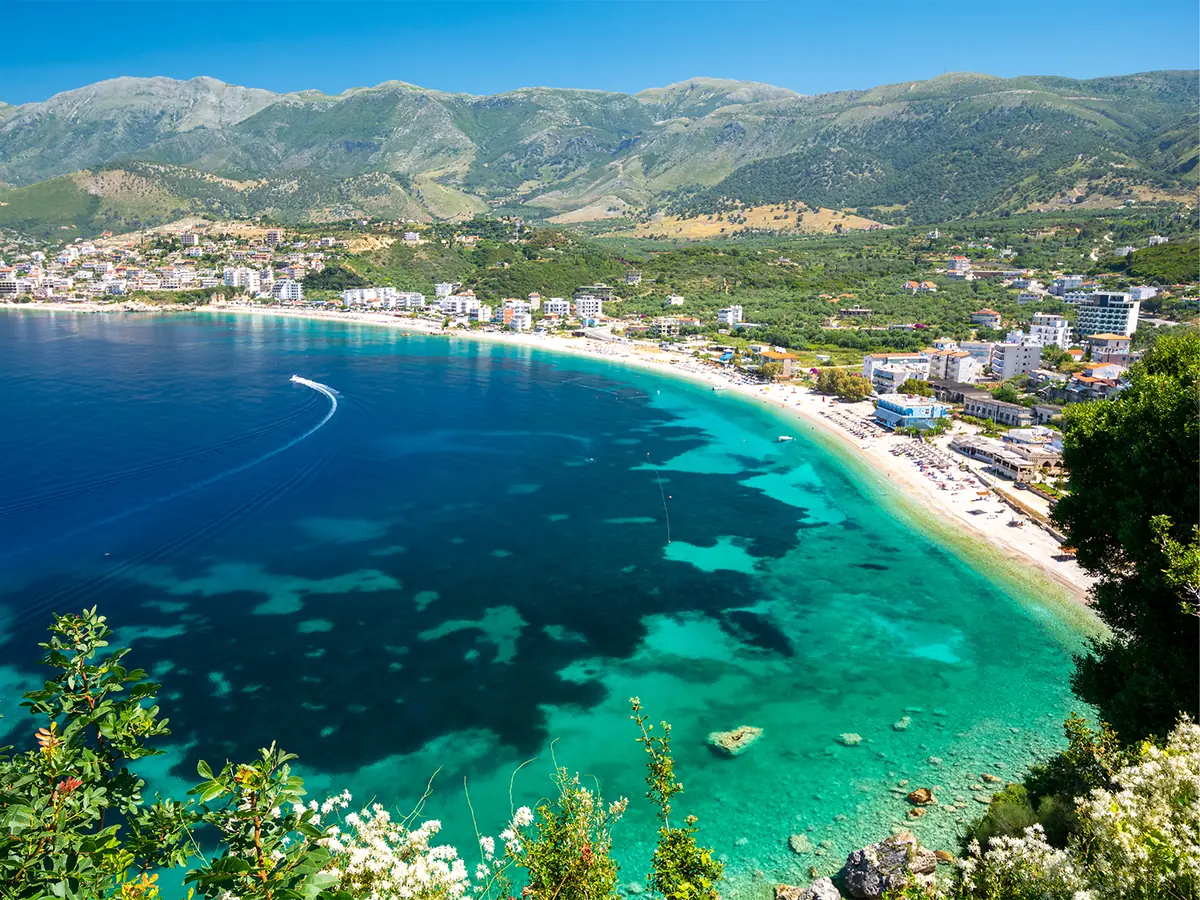
The Albanian Riviera — Bregu in Albanian — is a 75-mile (120 km) stretch of Ionian Sea coastline in southern Albania. It runs from the Llogara Pass and the village of Palasa down through Dhërmi, Himarë, Borsh and Lukove to Saranda and Ksamil at the Greek border. Saranda is the largest town and the unofficial gateway.
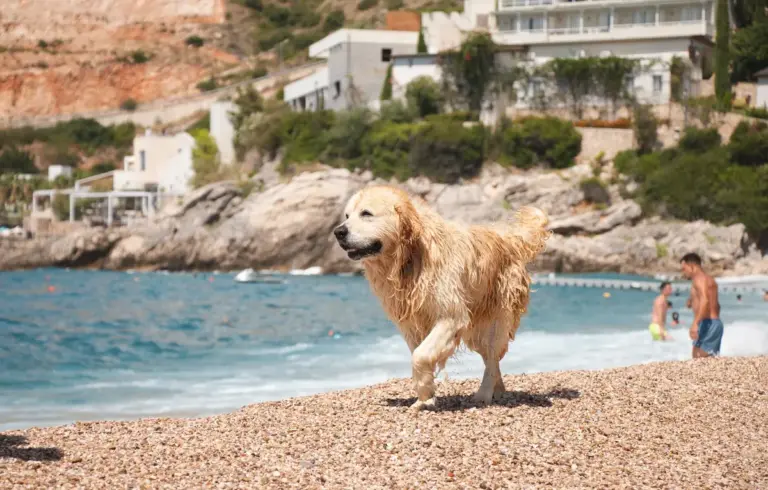
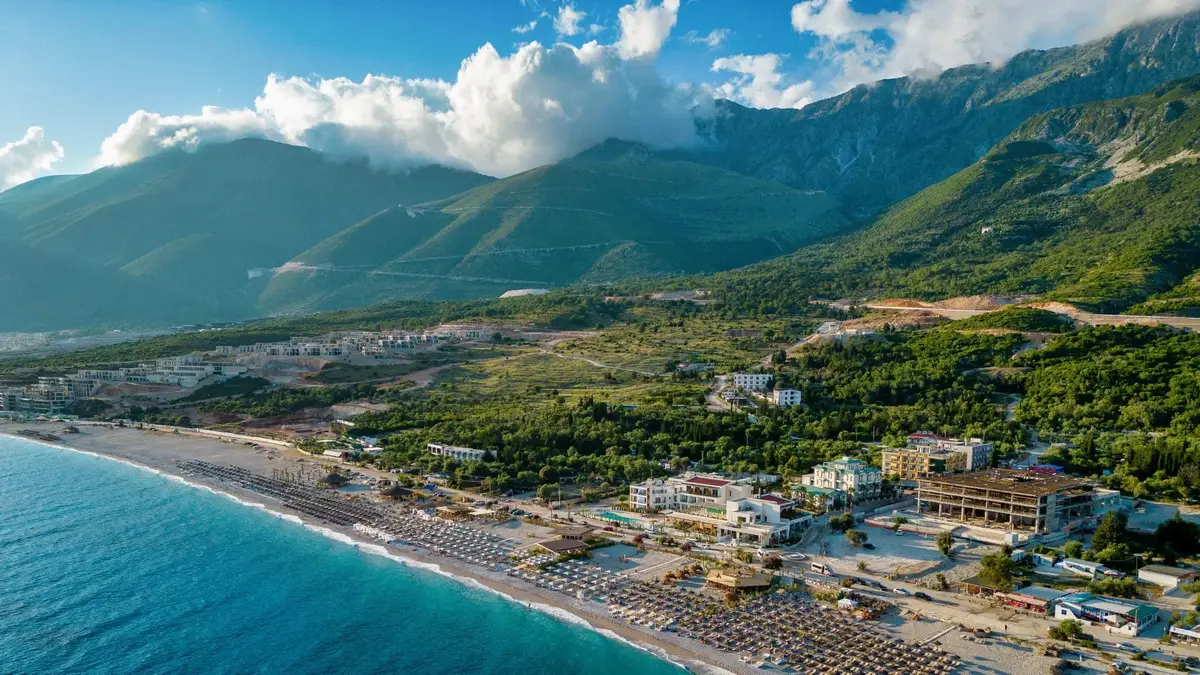
The Riviera is distinct from Albania’s other coast. The beaches at Durrës and Velipojë sit on the Adriatic — flatter, sandier, browner water, more like a Croatian or Italian seaside town than a postcard Mediterranean cove. The Ionian Riviera south of the Llogara Pass is the side with the Ceraunian Mountains tumbling straight into clear water, and the pebbled coves that get compared to the Greek islands.
At its narrowest point, the Riviera sits just 22 miles (35 km) of open water from Corfu. On clear days you can see the Greek island from the Saranda promenade.
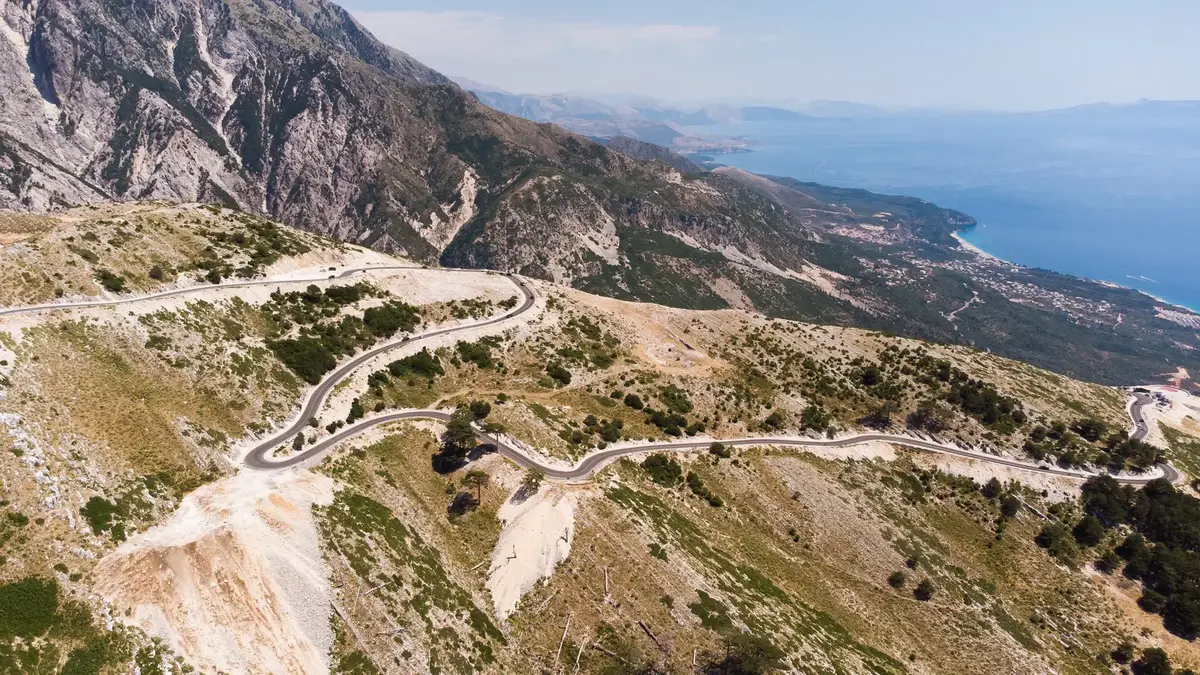
Pro Tip: The drive from the Llogara Pass viewpoint down to Dhërmi covers 17 switchbacks in roughly 5 miles (8 km). Stop at the small parking pull-off above Palasa for the cleanest panorama — the official viewpoint at the top of the pass has a restaurant blocking the best angle.
Albanian Riviera map and the 5 hub towns
A one-line read on each base town, north to south:
- Vlorë: the gateway city at the northern end, useful for ferries to Italy.
- Dhërmi (and Drymades): design hotels, beach clubs and the Kala festival crowd, which lands in early June.
- Himarë: a mid-coast Greek-speaking town with the deepest restaurant scene.
- Saranda (Sarandë): the urban base, Corfu ferries leave from the harbor.
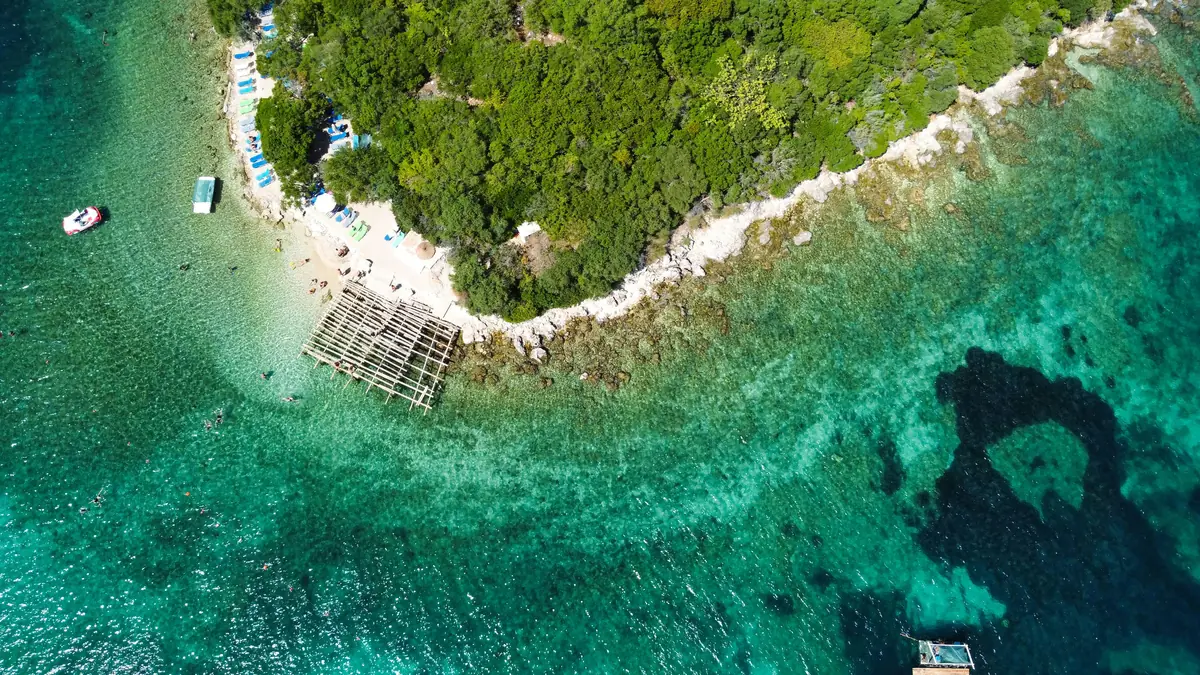
- Ksamil: white-pebble (and some imported sand) beaches on the Butrint side, plus the biggest tourist load.
How do you get from the US to the Albanian Riviera?
There are no nonstop flights from the United States to Albania. Most US travelers connect once — typically Istanbul (Turkish Airlines), Frankfurt or Munich (Lufthansa), Zurich (SWISS), Vienna (Austrian), Rome (ITA Airways) or London (British Airways) — to Tirana International Airport (TIA). Total travel time from JFK or EWR runs roughly 13 hours one-way on the fastest itineraries, and 18–22 hours on the cheap ones.
One nonstop now exists from North America, but not from the US: Air Transat flies Toronto Pearson (YYZ) to Tirana once weekly on an Airbus A330-200, seasonally from late June through early October. Tirana International Airport calls it the airport’s first transoceanic route. If you live in the Northeast and can reposition to Toronto cheaply, it’s the only way to reach Albania without a European connection. A New York–Tirana route has been discussed publicly by both Albanian officials and US carriers, but nothing is scheduled.
On price, a typical New York–Tirana round trip lands between roughly $400 and $800 in shoulder season, with one-way sale fares dipping into the $230–$310 range on Norse Atlantic, Wizz Air Malta and Air Serbia connections. Peak July and August itineraries commonly clear $1,000. March and October are consistently the cheapest months; July has the most flight options.
Two routings cover almost every US trip:
- Routing 1 — fly to Tirana (TIA): one-stop via a European hub, then either rent a car or take the Tirana–Saranda bus south. Driving time Tirana to Saranda is about 4.5–5 hours via the inland SH4 and the Kardhiq–Delvinë road, 6+ hours via the scenic SH8 coastal route.
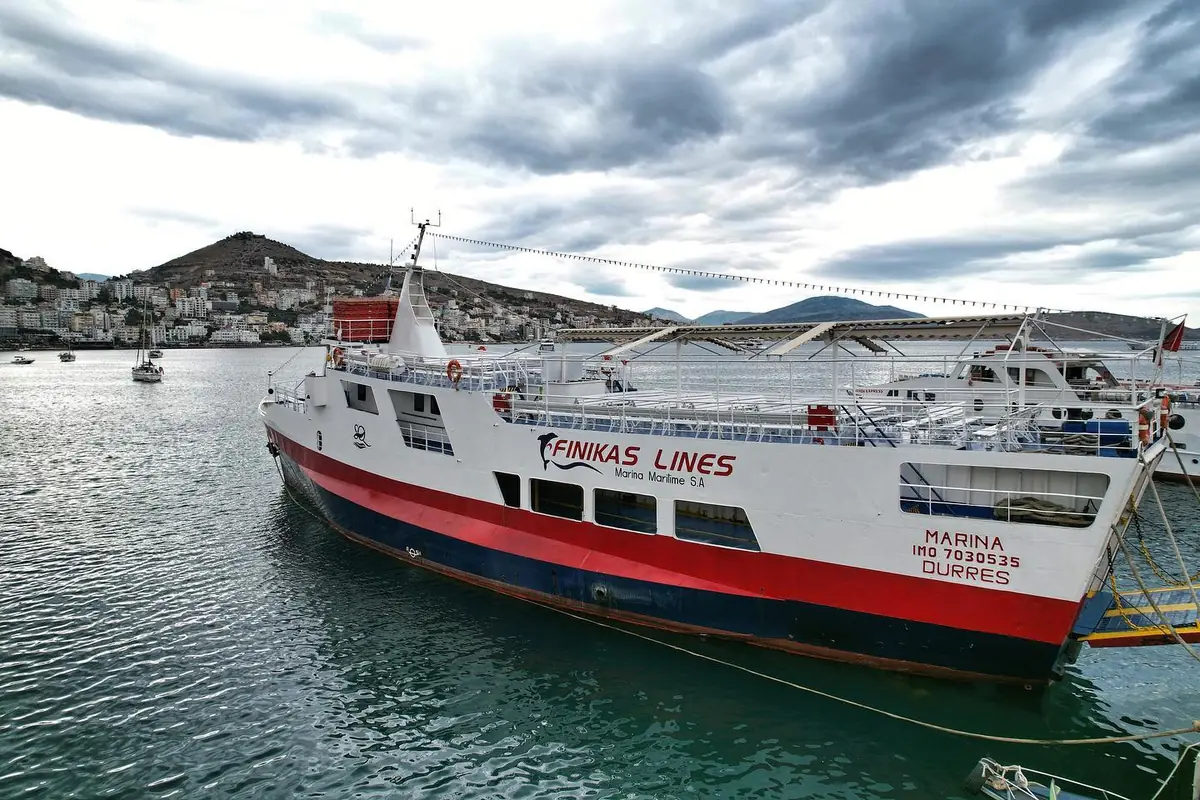
- Routing 2 — fly to Corfu (CFU) in Greece: one-stop via Athens, Rome, London or Frankfurt, then take the 30-minute high-speed ferry from Corfu Town to Saranda for roughly $22–$35 one-way (Finikas Lines, Ionian Seaways, Albania Luxury Ferries).
Pro Tip: Greece runs one hour ahead of Albania. A ferry that leaves Saranda at 10:00 arrives in Corfu at about 11:30 local time even though the crossing takes 30 minutes. Build that hour into any same-day flight connection out of CFU — it’s the single most common misread on this route.
Should you fly via Tirana or via Corfu?
Use Corfu if all three are true: (a) you’re spending fewer than 7 days, (b) your itinerary stays on the Riviera, and (c) you don’t want to drive Albanian roads. Use Tirana if any of these apply: (a) your trip is 8+ days, (b) you want to add inland Albania (Berat, Gjirokastër, Theth), or (c) you’re renting a car for the full trip — Tirana airport has the deepest rental selection and lowest base rates.
Three operators now run the Corfu crossing, with up to 10 daily sailings in high summer and only one or two in winter. The ferry also runs less reliably in shoulder season, since sea swell cancels it in late October and early April, so US travelers booking April or late-October trips should default to Tirana.
What’s the status of Vlora International Airport (VLO)?
Do not build a trip around VLO. Vlora International Airport holds its IATA code (VLO), completed its first certification flight, and has a finished 3,200-meter runway and 22,000 m² terminal — but it has still not obtained operating certification, and its opening has slipped repeatedly.
Albanian authorities notified tour operators that the airport could not open for the most recent summer season. Nordic charter contracts were cancelled and rebooked a year out, and a Chair Airlines Zurich–Vlora route that was announced and put on sale did not operate. The underlying problem is a legal dispute between the concession consortium’s main shareholders, and the operator has requested a deadline extension. Wikipedia’s airport entry, citing the same reporting, states plainly that certification delays left no scheduled flights.
Practical read for US travelers: TIA and CFU remain the only two workable entry points. If a booking site or a hotel sales page tells you VLO is “one hour away,” treat that as marketing, not a flight plan. There are no rental car desks at VLO either — rent in Tirana or Saranda.
Do US citizens need a visa for the Albanian Riviera?
US passport holders can enter Albania visa-free for up to 365 days under a bilateral arrangement confirmed on the US Embassy Tirana’s own entry page. The passport must be valid for at least 3 months past arrival, though the embassy itself recommends 6 months and airlines often enforce that at check-in. Time spent in Albania does not count against the EU Schengen 90/180-day limit.
Two details most guides skip. First, to reset the one-year clock you must leave Albania and stay out for 90 days — short hops to Corfu or Montenegro don’t restart it. Second, border officers increasingly log entries electronically instead of stamping passports, so save your boarding pass or ferry ticket as proof of your entry date.
This 1-year window is unusual. Most other nationalities (EU, UK, Canada, Australia, New Zealand) get 90 days in any 180. The 365-day allowance is one of the most generous in Europe for Americans, which is why long-stay US remote workers have shown up on the Riviera in numbers.
On the money side:
- Currency: the Albanian lek (ALL). The lek has been strengthening; the rate now sits near 81 ALL per USD, with a recent trading band of roughly 80–84. A stronger lek means your dollar buys less than the older guidebook math suggests.
- Euros: widely accepted on the Riviera at posted rates, especially in Ksamil, Saranda and Dhërmi. Many tourist businesses price in euros outright.
- USD cash: not accepted. Don’t carry dollars expecting to pay in them.
- ATMs: reliable at BKT, Credins and Raiffeisen branches; expect a $5–$9 withdrawal fee per transaction. Skip airport exchange kiosks entirely.
- Cards: acceptance is improving because Albanian law now requires accommodation businesses to run card terminals. Hotels, larger restaurants and Ksamil beach clubs take cards. Family guesthouses, taverna kitchens, furgon drivers, beach sunbed operators, the Blue Eye kiosk and the Llogara tunnel booth are still cash-first.
- Cash buffer: pull about $200 in lek on arrival in Tirana or Saranda for the first three days, and keep small notes — nobody breaks a 5,000-lek bill cleanly.
Pro Tip: Credins ATMs charged me roughly 700 lek (about $8.60) per withdrawal versus BKT’s 600 lek (about $7.40). If you’ll make four to five withdrawals on a two-week trip, that gap adds up to a Himarë dinner.
When is the best time to visit the Albanian Riviera?
The best windows for a US visitor balancing weather, crowds, water temperature and prices are mid-June and mid-September to early October. Peak season (mid-July to late August) hits 83–88°F (28–31°C), packs every beach, and pushes Ksamil room rates from $90 to $250-plus thanks to Italian Ferragosto and the Albanian diaspora returning from Germany, the UK and Italy.
Sea temperatures climb from 65°F (18°C) in May to 78°F (25.6°C) in August, then hold at 73°F (23°C) through October. July rainfall averages just 0.2 inches across the Riviera. Many family-run guesthouses, taverna kitchens and beach clubs close from mid-October to mid-May, so a March or November trip means a quiet, working town with limited dining.
Two timing wrinkles worth knowing. Kala, the boutique electronic festival in Dhërmi, runs for eight days in early June and fills Drymades accommodation well before the general season starts — great if that’s your scene, expensive and loud if it isn’t. And the shoulder season is no longer a secret: INSTAT recorded a 19% year-over-year jump in October arrivals in its most recent count, which is why early-October rates have firmed up.
Month-by-month at a glance
Air temperature, water temperature, crowd index (1 = empty, 5 = packed) and rough price index (1 = lowest, 5 = peak) for Saranda:
- January: 50°F (10°C) air / 58°F (14°C) water / crowd 1 / price 1 — most businesses closed.
- February: 52°F (11°C) air / 57°F (14°C) water / crowd 1 / price 1 — same.
- March: 56°F (13°C) air / 58°F (14°C) water / crowd 1 / price 1 — quiet, mild, cheapest flights.
- April: 62°F (17°C) air / 61°F (16°C) water / crowd 2 / price 2 — cool for swimming.
- May: 71°F (22°C) air / 65°F (18°C) water / crowd 2 / price 2 — workable, mostly Europeans.
- June (first half): 77°F (25°C) air / 70°F (21°C) water / crowd 3 / price 3 — the sweet spot, minus the Kala week in Dhërmi.
- June (late) through early July: 82°F (28°C) air / 73°F (23°C) water / crowd 4 / price 4.
- Mid-July to late August: 86°F (30°C) air / 77°F (25°C) water / crowd 5 / price 5 — packed and expensive.
- September: 79°F (26°C) air / 75°F (24°C) water / crowd 3 / price 3 — the smartest US window.
- Early October: 72°F (22°C) air / 72°F (22°C) water / crowd 2 / price 2 — quiet, warm enough, busier every year.
- Late October: 65°F (18°C) air / 68°F (20°C) water / crowd 1 / price 1 — businesses shutting.
- November–December: 56°F (13°C) air / 62°F (17°C) water / crowd 1 / price 1 — winter mode.
Why August is the worst month for US travelers
Three forces collide. Italian Ferragosto (a national vacation centered on August 15) brings Italian families across the Adriatic. The Albanian diaspora — hundreds of thousands of citizens working in Germany, Italy, Greece and the UK — returns home for the month. Greek and other Balkan tourists fill the rest of the rooms.
The result: Ksamil sunbed rates hit their annual ceiling; Himarë guesthouses reach $200/night for what costs $90 in June; the SH8 from Vlorë to Saranda turns into a parking lot at Dhërmi. Off-peak, operators will negotiate 20–30% off a sunbed set. On an August weekend there is zero flex. Skip August unless you specifically want heat.
Where should you base yourself: Saranda vs Ksamil vs Himarë vs Dhërmi?
For most first-time US visitors, Himarë is the best single base. It sits midway down the coast, has the deepest restaurant scene on the Riviera, walkable access to Livadhi and Filikuri beaches, and reaches Ksamil, Gjipe, Porto Palermo and the Llogara Pass within a 90-minute drive. Use Dhërmi for upscale beach clubs and music festivals, Saranda as a city base with the Corfu ferry, and Ksamil only if you specifically want sand and don’t mind the crowds.
Per INSTAT’s 2023 census reported by Monitor Magazine and balkanweb.com, the Municipality of Himarë grew 45% to 8,328 residents, Ksamil sits at 2,731 census residents (swelling to perhaps 25,000 in mid-August), and Saranda holds 17,000–20,000 in the city proper, climbing to around 30,000–35,000 in summer. For scale: INSTAT’s most recent full-year count put foreign arrivals to Albania at 12.47 million, up 6.6% year over year, against a national population of about 2.4 million.
Saranda (Sarandë): the urban base with the Corfu ferry
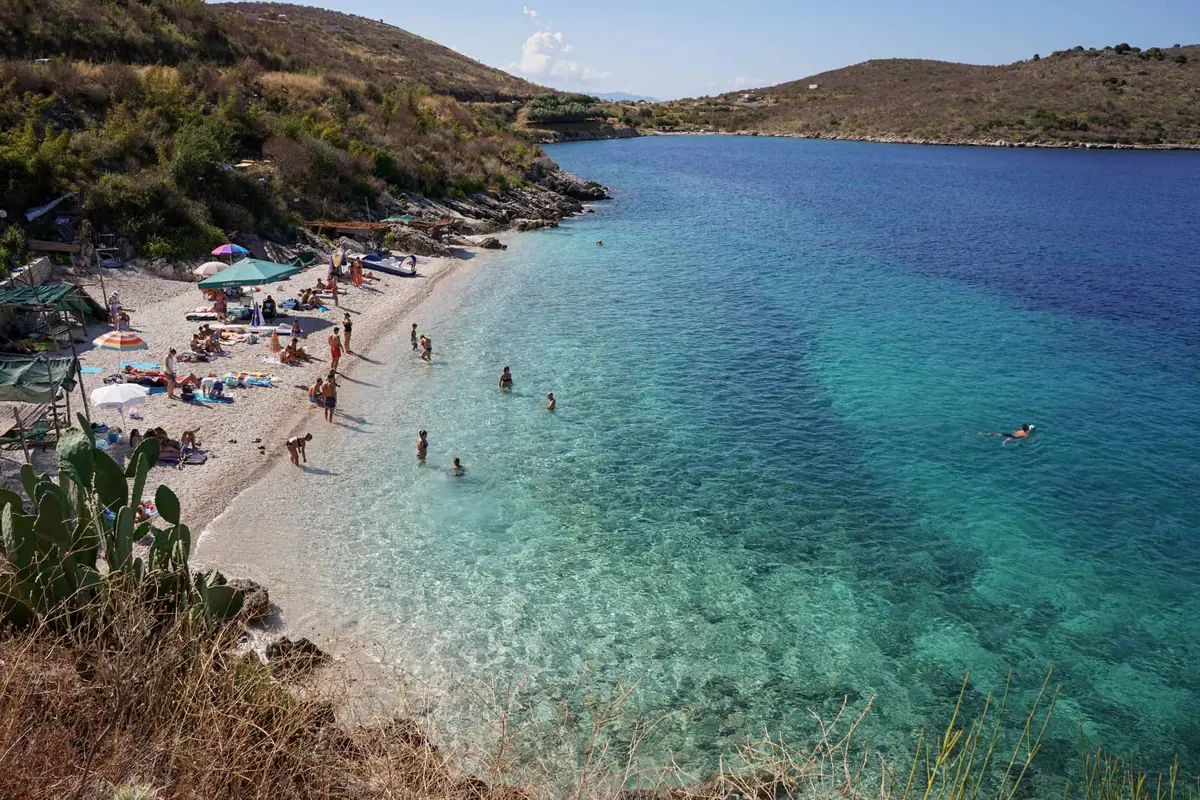
Saranda is the largest town on the Riviera and the only one that feels like a small city. The promenade runs about 1.2 miles (2 km) along the harbor, with concrete beach platforms more than sandy stretches. It’s loud at night around the Mango Beach Club strip and quieter at the northern end near Mia Marine and ArtNest Boutique Saranda.
The verdict: Saranda is the right base if you want the Corfu ferry on either end of your trip, a denser restaurant scene than the villages, and city services like 24-hour pharmacies. It is the wrong base if you came for beach mornings — Saranda’s own beaches are not the reason anyone visits Albania.
- Location: harbor city in the southern Riviera, 9 miles (15 km) north of Ksamil and 30 minutes by ferry to Corfu.
- Cost: mid-range double $80–$160 (June/September); $130–$300 in August.
- Best for: First-time visitors who want a city base, ferry-day arrivals, older travelers who want walkable amenities.
- Time needed: 2–3 nights minimum.
Ksamil: the postcard beaches with the heaviest tourist load
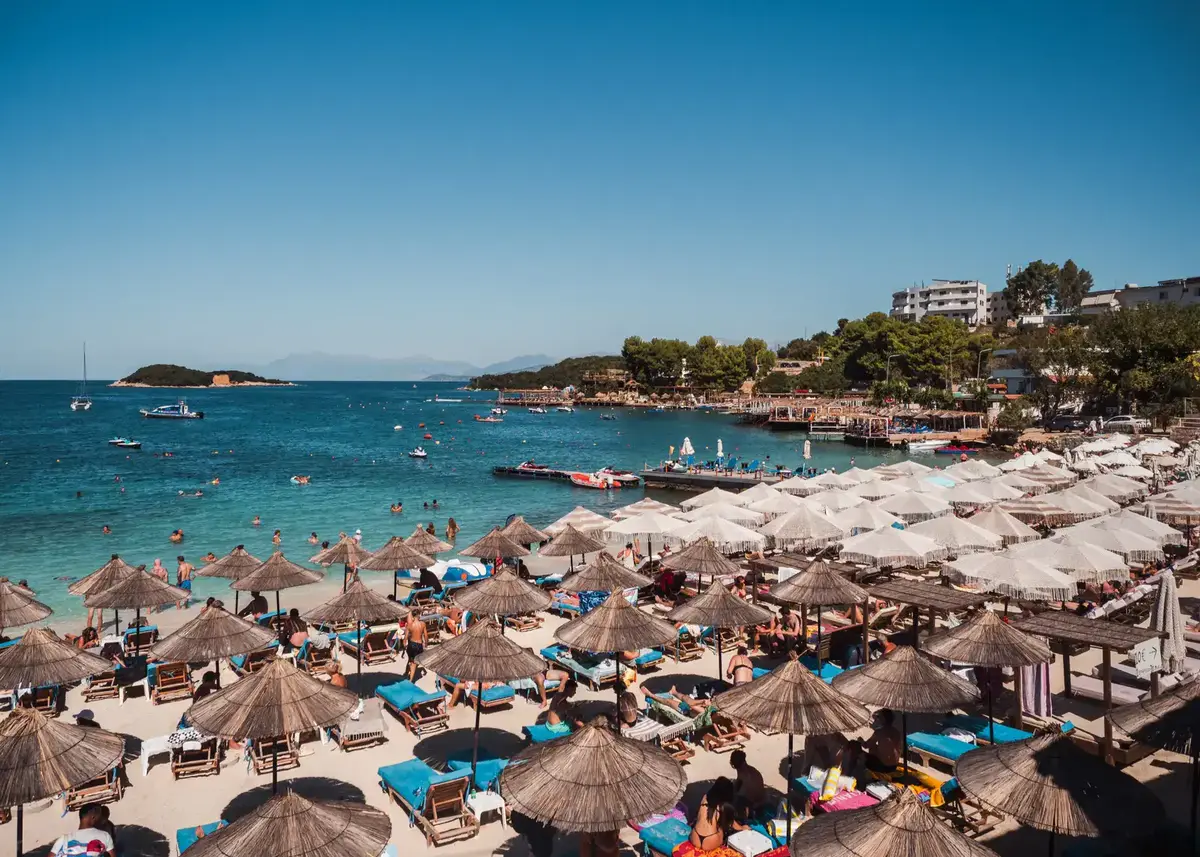
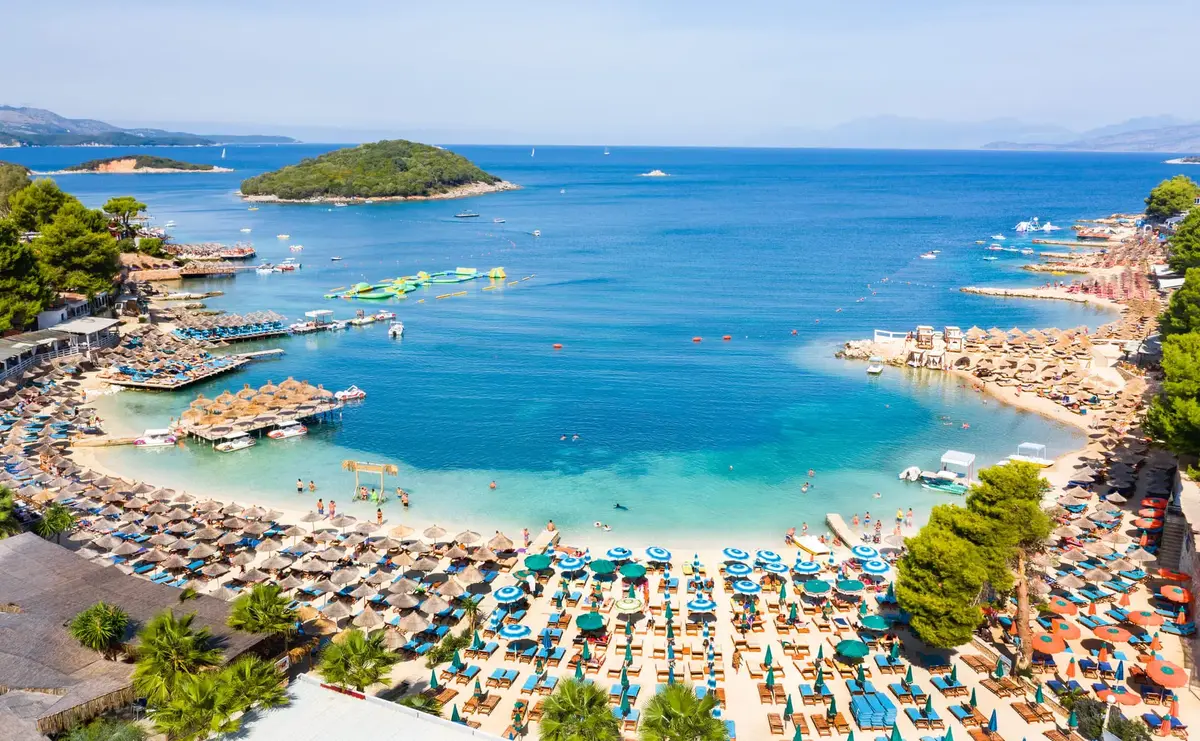
Ksamil’s three numbered beaches and the small offshore islets are the Riviera’s most-photographed view — sand soft underfoot, water clear enough to see your toes in 8 feet of depth. The town itself is a construction site by US standards: concrete-shell hotels going up between finished resorts, narrow roads, and beach clubs occupying much of the usable shoreline in summer.
Enforcement has tightened, though. Saranda’s border police and municipal police have run clearance operations removing piers, floating platforms and moored watercraft from Ksamil’s beaches, and the municipal council cut the number of maritime corridors to keep boats out of swimming coves. The water is meaningfully safer for swimmers than it was a couple of seasons ago.
The verdict: Ksamil is genuinely beautiful but oversold. Day-trip from Himarë or Saranda, swim the first beach before 10 a.m., and leave before the Saranda buses unload at noon.
- Location: 9 miles (15 km) south of Saranda, 5 minutes from Butrint National Park.
- Cost: mid-range double $90–$220; sunbed sets typically 1,000–1,700 lek ($12–$21), rising to $40 at the best-positioned clubs; VIP cabanas and daybeds $50–$120.
- Best for: First-time visitors specifically chasing the postcard photo; families with young kids who want sand.
- Time needed: 1 full day as a trip, 2 nights if you must stay there.
Himarë: the mid-coast pick for first-time visitors
Himarë is two settlements: a working harbor and beach town (Spile) along the water, and Old Himarë on the hillside above. The town speaks Greek as much as Albanian, the seafront restaurants take fish by the kilo, and Livadhi Beach (north of town) and Filikuri Beach (a hike or boat ride south) bracket the area with the best stretches of coast outside of Gjipe.
The verdict: Himarë balances access, food and authenticity better than any other base. The friction point: nightlife is mild compared to Dhërmi and Saranda — if you came to drink until 3 a.m., this isn’t the town.
- Location: midpoint of the Riviera, 35 miles (56 km) south of Vlorë and 40 miles (64 km) north of Saranda.
- Cost: mid-range double $70–$140; family guesthouses $40–$80; Spile town-beach sunbed sets 1,000–1,500 lek ($12–$19).
- Best for: First-time US visitors splitting their time between beaches, food and short drives; couples without kids.
- Time needed: 3–4 nights as a base.
Dhërmi and Drymades: festivals, design hotels and the Llogara Pass
Dhërmi sits below the Llogara Pass, a 5-mile (8 km) coastline split between Dhërmi village above the road and Drymades along the beach. This is the festival corner of the Riviera — Kala runs eight days in early June, other electronic events follow through summer, and the beach clubs (Havana Beach Club, Moyo, Folie Marine) play music until late. Design-forward hotels (La Brisa, Zoe Hora, Hotel Elysium) are denser here than anywhere else on the coast.
The verdict: Dhërmi is the right base if you came for the music festival window or want a more polished hotel experience than Himarë offers. It is the wrong base if you wanted to walk to dinner in a village — the road geometry forces a car for most evenings.
- Location: northern Riviera, 15 minutes south of the Llogara Tunnel exit.
- Cost: mid-range double $100–$200; design hotels $200–$400 in summer; sunbed sets 1,500 lek in early June rising to 3,000 lek ($19–$37) in August.
- Best for: Couples wanting beach clubs and design hotels; festival travelers.
- Time needed: 3 nights.
Vlorë and Palasa: gateway towns and the new luxury resorts
Vlorë is technically not the Riviera — it sits where the Adriatic meets the Ionian — but most road-trippers pass through and a growing share are staying. Palasa, 5 miles (8 km) south of the Llogara Tunnel exit, holds the Green Coast Resort & Residences development and is the closest the Riviera comes to a planned luxury hub. Accor’s first Albanian MGallery property, the 131-room Green Coast Hotel, anchors the seafront there, and Green Coast’s beach was Albania’s first to fly a Blue Flag.
The verdict: Vlorë makes sense as a one-night stop on a longer Albania trip, not as a Riviera base. Palasa works only if you booked the Green Coast specifically — and note that the resort’s own directions still route guests through Tirana or Corfu, roughly two hours away, because Vlora’s airport isn’t operating.
- Location: Vlorë sits 92 miles (148 km) south of Tirana; Palasa is 30 minutes south of Vlorë via the Llogara Tunnel.
- Cost: Vlorë mid-range double $50–$100; Green Coast suites $300+.
- Best for: Road-trippers, luxury resort travelers.
- Time needed: 1 night Vlorë, 3+ nights Palasa if you’re committing to the resort.
The 12 best Albanian Riviera beaches (and which to skip)
The best beaches on the Albanian Riviera, ranked for US visitors balancing scenery, access and crowd tolerance, are Gjipe, Drymades/Dhërmi, Filikuri, Borsh, Palasa, Livadhi, Jale, Porto Palermo Bay, Bunec, Krorëza, Lukove and — with caveats — Ksamil’s numbered bays. Most are white-pebble, not sand. Pack water shoes ($15 at any Saranda or Vlorë shop).
One rule change matters more than any individual beach. Under a Council of Ministers regulation, 30% of every 1,000-meter stretch of Albanian coastline must stay free and publicly accessible, sunbeds must sit at least 10 meters back from the waterline, and a 2.5-meter buffer in front of the first row stays open for public use. A later amendment also lets municipalities set maximum sunbed prices per coastal zone before the season, with contract penalties for operators who exceed them. In practice, enforcement is uneven — Ksamil and Dhërmi still feel concession-heavy — but you never have to pay to reach the water, and walking past the last row of umbrellas is always legal.
1. Gjipe Beach — the canyon hike worth doing
Gjipe sits at the mouth of a 1.2-mile (2 km) canyon between Dhërmi and Vuno. The water reads three shades of turquoise depending on the depth, and the cliffs frame the bay so completely that cell signal cuts out 200 yards before the sand. The friction: there’s no road. Park near the abandoned Vuno school, hike 25 minutes downhill on a dusty trail, or pay a Dhërmi boat captain $15–$20 round-trip.
- Location: between Vuno and Dhërmi, 12 miles (19 km) north of Himarë.
- Cost: free entry; sunbeds $8–$15/set; boat from Dhërmi $15–$20. Someone may flag you down on the access track asking 200–500 lek to “park” — some lots are legitimate, many aren’t.
- Best for: Solo travelers, couples without kids, photographers.
- Time needed: a half-day minimum once you factor in the hike.
2. Drymades Beach — Dhërmi’s quieter half
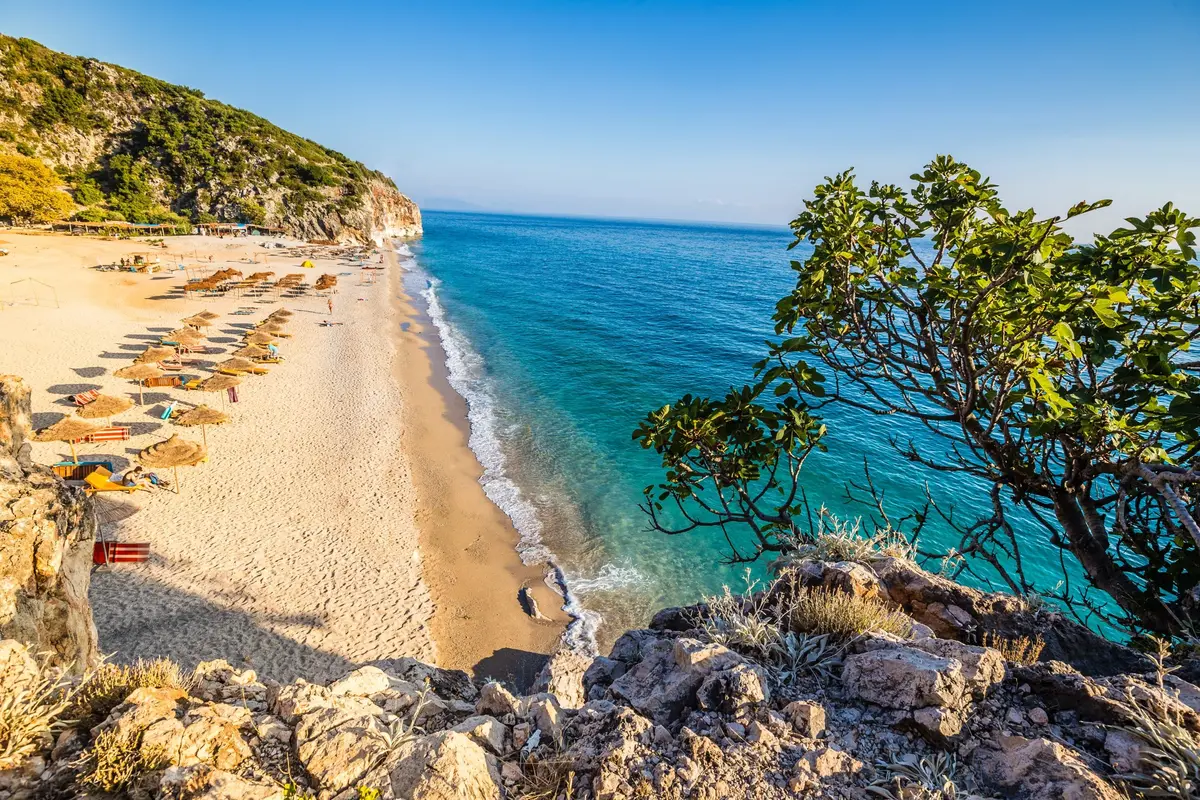
Drymades is the northern half of the Dhërmi coastline, a 0.6-mile (1 km) curve of white pebble fronted by Moyo Beach Club, Sea Turtle Camp and several pine-shaded campsites. The water gets deep fast — by 25 feet from shore you’re in 8 feet (2.4 m) of clear water. Drymades is louder than Gjipe but quieter than Ksamil.
- Location: north of Dhërmi village along the SH8.
- Cost: sunbeds $19–$37/set depending on the month; beach club meals $15–$25 per person.
- Best for: Couples, beach club fans, mid-range budgets.
- Time needed: a full beach day.
3. Filikuri Beach — the rope descent below Himarë
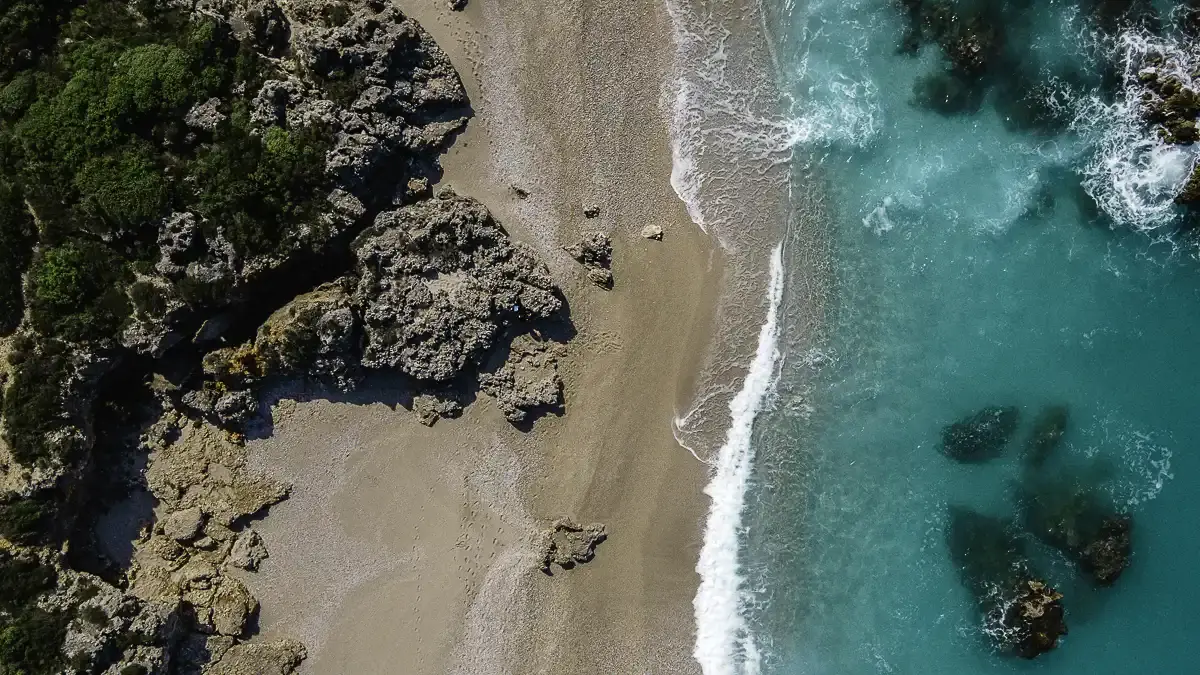
Filikuri is a 100-yard stretch of perfect pebble reachable two ways: a boat from Himarë harbor ($10–$15 round-trip) or a steep scramble down a cliff using a fixed rope. The rope route is genuinely sketchy — not for kids or anyone uncomfortable with exposure — but the beach below is the quietest swim on the Riviera in peak summer.
- Location: south of Himarë by water, 15 minutes from Spile harbor.
- Cost: free entry; bring your own water and food (no services).
- Best for: Adventurous solo travelers, couples without kids.
- Time needed: a half-day.
4. Borsh Beach — the long olive-grove sweep
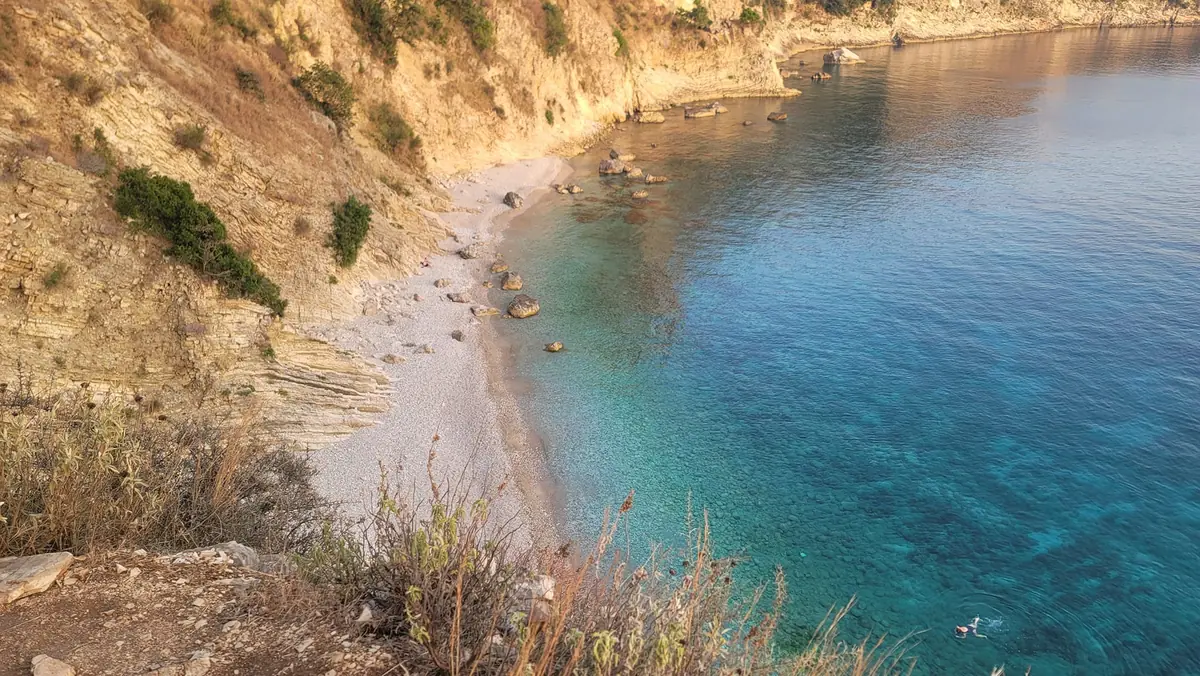
Borsh is the longest beach on the Riviera, a 4.3-mile (7 km) sweep backed by olive groves that produce some of Albania’s best oil. It’s the least developed major beach — a handful of taverna shacks, cheap sunbeds, almost no concrete. It’s also where the free-beach rule works best: the sand runs long enough that open space is never a problem. Locals come to Borsh on weekends.
- Location: 14 miles (22 km) south of Himarë on the SH8.
- Cost: sunbeds $5–$12/set; village taverna meal $8–$15.
- Best for: Families with older kids, travelers wanting the cheapest beach day on the coast.
- Time needed: a full day.
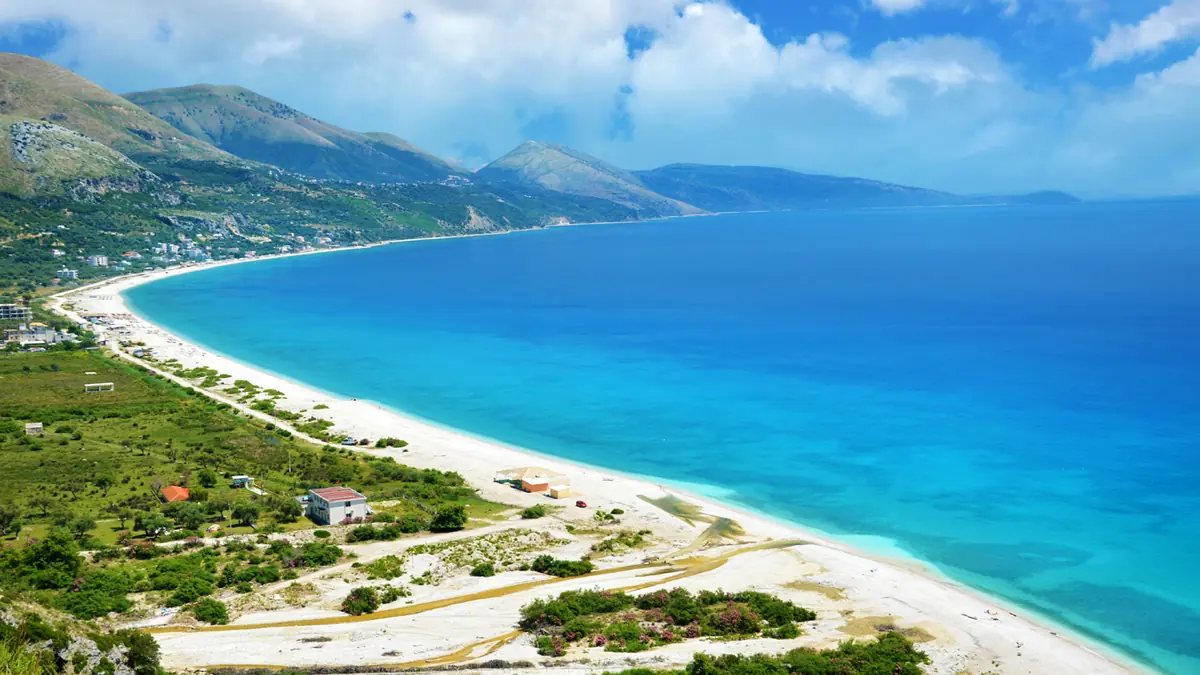
5. Palasa Beach — the cleanest northern arc
Palasa is the first beach you hit coming south through the Llogara Tunnel — a 1.1-mile (1.8 km) crescent of pale pebble below the Green Coast development. Water clarity rivals Gjipe, and the Green Coast end now runs a lifeguarded, Blue Flag-certified stretch. The friction is access at the wild end: a steep dirt road or a 25-minute walk down from the village.
- Location: 5 miles (8 km) south of the Llogara Tunnel exit.
- Cost: free entry; sunbeds $12–$25/set at the Green Coast end.
- Best for: Couples, photographers, anyone wanting an early-season swim.
- Time needed: a half-day to full day.
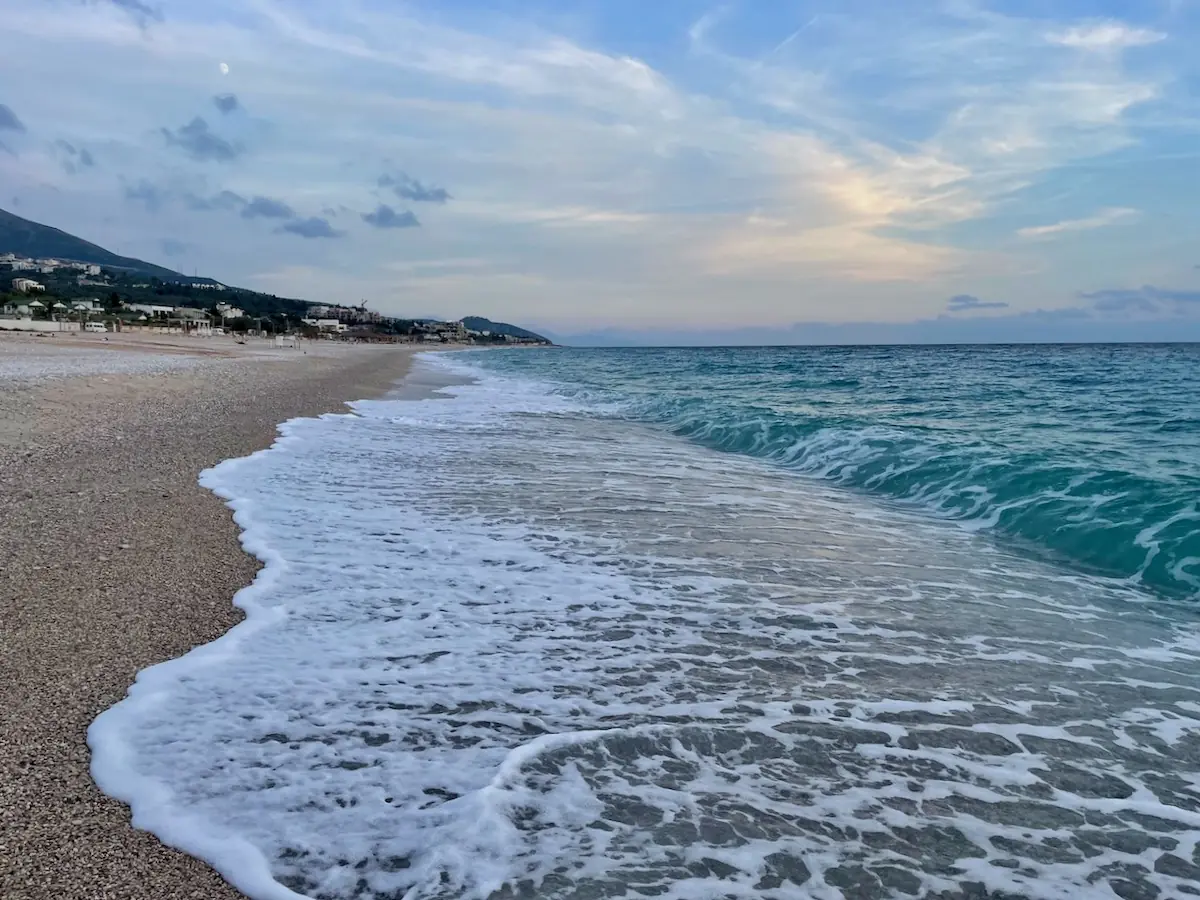
6. Livadhi Beach — Himarë’s everyday swim
Livadhi sits a 10-minute drive north of Himarë, a 0.9-mile (1.4 km) pebble bay backed by a row of taverna-bars including Sea Turtle Beach Bar. It’s the best base-camp beach if you’re staying in Himarë — easy to reach by scooter or rental car, and long enough that the free sections stay generous even in August.
- Location: 2.5 miles (4 km) north of Himarë town.
- Cost: sunbeds $10–$18/set; lunch $10–$18.
- Best for: Himarë base travelers, families, mid-range budgets.
- Time needed: a full day.
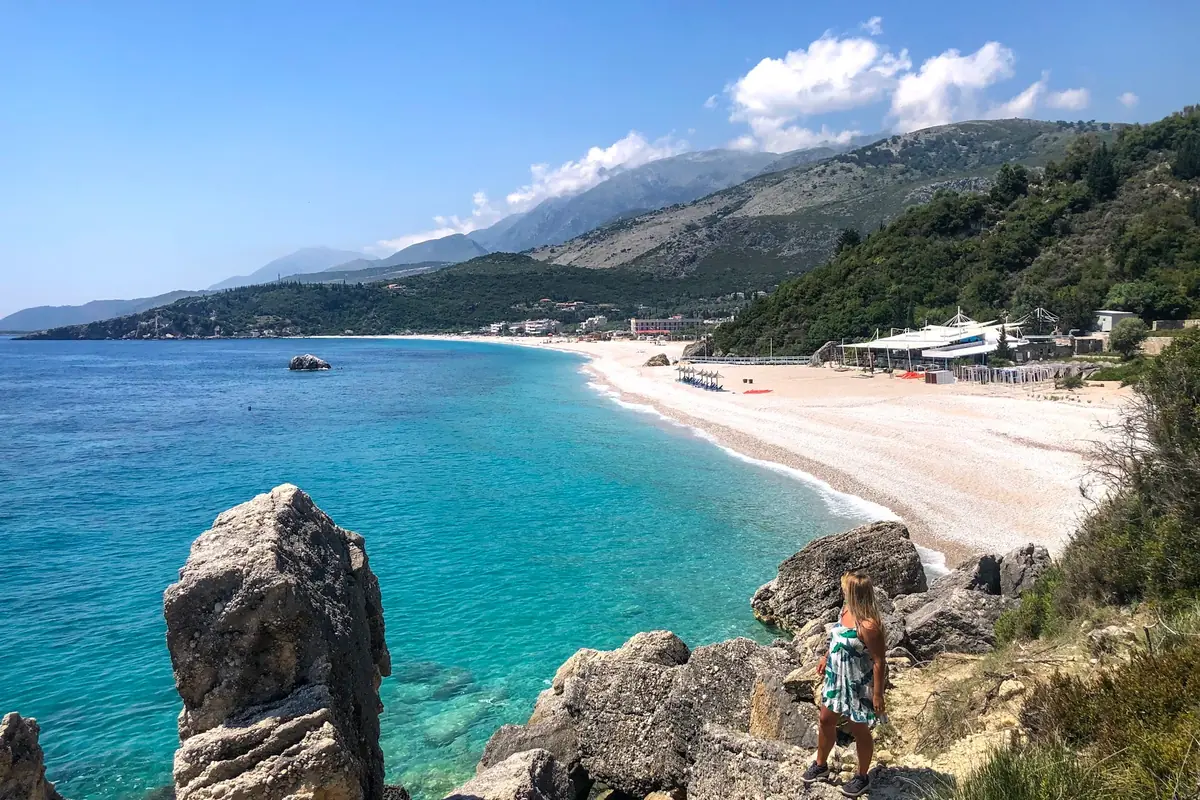
7. Jale (Jala) Beach — the festival cove
Jale is a small twin-bay south of Vuno that hosts Folie Marine and Sea Turtle Camp. The vibe runs younger and louder than most of the Riviera, especially during the summer festival circuit. The southern bay is quieter than the northern one.
- Location: 4 miles (6.5 km) south of Dhërmi via the SH8.
- Cost: sunbeds $15–$30/set; club meals $15–$25; informal parking 200–500 lek on the access track.
- Best for: Twenties travelers, couples without kids, music festival visitors.
- Time needed: a full day or overnight.
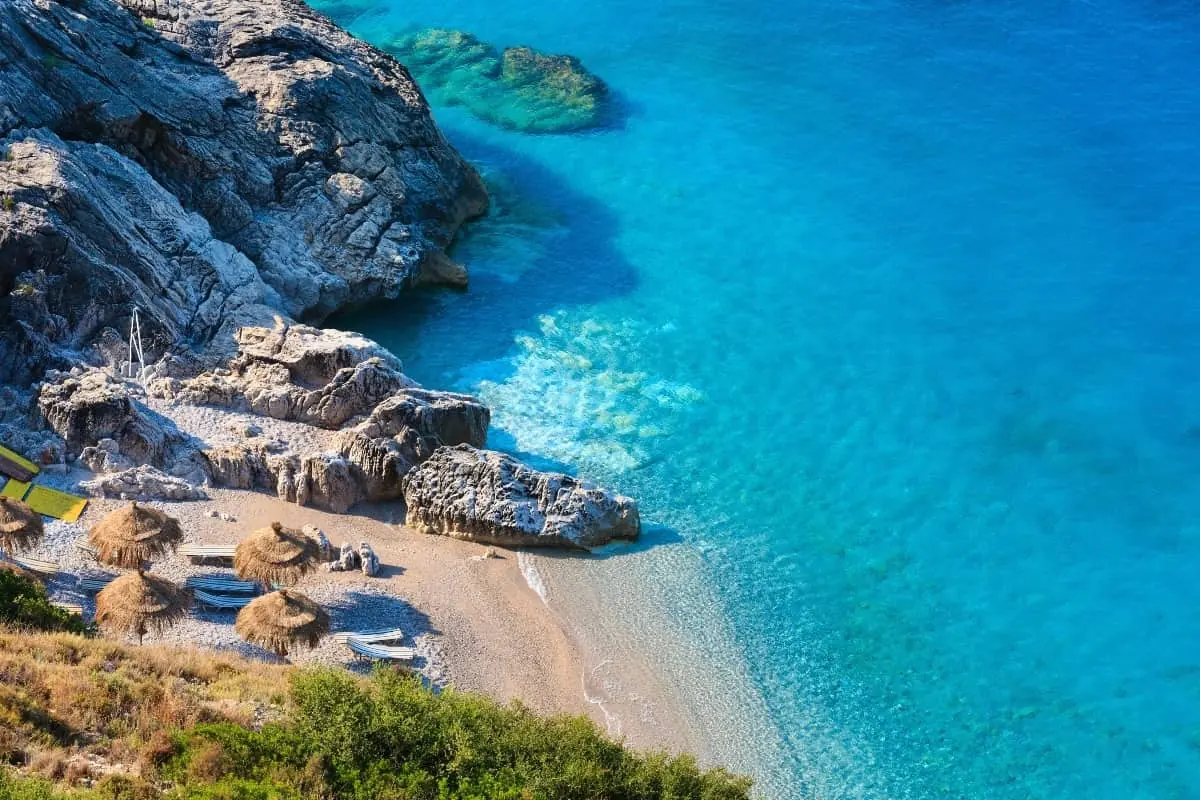
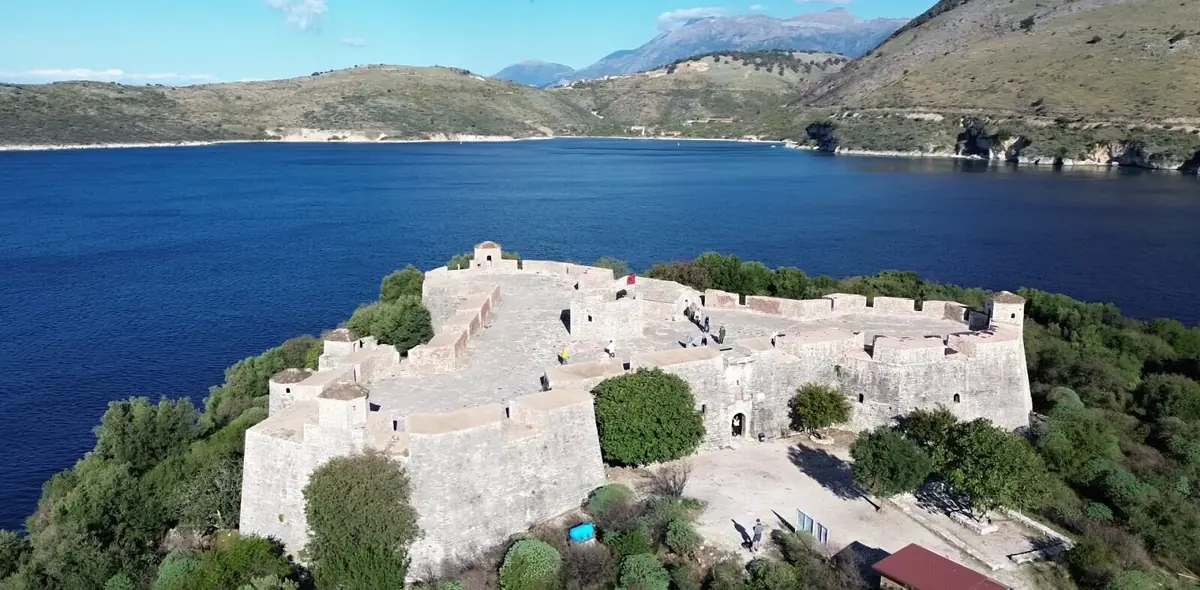
8. Porto Palermo Bay — castle, submarine bunker, calm water
Porto Palermo is a near-circular bay south of Himarë anchored by Ali Pasha’s 19th-century castle and the abandoned Hoxha-era submarine bunker carved into the headland. The water is glassier than open-coast beaches because the bay shape kills most wind chop.
- Location: 7 miles (11 km) south of Himarë on the SH8.
- Cost: free swim access; castle entry 200 lek (about $2.50), cash; kayak rental $10/hour.
- Best for: History travelers, calm-water swimmers, families with kids.
- Time needed: a half-day combining beach and castle.
9. Bunec Beach — the southern cove without the noise
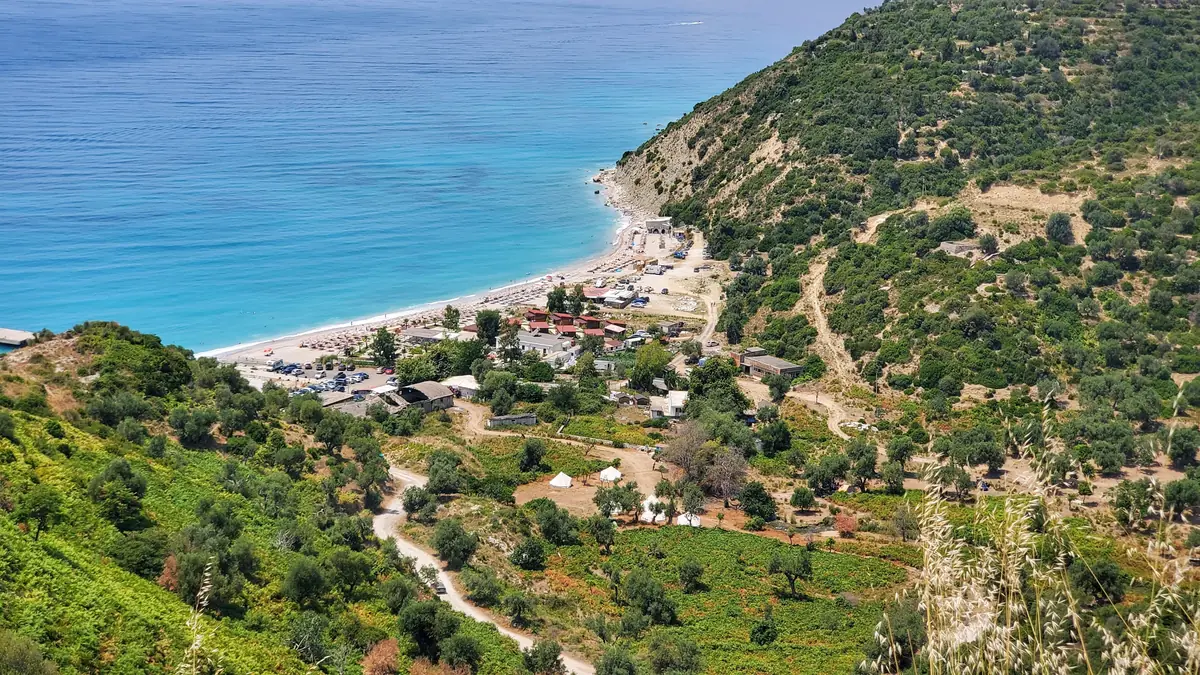
Bunec is a tiny double-bay just north of Lukove, broken by a small headland. There’s a single beach bar, no resorts, and a parking lot that fills by noon. The pebbles are larger than at Borsh — water shoes aren’t optional.
- Location: 9 miles (14 km) south of Borsh on the SH8.
- Cost: sunbeds $8–$15/set; beach bar meals $8–$15.
- Best for: Couples, travelers wanting a quiet beach close to Saranda.
- Time needed: a half-day.
10. Krorëza Beach — a true escape between Bunec and Saranda
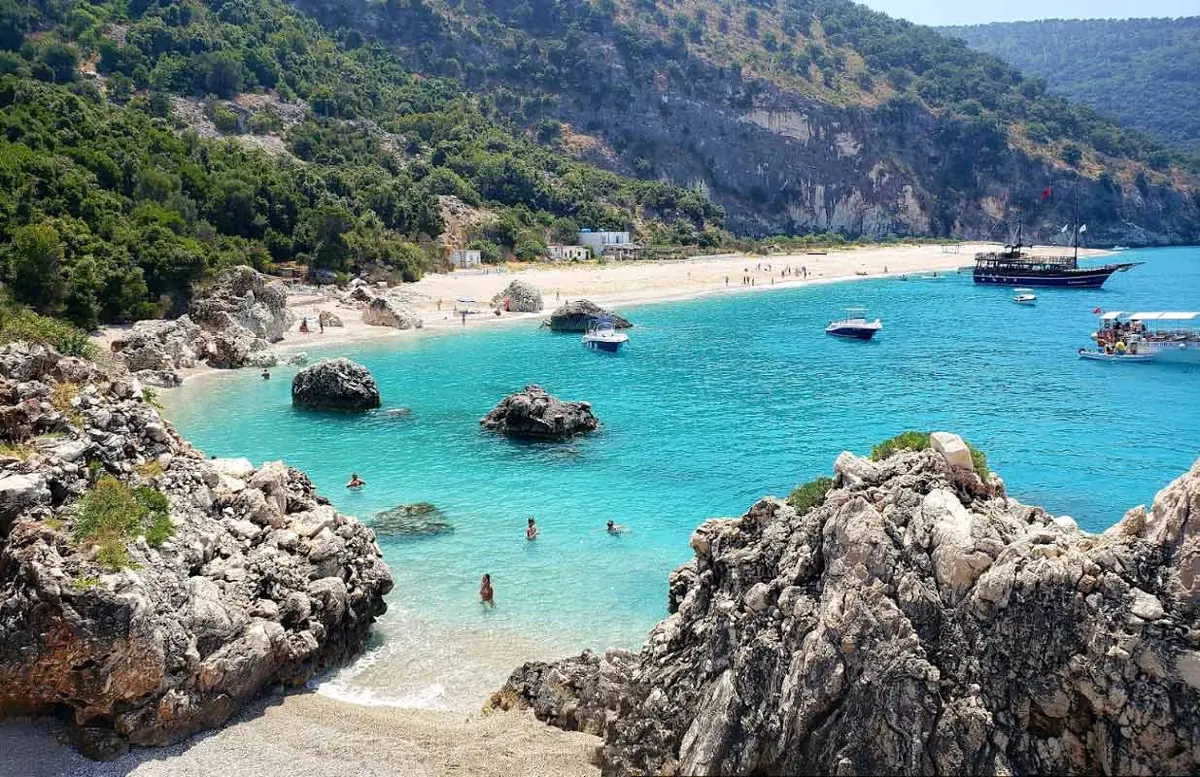
Krorëza is reached only by a steep dirt road off the SH8 or by boat from Saranda. Once you’re down, you’ll find one shack-bar, no music, and water that gets to 8 feet (2.4 m) of depth within 30 feet of shore.
- Location: between Bunec and Saranda, 18 miles (29 km) south of Borsh.
- Cost: free entry; sunbeds $8–$12/set.
- Best for: Solo travelers, couples without kids, true escape seekers.
- Time needed: a full day (the drive in justifies it).
11. Lukove Beach — quiet, unfussy and cheap
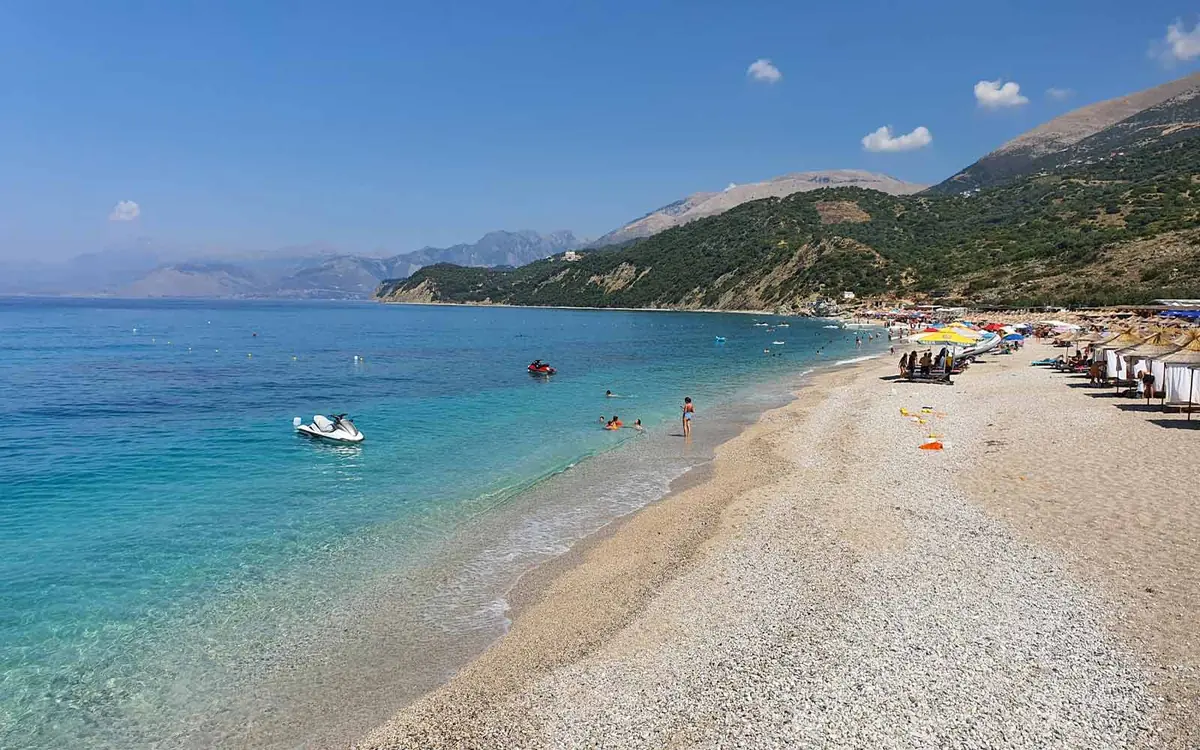
Lukove sits below the village of the same name, a working stretch of coast with a handful of campsites and family-run tavernas. Don’t come for polish — come for $5 sunbeds and $8 grilled fish.
- Location: 13 miles (21 km) north of Saranda on the SH8.
- Cost: sunbeds $5–$10/set; meals $8–$15.
- Best for: Backpackers, road-trippers stopping en route between Himarë and Saranda.
- Time needed: 2–3 hours as a lunch stop.
12. Ksamil’s numbered beaches — the postcard with the price tag
Ksamil has three main beaches running north to south (locally numbered 1, 2 and 3), plus the offshore islets you can swim to in 200 feet of open water. The sand is partly imported; the water clarity is genuine. The problem is density: by noon in August, most of the usable beach is sunbed and every restaurant has a 30-minute wait. Plazhi Ksamil 7 is the section local families use, and it stays free.
- Location: 9 miles (15 km) south of Saranda.
- Cost: sunbed sets $12–$40; VIP cabanas $50–$120; boat to the islets $5–$10/person.
- Best for: First-time visitors who must see the postcard view; families with very young kids who need sand.
- Time needed: 1 full day (morning arrival is mandatory).
Skip these beach assumptions
A few honest cuts:
- Skip Saranda’s own town beaches — they’re concrete platforms over loud restaurants. The Saranda promenade is for sunset drinks, not swimming.
- Skip the assumption that a sunbed price is fixed. Prices often aren’t posted in Ksamil; ask before you sit down, and negotiate in June, September or on a weekday in July.
- Skip the inland “Albanian Maldives” marketing tagline. Water clarity is real; soft sand is partly trucked in; the “islands” are tiny offshore islets you can swim to in ten minutes; sunbeds still blanket the prime stretches in summer. It’s lovely; it isn’t the Maldives.
The “Albanian Maldives” claim — accurate or marketing hype?
The marketing tagline overstates the case. Ksamil’s water is as clear as parts of Greece or Croatia, but the comparison to the Maldives oversells three things at once: the sand (partly imported, not coral-white), the islands (tiny rocky islets you can swim to in a few minutes, not bungalow-ringed atolls), and the seclusion (which doesn’t exist in summer). Call it a great Mediterranean beach, not a tropical one.
Which cultural day trips are worth the drive?
Three day trips are near-mandatory from any Riviera base: Butrint National Park (UNESCO World Heritage, 1,000 lek/about $12 entry), the Blue Eye / Syri i Kaltër karst spring (50 lek/about $0.60 entry), and Gjirokastër — the UNESCO-listed “city of stone” — now roughly an hour inland from Saranda. Add Porto Palermo Castle (already on the way north) and Lekuresi Castle above Saranda for sunset and you’ve covered the Riviera’s headline culture.
Butrint’s official tariff is 1,000 lek for a standard adult ticket, 800 lek per person for groups of 10 or more, 500 lek for ages 12–18 and free under 12; tickets can now be bought online and shown as a PDF. From April 1 to October 31 the site opens at 08:30 with last entry at 18:00 and closing at 20:00; from November 1 to March 31 it opens at 09:00 with last entry at 15:00. The Acropolis museum keeps shorter hours, roughly 9 a.m. to 4 p.m. The walking loop through the Greek theater, Triconch Palace and Venetian tower runs about 2 miles (3.2 km) on uneven stone — wear closed shoes, bring water. Skip the Corfu cruise group window (10:30 a.m.–2 p.m.) by arriving at opening or after 3 p.m. If the main lot is full, there’s overflow parking across the Vivari Channel reached by a small car ferry (about 700 lek).
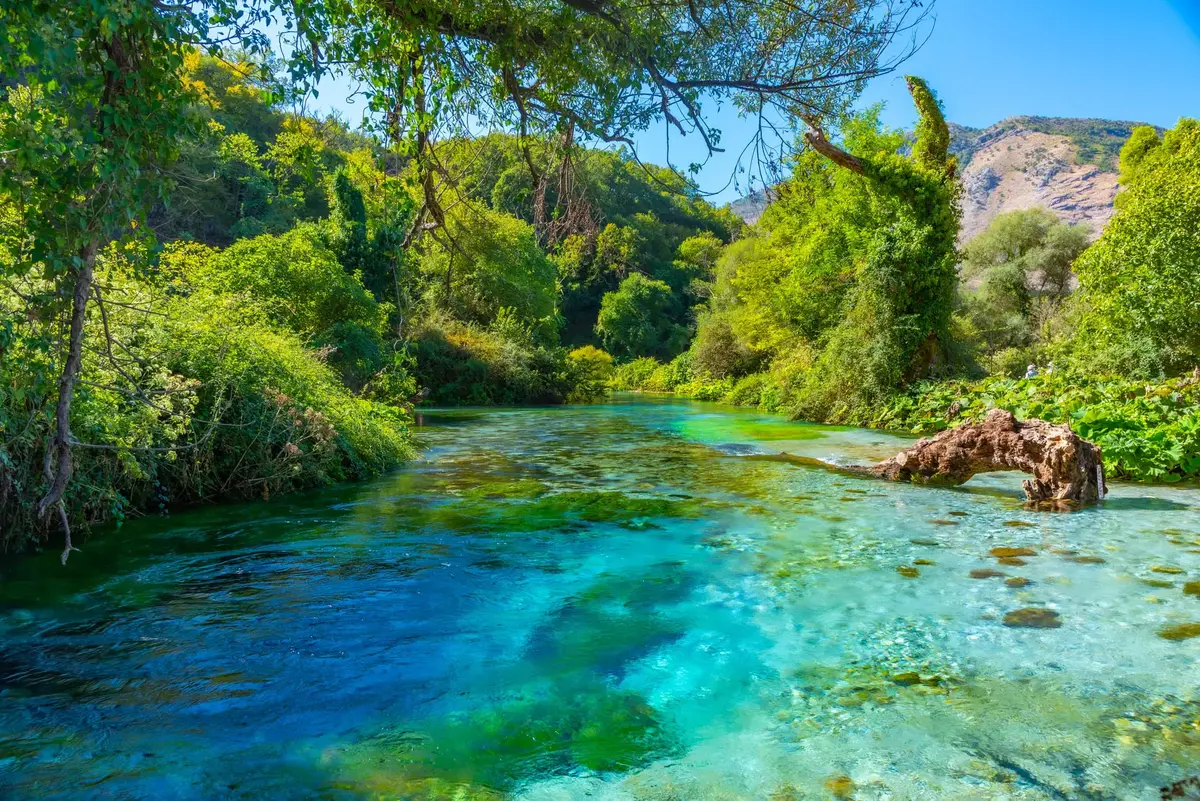
The Blue Eye is a karst spring on the Bistricë River, about 22–24 miles (35–39 km) from Saranda, discharging roughly 18,400 liters per second. The Albanian Council of Ministers reclassified it from Nature Monument to Natural Park, which closed the old dirt drive-up and added a 1.4-mile (2.2 km) walk in from the paid parking lot. A small shuttle train covers that stretch for around 300 lek each way if the hill isn’t appealing. The site runs roughly 7 a.m. to 7 p.m., and swimming at the spring itself is banned and enforced — it’s also a drinking-water source, and the water sits at 10–12°C year-round. Bring small lek bills for parking (100–200 lek for cars, more for campers) and the entry kiosk (50 lek). There is no card payment and no ATM.
Gjirokastër is closer than most older guides claim. The Kardhiq–Delvinë axis, including the Skërfica tunnel, bypasses the old Muzina pass and cut roughly 45 minutes off the run; Saranda to Gjirokastër is now about an hour by car. One catch for bus travelers: many Saranda–Gjirokastër services now use that bypass and skip the Blue Eye turnoff entirely, so ask the driver before boarding. The Cold War Tunnel below the bazaar runs 2,000 feet (610 m) under the old town and was built as a Hoxha-era bunker, and the city has opened a Museum of Iso-Polyphony inside a network of historic bunkers.
Pro Tip: Combine the Blue Eye and Gjirokastër into one inland day from Saranda or Himarë. The Blue Eye works as a morning stop on the way north (cooler, fewer tour groups before 9 a.m.), with lunch and the castle in Gjirokastër in the afternoon. If you’re driving yourself, the SH99 turnoff is easy to miss — mapping apps regularly overshoot it.
Albanian iso-polyphony: the UNESCO heritage soundtrack
Albanian iso-polyphony is on the UNESCO Representative List of the Intangible Cultural Heritage of Humanity. The Lab tradition centers on the Himarë hinterland — Pilur, Dukat and Tërbaç — and the Tosk tradition runs across the rest of southern Albania.
One correction worth making, because plenty of guides get it wrong: Gjirokastër’s National Folklore Festival is not an annual event. It runs at Gjirokastër Castle roughly every five years, and the most recent edition — the 11th — was held over eight days in late June and early July after an eight-year gap. The next is expected toward the end of the decade. Unless your trip happens to land in a festival year, plan around these instead: the Himara International Music Festival, an annual summer program of classical, folk and jazz performances staged at Himara Castle and All Saints’ Church; village taverna nights in Pilur and Dukat in mid-summer; and the Museum of Iso-Polyphony in Gjirokastër for context between live performances.
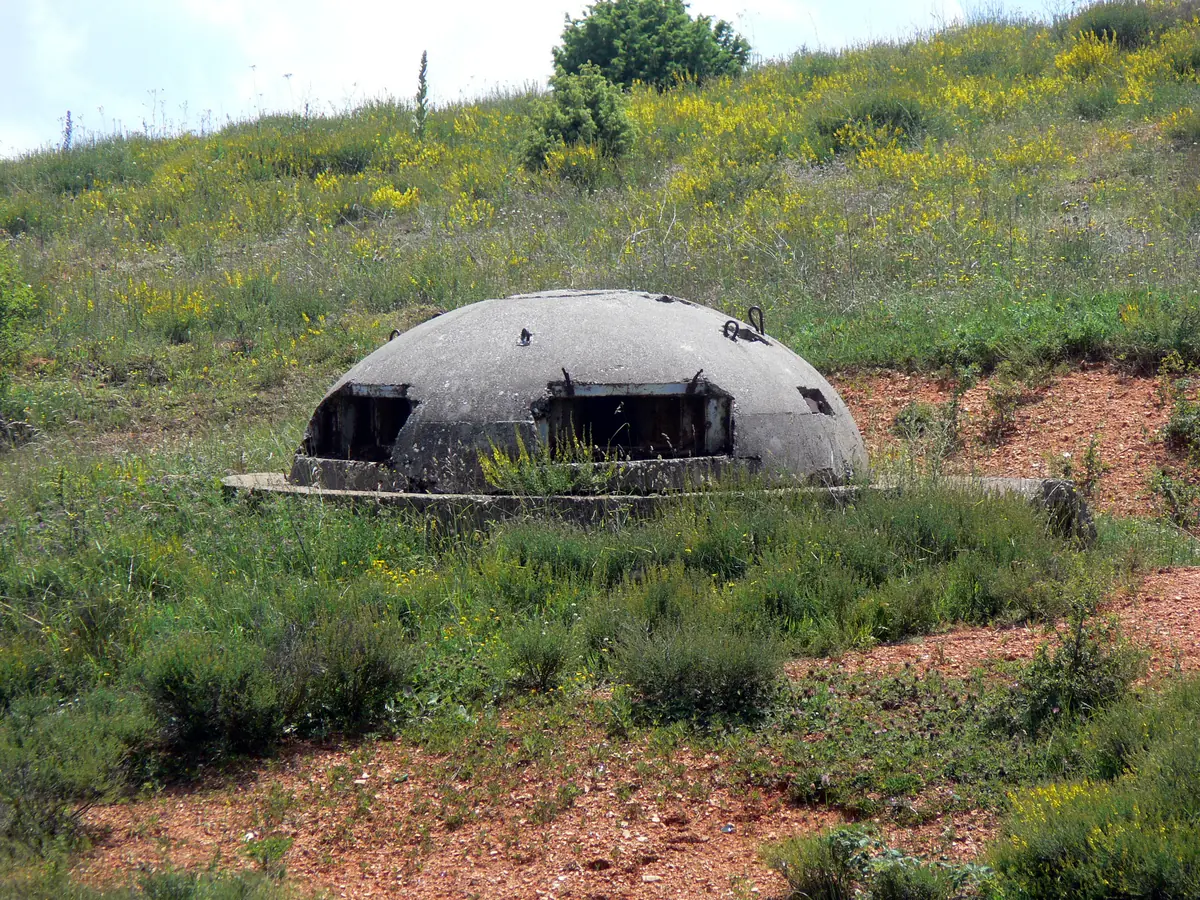
Hoxha-era bunkers on the Riviera
Albania built between 173,000 and 750,000 concrete bunkers under the Hoxha dictatorship — estimates vary because many were never officially counted. On the Riviera you’ll see them everywhere: on the Llogara Pass shoulders, dotted across the Vuno hillside, along Borsh Beach, and as a converted submarine bunker at Porto Palermo. For full context, the Bunk’Art 1 and Bunk’Art 2 museums in Tirana are the best deep dives if your trip routes through the capital.
What’s it like to drive the SH8 and the Llogara Pass?
The SH8 coastal highway from Vlorë to Saranda runs roughly 90 miles (145 km) along the coast, climbs to 3,369 feet (1,027 m) at the Llogara Pass, and drops in tight switchbacks to Dhërmi. The Llogara Tunnel — just under 6 km, with a parallel emergency tube and cross-passages — reduced the Dukat–Palasa segment from about 45 minutes to under 10; Hill International, the official construction supervisor, states the tunnel “reduce[s] the driving time from Vlorë to Sarandë by approximately 40 minutes.” Most US travelers should still drive the old pass at least once for the viewpoint.
The tunnel is no longer free. A toll of 250 lek (roughly $3) applies each way for passenger cars, so budget about 500 lek round trip, in cash. The tunnel runs 24/7 in normal conditions, with occasional overnight maintenance and heavy-vehicle restrictions in peak summer. The old pass road remains free and is the better drive in good weather; the tunnel wins in fog, rain, winter conditions or when you’re simply out of patience. Note that Vlorë–Saranda buses generally still take the pass, not the tunnel.
The road itself is paved but narrow. Guardrails are intermittent. You’ll share the SH8 with goats, cyclists, slow trucks and the occasional tour bus that doesn’t yield on switchbacks. Rental cars at Tirana airport start around $25–$60/day with full insurance. Fuel is government-regulated and expensive by regional standards: 95-octane runs roughly 185–200 lek per liter, about $8–$9 per US gallon equivalent. Fill up in Vlorë or Dhërmi — there are no stations on the pass itself.
Pro Tip: Drive the Llogara Pass northbound (Dhërmi to Vlorë) rather than southbound on your first traverse. You’ll be on the inside lane of every switchback, which is dramatically less stressful than the cliff-edge outside lane heading down.
Should US travelers rent a car or take buses?
Rent a car if any of these apply: (a) your trip is 5+ days on the Riviera, (b) you want to reach Gjipe, Filikuri, Borsh or Krorëza, or (c) you’ll combine the Riviera with Berat or Gjirokastër. Bus the route if your trip is 3 days or fewer and you’re basing in Saranda or Himarë — the SH8 bus network connects every major town.
US drivers used to gentle interstates will find the SH8 demanding for the first hour. By the third day you’ll have figured out the rhythm. The bigger risk isn’t crime or car trouble — Albania’s road fatality rate runs several times the EU average per capita, concentrated in rural areas and among pedestrians. Don’t drive unlit mountain roads at night, and never assume a car will stop at a crosswalk.
Bus and furgon network: Tirana to Saranda
Buses run from Tirana’s South & North Bus Terminal to Saranda’s central stop roughly 11 times daily, starting at 5:30 a.m. and ending at 10:00 p.m. The fare is 1,500 lek (about $18), paid in cash to the driver; seats can also be pre-booked online for a small booking fee, which is worth it on July and August weekends. The inland route via SH4 and the Kardhiq–Delvinë road takes 4h 15m–5h; the scenic SH8 coastal route via Vlorë takes 6 hours or more. Tisa Travel runs the inland route; Olgeno Travel & Tours runs the coastal one.
One logistical trap: the terminal sits about 25 minutes northwest of central Tirana, not downtown, and there’s no clean direct coach from Tirana airport. Budget a municipal bus or a $12–$15 taxi to reach it, and arrive 30–45 minutes early in summer. If you need the same-day Corfu ferry, only the 5:30 a.m. departure leaves a safe buffer.
Furgons (shared minivans) cover smaller villages — useful for hopping between Himarë, Dhërmi and Borsh without a car. Fares are typically 200–500 lek (about $2.50–$6) per leg, cash only.
What does a week on the Albanian Riviera actually cost in USD?
The Albanian Riviera is the cheapest stretch of Mediterranean coast left in Europe — for now — but Ksamil and Dhërmi beach clubs have closed much of the gap with Greek island prices in peak summer, and a strengthening lek has quietly raised dollar costs. Budget about $80–$120/day for a mid-range solo traveler, $150–$220 for a couple, and $300+ for couples basing in Dhërmi or Palasa luxury hotels.
Reference exchange rate for the figures below: approximately 81 ALL = $1 (recent trading band 80–84).
Concrete daily-life prices:
- Espresso: $1–$1.50.
- Beer (Birra Korça, 0.5L draft): $2–$3.50.
- Mid-range dinner for two with wine: $40–$70.
- Sunbed + umbrella (one set): $10–$25 across most of the coast; $12–$40 in Ksamil and Dhërmi at peak; VIP cabanas $50–$120.
- Mid-range hotel double room (June/September): $80–$160.
- Mid-range hotel double room (August): $130–$300.
- Budget guesthouse: $40–$80.
- Tirana–Saranda bus: 1,500 lek, about $18.
- Saranda–Corfu high-speed ferry: about $22–$35 one-way.
- Butrint entry: 1,000 lek / about $12.
- Blue Eye entry: 50 lek / about $0.60 (plus 100–200 lek parking, plus about 300 lek each way for the shuttle train).
- Lekuresi Castle entry: free; restaurant dinner $20–$30/person.
- Rental car (compact, full insurance): $25–$60/day.
- Gasoline: roughly $8–$9 per US gallon equivalent.
- Llogara Tunnel toll: 250 lek each way, about $3.
- ATM withdrawal fee: $5–$9 per transaction.
Sample week (couple, mid-range, June or September, Himarë base):
- 6 nights mid-range hotel at $110/night: $660.
- 7 days food and drink at $90/day: $630.
- Rental car 6 days at $40 + fuel $80 + tolls and parking $15: $335.
- 4 beach days at $25 in sunbeds: $100.
- 2 cultural entries (Butrint + castle): $30.
- Corfu ferry both directions (couple): $90.
- Total: roughly $1,845 for two, before flights.
That same week for a couple on Mykonos or Santorini lands closer to $3,800–$5,000 before flights.
Albanian Riviera vs Greek islands: which makes sense for US travelers?
The Albanian Riviera offers similar Ionian Sea water clarity to Corfu, Lefkada and the Greek mainland coast at roughly 30–50% lower total trip cost, with fewer crowds and noticeably less polished infrastructure. Greece wins on ferry connectivity, sand-beach variety, restaurant polish and international flight options. Albania wins on price, novelty and the feel of a coastline that hasn’t been fully formatted by mass tourism yet — though the gap narrows every summer on the Riviera’s most developed stretches.
Where the math really shows up:
- Espresso: $1.20 in Himarë vs $4 on Santorini.
- Sunbed set: $12–$30 most of the Albanian Riviera vs $50–$130 at Mykonos beach clubs.
- Mid-range dinner for two with wine: $50 in Himarë vs $90 on Corfu vs $140 on Santorini.
- Mid-range double in shoulder season: $110 in Himarë vs $200 on Corfu vs $400+ on Santorini.
- Flight options from US East Coast: 1-stop to Albania via Istanbul or Frankfurt; nonstop to Athens (United, Delta, American seasonal), then onward island ferry.
- Beach access rules: Greece now reserves 70% of designated “untrodden” beaches from sunbeds (85% in Natura 2000 zones); Albania requires 30% of every kilometer of coast to stay free. Both are enforced unevenly.
The honest pick: if it’s your first European beach trip, Greece is more polished and easier. If you’ve done Greece and Croatia and want the same water for a lot less money — and you’re willing to drive on harder roads — the Albanian Riviera wins. The 22-mile (35 km) ferry between Corfu and Saranda also lets you combine both on one trip.
Is the Albanian Riviera safe for solo women, LGBTQ+ and family travelers?
The US Department of State rates Albania at Travel Advisory Level 2 (“Exercise Increased Caution… due to crime”) — the same level applied to France, Germany, Italy, Spain and the UK. Violent crime against tourists is rare. Eurostat recorded 41 intentional homicides in Albania in its most recent reported year, which works out to about 1.7 per 100,000 against the new census population of 2.39 million — well below the US rate of roughly 5.8 per 100,000, though higher than the UK. Crime against visitors is overwhelmingly non-violent: pickpocketing in crowded spots, unlicensed taxi overcharging, occasional vehicle break-ins.
The US Embassy in Tirana periodically issues security alerts unrelated to street crime — for example, warnings about groups that may target US-associated venues. These are precautionary rather than incident-driven, but they’re a good reason to enroll in the State Department’s STEP program before you fly, so alerts reach your inbox while you’re on the coast.
In practice, by audience:
- Solo women: comfortable across most of the Riviera. The exception is persistent staring and verbal hassling on the central Saranda promenade after 11 p.m. and around the Ksamil bus station. Himarë, Dhërmi and Borsh are calmer.
- LGBTQ+ travelers: Tirana is visibly progressive — Pride happens, gay-friendly venues exist. The Riviera is tolerant but discreet; public same-sex affection is uncommon outside Tirana, and rural villages remain conservative. Booking double rooms as a couple isn’t a problem.
- Families with young kids: Ksamil is the most kid-friendly beach (sand, shallow water, and fewer boats in the swimming coves since the maritime corridors were cut); Himarë, Borsh and Dhërmi all work. Strollers are useless on the pebble stretches and pebbled village lanes — use a hiking carrier instead.
- Older travelers: Saranda is the best base — flat promenade, elevators in mid-range hotels, English widely spoken, the densest pharmacy and medical-clinic network on the coast.
US health considerations:
- Tap water: not recommended for drinking; bottled water costs $0.30–$0.60 per liter.
- Travel medical insurance: carry comprehensive coverage with medical evacuation. Small clinics in Saranda and Vlorë handle routine cases; serious injuries get routed to Tirana or by ferry to Corfu.
- Pharmacies: well-stocked in Saranda and Vlorë; thinner in Dhërmi and Borsh.
- Sun: the UV index hits 9–10 in July; an SPF 50 from a US pharmacy is worth packing.
Pro Tip: The Saranda promenade between the harbor and the Lekuresi turn-off is genuinely fine for a solo woman to walk after dinner. The friction zone is the southern strip near the late-night clubs — switch to a rideshare for that stretch.
Sample US-friendly Albanian Riviera itineraries
Three templates calibrated to typical US vacation lengths. Each accounts for the Llogara Tunnel and Kardhiq–Delvinë time savings.
5 days (long weekend, Corfu-in/out)
- Day 1: Fly into Corfu (CFU); afternoon ferry to Saranda (remember the one-hour time change); sunset dinner on the promenade.
- Day 2: Morning Butrint at opening; afternoon Ksamil beach (first beach, sunbed at one of the quieter clubs).
- Day 3: Drive or transfer to Himarë (about 1 hour); afternoon Livadhi Beach; dinner at Taverna Lefteri.
- Day 4: Boat or hike to Filikuri; afternoon Porto Palermo Castle; back to Himarë for dinner.
- Day 5: Morning drive back to Saranda; mid-morning ferry to Corfu; afternoon CFU flight.
8 days (a real week, Tirana-in / Corfu-out)
- Day 1: Fly to Tirana (TIA); transfer to Berat (2 hours).
- Day 2: Morning in Berat’s Mangalem quarter; afternoon drive to Vlorë (2.5 hours).
- Day 3: Vlorë morning; drive the Llogara Pass to Dhërmi (about 90 minutes via the old pass road, under 40 via the tunnel); afternoon Drymades.
- Day 4: Gjipe hike or boat from Dhërmi; evening Havana Beach Club.
- Day 5: Drive to Himarë (35 minutes); afternoon Livadhi.
- Day 6: Filikuri and Porto Palermo from Himarë.
- Day 7: Drive to Saranda (1 hour); afternoon Butrint or Lekuresi sunset.
- Day 8: Morning Ksamil; mid-day ferry to Corfu; CFU flight out.
14 days (full vacation, both UNESCO loops)
- Days 1–2: Tirana arrival; day trip to the Bunk’Art museums and Kruja Castle.
- Days 3–4: Berat (UNESCO); drive to Gjirokastër (UNESCO).
- Day 5: Drive to Saranda via the Blue Eye (about 2 hours with the stop); Butrint in the late afternoon.
- Days 6–7: Ksamil and a Saranda beach day from a Saranda base.
- Days 8–10: Move to Himarë; Livadhi, Filikuri, Porto Palermo.
- Days 11–12: Move to Dhërmi/Drymades; Gjipe; Llogara Pass.
- Day 13: Drive back to Tirana via Vlorë.
- Day 14: Tirana day; TIA flight out.
A 7- to 8-day trip is the highest-ROI option for a US visitor’s flight cost. Anything under 5 days means most of your money goes to airfare for two beach mornings.
What should you actually order at a Riviera taverna?
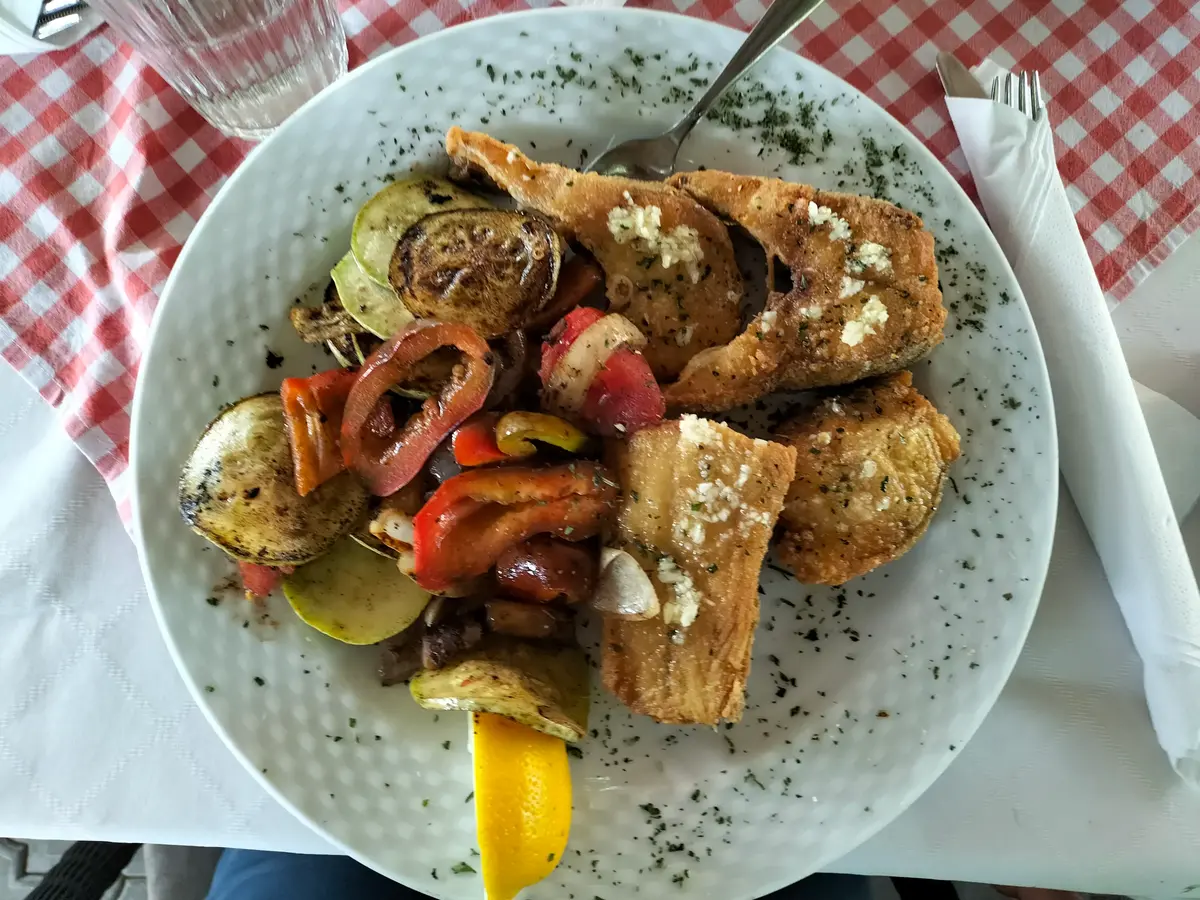
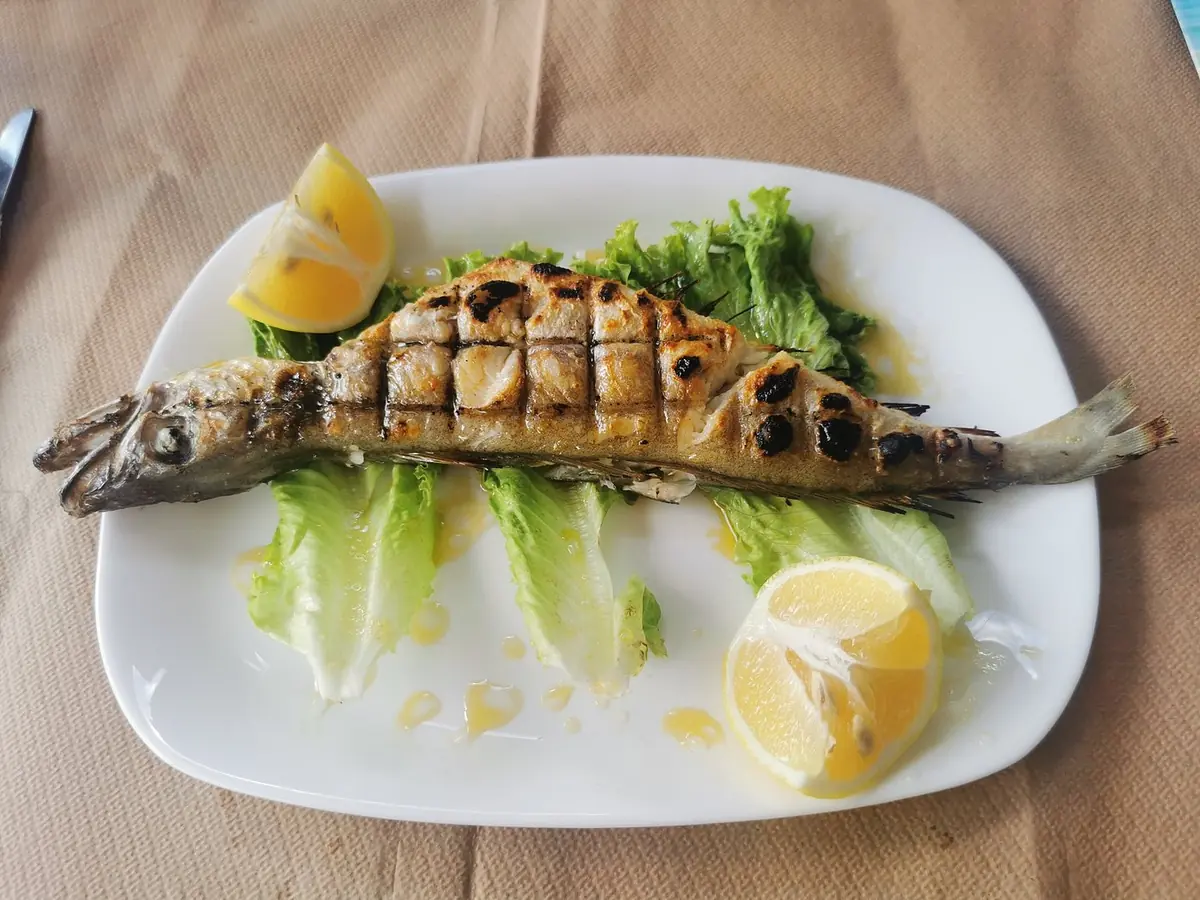
The Riviera’s food is a Greek-Italian-Albanian hybrid built around grilled seafood, olive oil, peppers, yogurt and pastry. Order grilled lavraki (sea bass) or orata (sea bream) — both come whole and are priced by the kilo. Add qofte (grilled lamb-and-beef meatballs), fërgesë (a skillet of peppers, tomatoes and cottage cheese), tavë kosi (lamb baked in yogurt), and byrek (flaky cheese or spinach pastry). Finish with a homemade raki.
Essential rules for ordering fish on the coast:
- Always confirm price-per-kilo on fish before the kitchen weighs it.
- A 600–800 gram whole fish (1.3–1.8 lb) feeds two people.
- Wild-caught lavraki runs 3,500–5,000 lek/kg (about $43–$62/kg); farmed runs 1,500–2,500 lek/kg (about $19–$31/kg). Most coastal restaurants serve both; ask which.
Named places worth the table:
- Plazhi i Saturnit (Himarë): old-school taverna, the grilled fish is the reference standard.
- Taverna Lefteri (Himarë): family-run, tavë kosi is the order.
- Lula (Dhërmi village): the best mid-range dining in upper Dhërmi.
- Brothers Fish Tavern (Ksamil): the most reliable seafood in Ksamil, away from the beachfront markup.
- Taverna Labëria (Saranda): traditional Albanian, qofte and fërgesë.
- Mango Beach Club (Saranda): drinks and sunset, not the food.
Drinks to know:
- Birra Korça and Birra Tirana: the two dominant local lagers, $2–$3.50 a draft.
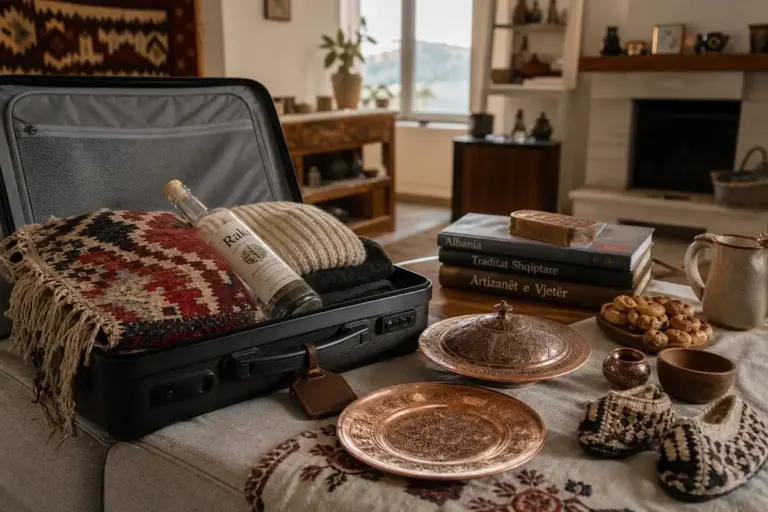
- Raki: homemade grape (rrushi) or mulberry (mani) brandy; offered free at the end of most meals.
- Çai mali (mountain tea): the post-dinner non-alcoholic standard, infused from sideritis from Mount Tomorr.
- Albanian wine: the Shesh i Zi and Kallmet grapes are the ones worth trying; bottle prices $12–$25 at restaurants.
5 mistakes US travelers make on the Albanian Riviera
The five repeat-offender mistakes:
- Booking only Ksamil. The town has the worst crowds and the highest sunbed prices on the Riviera. Base in Himarë and day-trip Ksamil instead.
- Visiting in August. Italian Ferragosto + the Albanian diaspora + heat = the most expensive, most crowded window of the year. June or September deliver the same water at roughly 60% of the cost.
- Planning around Vlora airport. It has an IATA code, a finished terminal and no operating certificate. Fly into Tirana or Corfu and treat any VLO promise as speculative.
- Expecting card payments everywhere. Hotels are now required to run card terminals, but taverna kitchens, beach sunbed operators, the Blue Eye kiosk, the Llogara toll booth and most furgon drivers are cash-only. Carry lek in small notes.
- Underestimating Tirana–Saranda drive times. Mapping apps will show 4 hours; budget 5 if you’re going inland, 6+ if you’re taking the SH8 with stops.
The bonus mistake: getting talked into a private taxi at Saranda’s bus station after a driver tells you the Ksamil bus is “cancelled” or “full.” It isn’t — buses and minibuses run frequently in summer, the fare is 100–200 lek (about $1.20–$2.50), and the stop is a short walk uphill from the main station.
For most US visitors, the smartest Albanian Riviera trip is 7–8 days in shoulder season (mid-June or mid-September), based primarily in Himarë with a Saranda finish for the Corfu ferry out. Rent a car at Tirana airport, carry lek in cash, skip August entirely, and treat Ksamil as a day trip rather than a base.
The Albanian Riviera will not stay this cheap. The Llogara Tunnel has already pulled Palasa and Dhërmi inside two hours of Tirana, the Kardhiq–Delvinë road put Gjirokastër an hour from the coast, the Green Coast development is reshaping the northern shoreline with an international five-star brand, and Vlora International Airport will eventually clear certification and land its first meaningful connections. The trip you take in the next two or three summers will not be the same trip in five years.
What’s your single biggest question about planning a trip — the route, the base town, the budget, or whether to skip Ksamil? Drop it in the comments and I’ll answer with specifics.