Planning a road trip through the Balkans is a brilliant move, but renting a car in Albania comes with a specific set of raw realities. You will face unique bureaucratic requirements and financial traps that most sanitized travel guides completely miss. Here is exactly what you need to know before you grip that steering wheel.
What is driving in Albania actually like?
Driving in Albania is a split experience between fast, modern coastal corridors and narrow mountain tarmac. The main route running from Tirana south through Durrës, Vlorë, and toward the Riviera is well-paved and entirely manageable for an American driver. The road network has improved dramatically over the past few years, including a tunnel under the Llogara Pass and a fully asphalted mountain road to Theth. The moment you turn onto village tracks or remote interior roads, however, the hazard profile shifts.
The local driving culture is highly assertive. Albanian drivers rely on horn honks and headlight flashes as a constant, non-verbal communication system. Once you learn to read this language, it becomes a genuine advantage rather than a source of panic.
Pro Tip: Flashing high beams from an oncoming driver almost always means a police speed trap or checkpoint is ahead. Flash back once to say thank you.
Documents every US citizen needs to drive in Albania
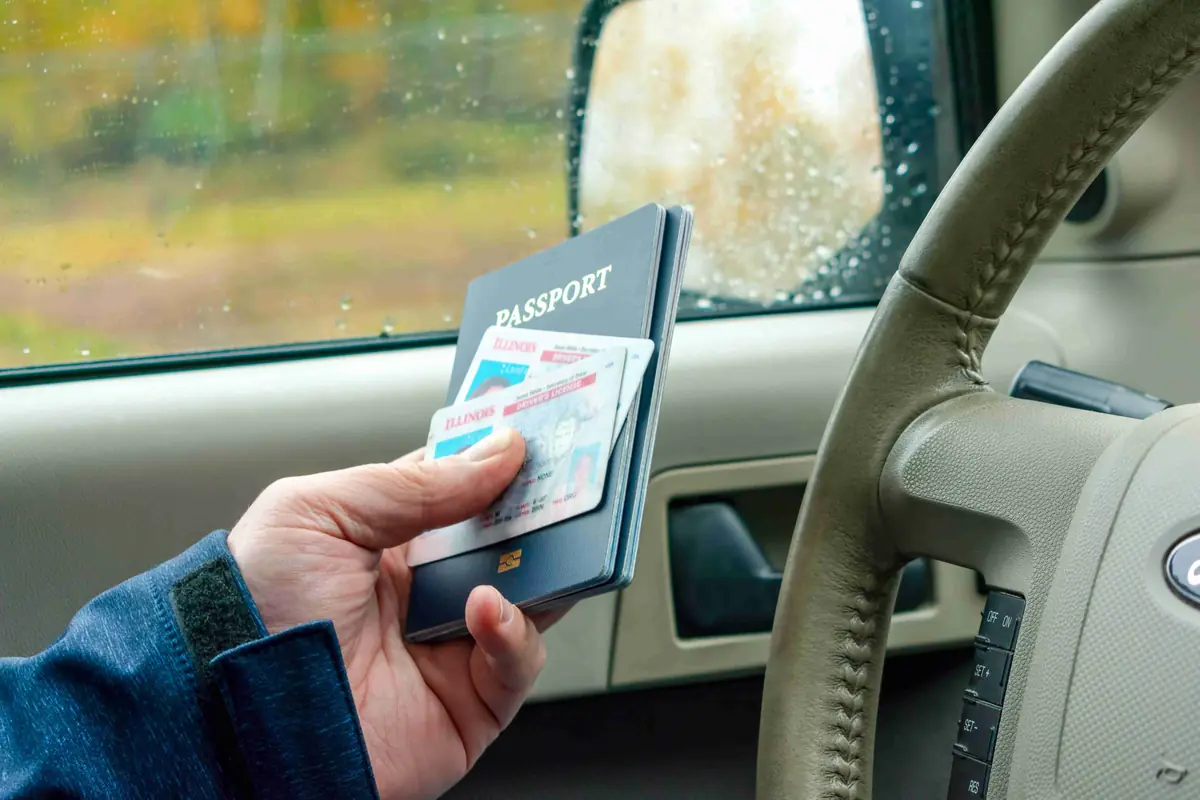
US citizens need two exact documents to legally operate a vehicle when renting a car in Albania: a valid American driver’s license and an International Driving Permit (IDP). While some rental agents at major chains might hand you the keys without the permit, local traffic police absolutely will not.
Driving without an IDP risks an on-the-spot fine, and worse, your rental contract may be instantly voided if you are involved in a crash. Treat this piece of paper as strictly non-negotiable. The permit is only valid alongside your physical US license, so carry both, plus your passport and the rental agreement.
How to get your IDP before you fly
Two organizations are authorized by the US Department of State to issue International Driving Permits: the American Automobile Association (AAA) and the American Automobile Touring Alliance (AATA). Every other website selling “international licenses” is either a translation service or an outright scam. AAA remains the fastest route for most travelers, with three ways to apply: walk into a participating AAA branch for same-day processing, apply online, or mail your documents in.
What you need:
- Valid US driver’s license (photocopy both sides if applying by mail)
- Two passport-compliant photographs, signed on the back
- Completed AAA application form
- $20 permit fee in person; online applications run about $30 including the digital photo, plus shipping
Pro Tip: The IDP cannot take effect more than six months after your application date, and it expires one year from issue. Apply close to your departure, and call your branch first, since not every location processes permits on every day.
Age requirements and the young driver surcharge
The legal minimum driving age in the country is 18, but the commercial reality at the rental desk is much different. Most agencies require a minimum age of 21 for standard fleet vehicles, plus a license held for at least one year. A daily young driver surcharge of roughly $4–$12 typically applies to anyone under 25.
A handful of small local operators, usually reachable through Balkan-focused aggregators, will rent economy manuals to drivers aged 18 or 19. Expect a higher deposit, mandatory full coverage, and no automatic transmission. If you are targeting the Albanian Alps, agencies often set the minimum age for SUVs and 4x4s at 23 or 25, with a two-year license requirement.
At the other end, many operators impose a maximum rental age of 70 or 75. Senior drivers above that threshold might have to present a medical certificate before driving off the lot. Always verify these limits with your chosen agency before locking in your booking.
Mastering the rental contract and deposit
Always use a credit card for your security deposit when renting a car in Albania, never a debit card. Agencies typically place a hold of $275–$1,700 depending on the vehicle class and the coverage you select. If you use a debit card, that money is usually taken as an actual payment rather than a hold, and refunds can take up to 30 days to land back in your checking account.
Comparing providers comes down to large international chains such as Hertz, Avis, Sixt, and Europcar versus local operators booked directly or through Balkan aggregators. Local agencies routinely undercut the international desks by 30 to 50 percent, and several now offer genuinely low or zero-deposit options, but fleet condition and customer service consistency vary wildly. Expect roughly $15–$30 per day for an economy car in low season and $45–$65 per day at the height of summer, with SUVs climbing well past $100 in July and August.
Always book with a written confirmation, read every line of the fine print, and check the mileage clause. Some “unlimited mileage” contracts quietly cap you at 2,000 km or exclude cross-border travel entirely, and overage fees of $0.25–$0.45 per kilometer add up fast on a country this long.
Decoding insurance: CDW, SCDW, and what is actually excluded
This is exactly where most travelers bleed money. The standard Collision Damage Waiver (CDW) is included in the base rate, but it leaves you with a substantial deductible, usually $550–$1,700. It covers body damage and completely ignores your tires and undercarriage.
| Insurance Tier | Daily Cost | Your Deductible | Covers Body Damage | Covers Tires & Undercarriage |
| Standard CDW | Included | $550–$1,700 | Yes | No |
| Super CDW (SCDW) | +$12–$23/day | $0 on body damage | Yes | Rarely |
| Third-party excess policy | From about $90/year | Reimbursed after you pay | Yes | Usually, check the wording |
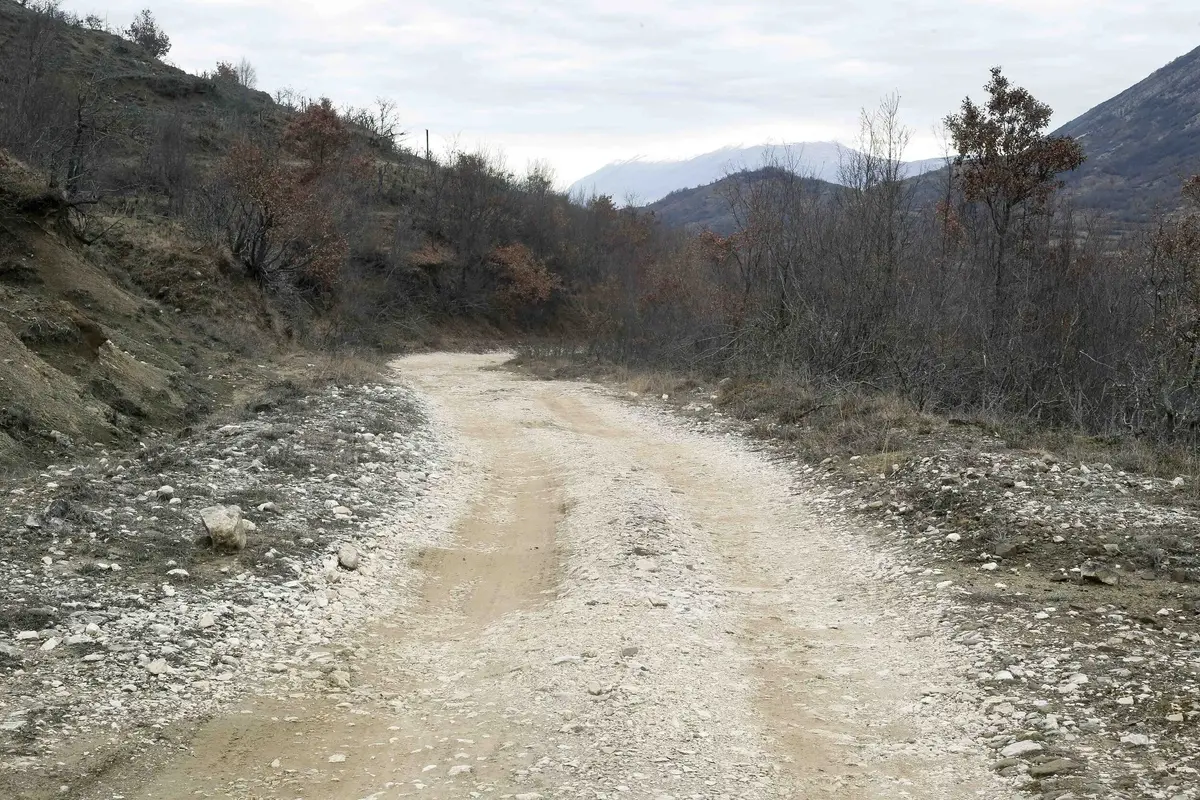
The critical exclusion buried in the footnotes is that standard CDW almost never covers tire blowouts, undercarriage scrapes, cracked rims, roof damage, or shattered glass. Anything the contract labels “off-road use” is also excluded, which can include unpaved village tracks. Given the potholes on rural Albanian roads, this is not a hypothetical risk. It is a near-certainty on any mountain route.
Upgrading to SCDW eliminates your deductible on body damage. To protect your tires, glass, and undercarriage, you must ask for a specific addendum at the desk and get the inclusion confirmed in writing. Note that most agencies also add a fixed damage administration fee of around $45 on top of any claim, regardless of coverage tier.
Pro Tip: Check your US credit card’s rental car benefits before paying for agency coverage, and call the benefits line to confirm Albania is not on the excluded-country list. Premium travel cards often provide primary or secondary coverage that offsets your liability, but almost all of them exclude tires and undercarriage too.
The scratch scam: how to defeat it
Fraudulent damage claims remain a documented nightmare at a minority of local agencies. The playbook is simple: a tourist is charged several hundred dollars for pre-existing bumper scratches on a standard fleet vehicle. Agents will cite damage that you absolutely did not cause, then deduct it from a deposit you have already handed over.
The non-negotiable pickup protocol:
- Record a continuous 360-degree video walk-around of the entire vehicle in good lighting before taking the keys.
- Point the camera directly at the undercarriage, windshield, all four wheels and rims, the roof, and every existing dent or paint chip.
- Ensure the rental agent is visible in the video frame so the footage is timestamped and witnessed.
- Photograph the exact fuel gauge level and odometer reading on the instrument panel before leaving the lot.
- Force the agent to mark every pre-existing scratch on the damage diagram and sign it, then photograph the signed form.
The return protocol most guides forget: film the same walk-around at drop-off, get a signed check-in sheet confirming no new damage, and never leave the car in an unattended lot without documentation. If a charge appears on your statement weeks later, your video and the signed form are what win a credit card dispute.
Pro Tip: Upload both videos to cloud storage immediately. Footage stuck on a lost or broken phone will not save you from a scam.
Surviving Albanian road rules
Speed limits are enforced with fixed cameras and mobile radar units, and traffic police pay particular attention to foreign plates and rental cars. Enforcement tolerance is roughly 10 km/h, and posted signs always legally supersede the default limits below.
| Road Type | Default Limit (Cars) | US Equivalent |
| Built-up areas | 40 km/h | 25 mph |
| Rural and main roads | 80 km/h | 50 mph |
| Expressways | 90 km/h | 56 mph |
| Motorways | 110 km/h | 68 mph |
On-the-spot fines are commonly capped around 5,000 Albanian Lek for routine offenses, with heavier penalties for serious speeding and red-light violations. Fines issued at night carry a surcharge, while prompt payment often qualifies for a discount. Ask for the official ticket and pay through proper channels only.
Seat belts are mandatory for every occupant, front and back. Headlights are legally required at night and in poor visibility, and most agencies and local drivers keep dipped beams on around the clock, which is the safer default on mountain roads. Handheld mobile phone use while driving is strictly prohibited. All three are prime targets during routine traffic stops involving foreign-plated vehicles.
The blood alcohol concentration limit is 0.01%, which is functionally zero tolerance. A single glass of wine at a coastal lunch will push you over the line. Penalties include on-the-spot fines, license confiscation, vehicle impoundment, and potential jail time.
The chaos of Tirana roundabouts
You must yield to traffic already in the roundabout, even when the law technically favors your entry. The Albanian traffic code might dictate that entering vehicles from the right have priority in certain junctions. However, the raw reality in Tirana is that circulating vehicles and larger cars assert dominance regardless of the rules.
The rolling, layered cacophony of horns inside a Tirana roundabout is not road rage. It is a continuous acoustic signal system where every honk is a position broadcast. Do not take it personally.
Approach every roundabout at a reduced speed, prepare to yield unconditionally, and accept that giving way is tactically smart. Low-speed urban collisions happen far more frequently than major highway crashes.
Livestock, potholes, and why you must not drive at night outside cities
Do not drive on rural roads after dark. Treat this as a firm survival rule, not a casual suggestion. The US Embassy in Albania flags night driving outside main urban areas as particularly dangerous.
Outside major urban centers, roads suffer from a total absence of lighting and sudden unmarked pavement drop-offs. You face the persistent hazard of unlit agricultural vehicles, horse-drawn carts, and pedestrians walking on the asphalt in dark clothing. There is zero warning system for any of these obstacles.
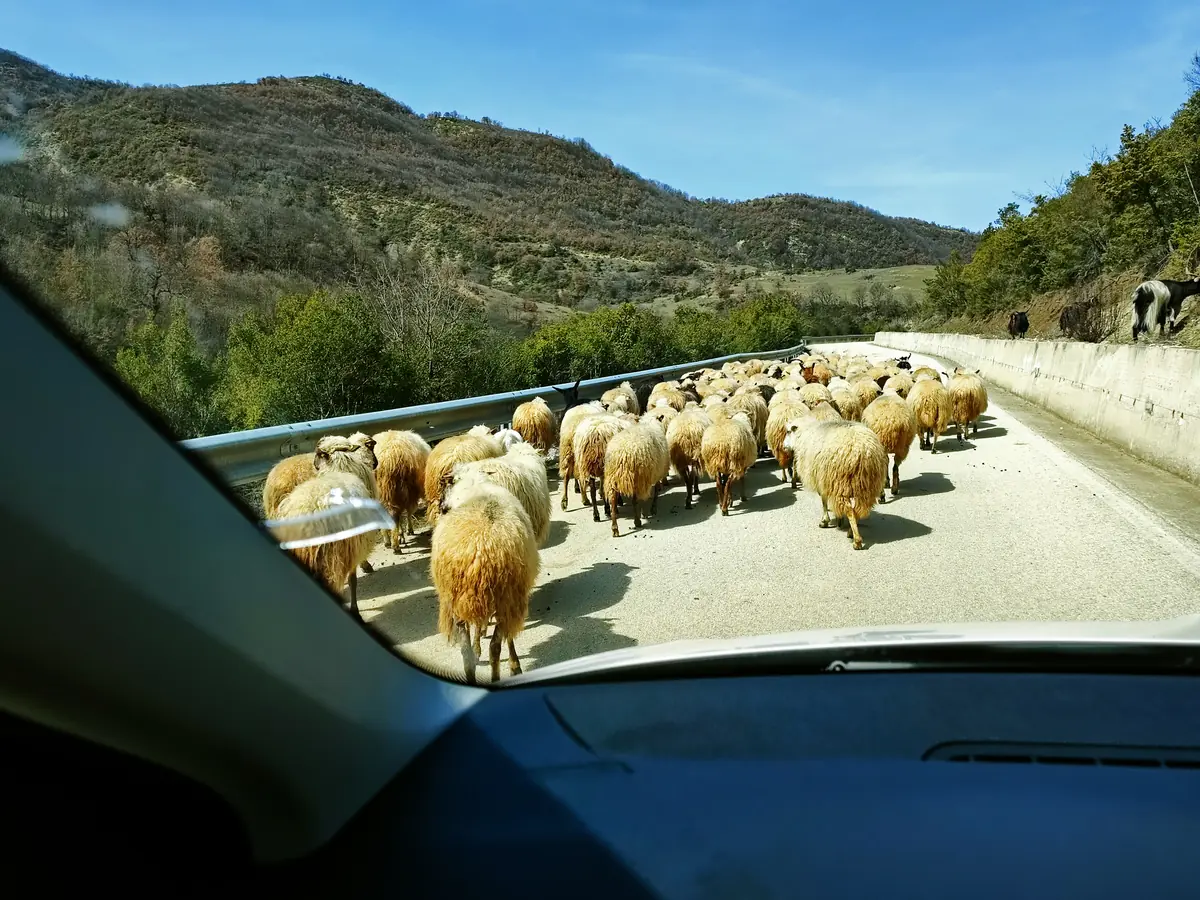
During daylight hours on mountain passes, expect free-ranging sheep, cows, and goats to block blind curves. Keep your speed low enough to guarantee full brake engagement at a second’s notice. The SH21 road to Theth is now fully asphalted across its 76 km, but it remains a narrow mountain route with a long hairpin descent from the Qafa e Thorës pass, and the mountain roads can be blocked by snow and require chains outside the summer season.
Handling police checkpoints
Foreign drivers are frequently pulled over for routine compliance checks. Stay perfectly calm and immediately hand over three items: your passport, International Driving Permit alongside your US license, and the physical rental agreement.
Officers usually speak limited English, so having your documents organized communicates competence. This preparedness almost always results in a swift, penalty-free resolution. Never argue and never offer cash, as both actions will heavily escalate the situation.
Gas stations, tolls, cash, and the Lavazh rule
Large branded stations from chains such as Kastrati, Shell, Bolv Oil, and Kurum reliably accept international credit cards and are your safest bet for fuel quality. Once you leave the coastal corridor and head inland, the payment infrastructure shifts to cash-only, and stations can sit more than 60 miles apart. Always carry Albanian Lek when navigating the interior, and fill up before any mountain leg. Fuel runs roughly $2 per liter, which works out to around $8 per US gallon.
Albania’s toll network is small but no longer limited to a single booth, so budget for these three:
| Toll Point | Where It Is | Car Rate | Payment |
| A1 near the Kalimash tunnel | Rruga e Kombit, on the route toward the Kosovo border | About $6 | Cash preferred, card lanes at newer plazas |
| Llogara Tunnel | Dukat end, on the SH8 toward the Riviera | 250 lek one way, 500 lek round trip | Cash in lek is safest |
| A1 Thumanë–Kashar | Near Tirana International Airport | About 250 lek each way | Cash or card |
One common misconception is worth clearing up: the Kalimash toll only applies if you are heading northeast toward Kosovo. Driving from Tirana to Shkodër, Theth, or the southern Riviera does not take you through it. The Llogara Tunnel is likewise optional, since the old Llogara Pass climbs over the mountain right beside it and remains completely free.
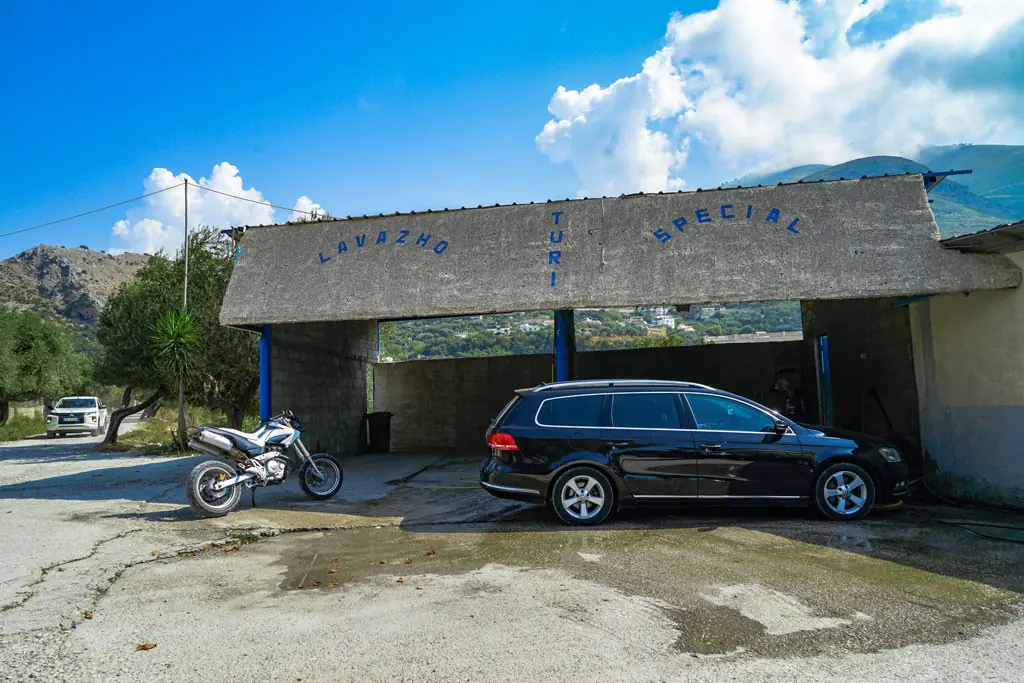
Before returning your car, you must stop at a Lavazh. These ubiquitous roadside manual car-wash stations consist of a shack, a high-pressure wand, and one attendant who charges roughly $6–$12 to blast mountain dust off your vehicle. Many local agencies include a contract clause requiring a clean return. Skipping the Lavazh results in a cleaning surcharge of around $12–$25 automatically deducted from your deposit.
Pro Tip: Find a Lavazh within a few miles of the airport drop-off zone. This ensures the vehicle stays presentable for the final handover inspection.
Cross-border driving: what you actually need at the border
Taking your vehicle across an international border when renting a car in Albania requires prior written authorization from your agency, arranged at booking rather than at pickup. Attempting to cross without it will void your insurance and can get you turned back at the checkpoint.
You also need the “Kartoni i Sigurimit”, internationally known as the Green Card or IMIC insurance certificate. This proves your third-party liability coverage is valid in the destination country, and it covers damage you cause to others only. It is not collision cover for your own rental. Montenegro now accepts the Green Card in digital PDF form, though carrying a physical paper copy remains the safest strategy at smaller crossings.
Budget realistically. Most agencies charge a cross-border authorization fee of roughly $45–$70, plus $35–$60 for the Green Card, which lands the typical total between $80 and $130. Some operators bundle the two into a single fee, and some refuse certain destinations outright, so confirm your exact route in writing.
| Destination | Main Crossing | Green Card Required | Typical Total Add-On |
| Montenegro | Hani i Hotit / Muriqan | Yes | $80–$130 |
| Kosovo | Morinë (via Kukës) | Usually not for Albanian-plated rentals | $45–$70 (authorization only) |
| North Macedonia | Qafë Thanë | Yes | $80–$140 |
| Greece | Kakavijë or Kapshticë | Yes | $90–$160, and many agencies refuse entirely |
Pro Tip: Kosovo sits outside the Green Card system for political reasons, which is why the paperwork differs there. Vehicles that are not Albanian-registered generally have to buy short-term border insurance on arrival, so confirm your car’s plates and your agency’s policy before you commit to that route.
Choosing the right vehicle for your route
Choosing the right vehicle when renting a car in Albania depends heavily on your specific itinerary. A compact economy car is the perfect choice for the Albanian Riviera and coastal routes. Historic village alleys are incredibly tight, and beach parking is practically nonexistent.
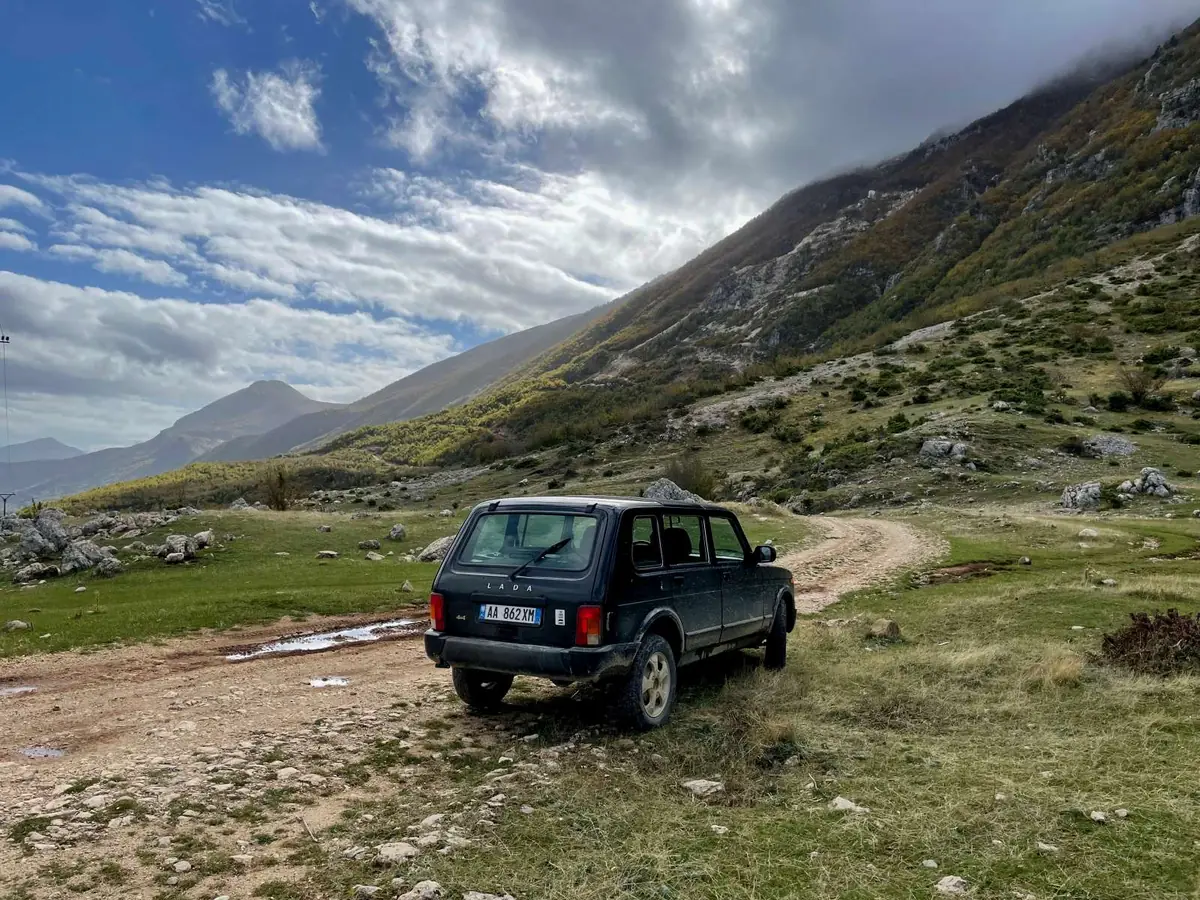
A large SUV quickly becomes a liability in the narrow streets of Sarandë or Ksamil. For the Albanian Alps, the calculus has changed: the paved SH21 means a standard car can now reach Theth village in summer without drama. What still demands genuine ground clearance are the unpaved tracks inside the village, the rough road toward Nderlysa and the Blue Eye of Theth, and any shoulder-season or winter driving. A crossover or compact SUV such as a Dacia Duster is the practical middle ground.
Wrecking the undercarriage of a rental car in a location with zero mobile signal is an exceptionally expensive and isolating disaster, and it is exactly the damage your CDW does not cover.
The best stops only reachable by car
1. The Llogara Pass
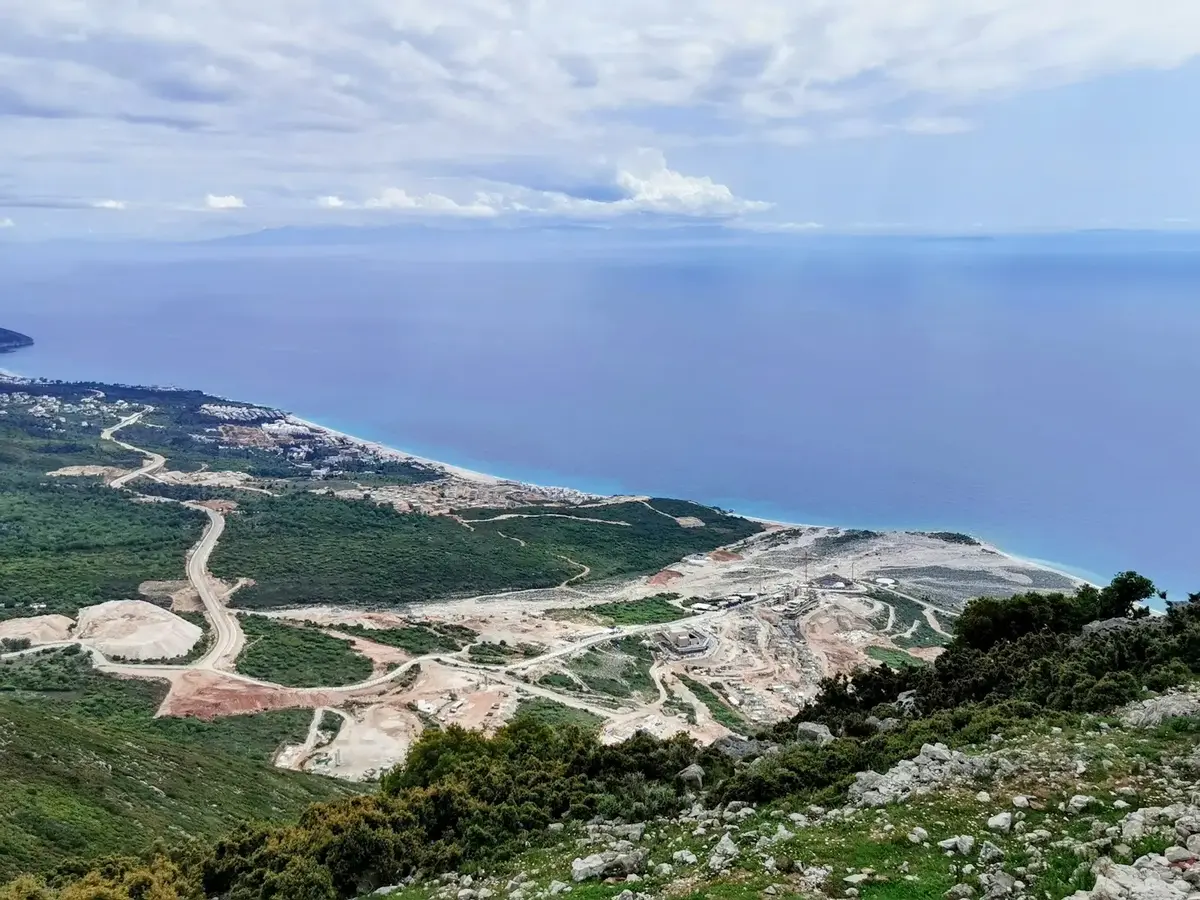
At roughly 3,370 feet (1,027 m) above sea level, the summit of the Llogara Pass offers a sharp temperature drop where pine air mixes with the salty Ionian coast below. Since the Llogara Tunnel opened underneath it, through-traffic has thinned out considerably, which makes the old pass road quieter and better than ever for a slow drive. The descent toward the Riviera is one of the best drives in the region.
- Location: SH8 highway, between Vlorë and Palasë
- Cost: Free to drive; the tunnel alternative costs 250 lek
- Best for: Couples, solo drivers, photography
2. Uka Farm
This working organic farm and winery sits on the flats just outside Tirana and serves farm-to-table meals alongside its own Kallmet and Shesh wines. It is only realistically reachable by driving and stands as one of the most rewarding lunch detours in the country. Reserve ahead in summer.
- Location: Laknas, on the Tirana–Durrës side of the city near the airport road
- Cost: $18–$35/person
- Best for: Food lovers, wine drinkers, couples
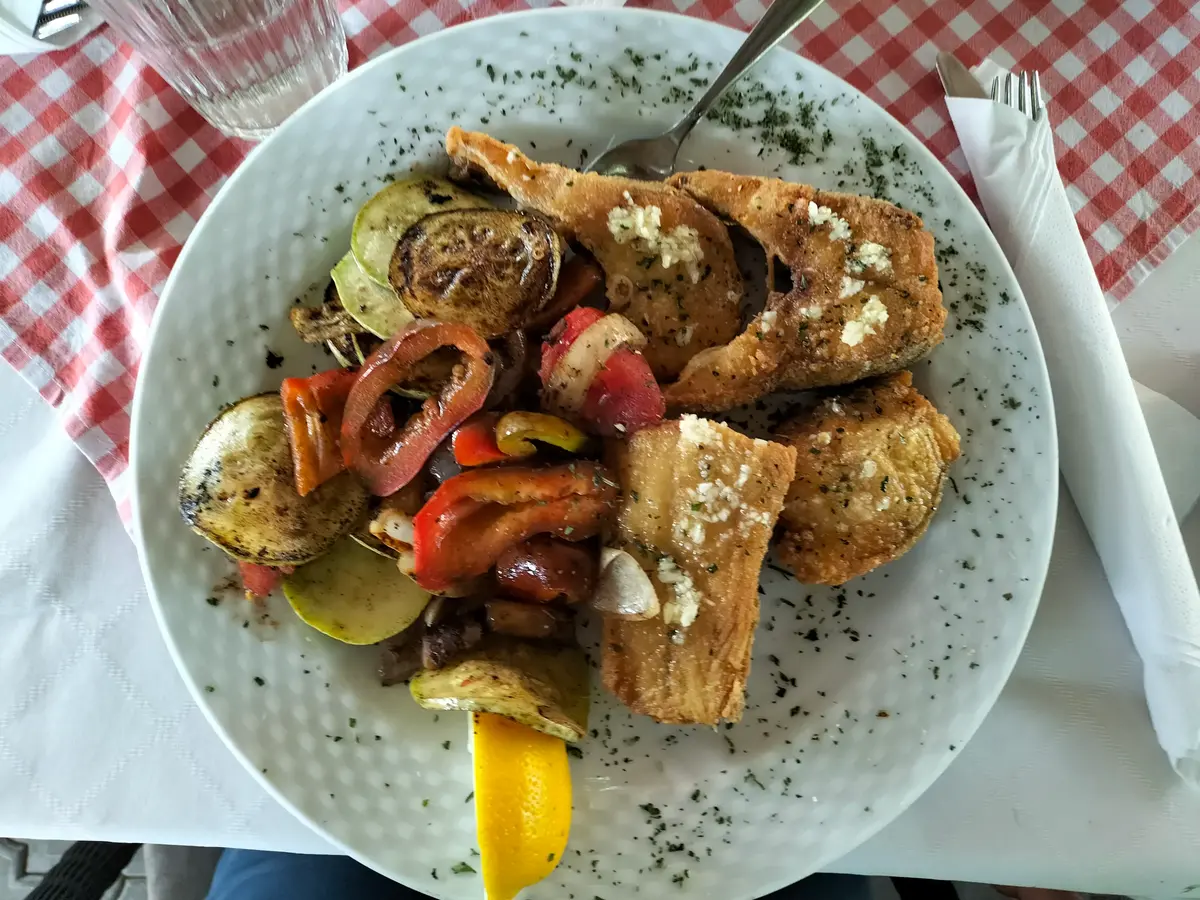
3. Guvat Restaurant, Ksamil
Enjoy fresh seafood while looking out over the water toward the Ksamil islands. Ksamil’s coast is best accessed by arriving early in the morning before the beach roads choke with traffic, or booking a table for sunset, when the place fills quickly.
- Location: Three Islands Street, Ksamil, Albanian Riviera
- Cost: $12–$25/person
- Best for: Seafood lovers, couples, sunset views
4. Blue Eye spring (Syri i Kaltër)
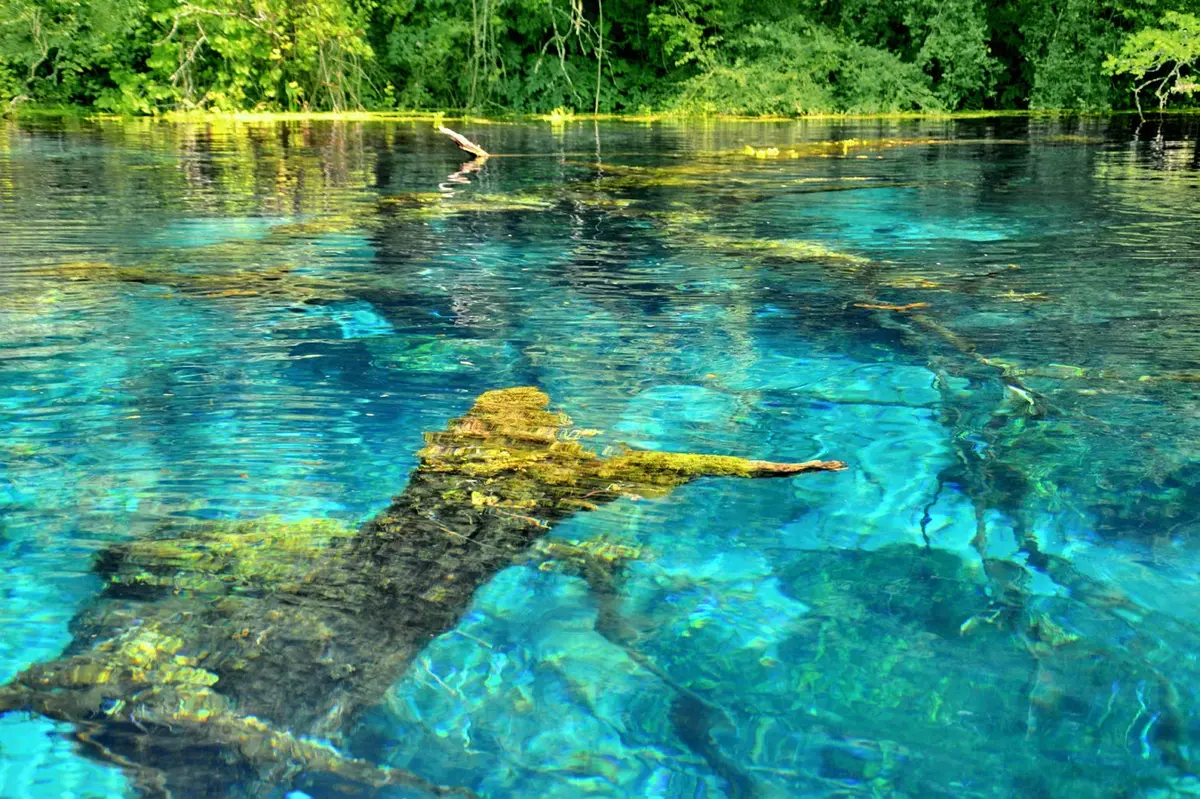
This otherworldly karst spring releases crystalline, deep-blue water straight from an underground source at around 18,400 liters per second. The access road demands a vehicle, as there is no reliable public transport to the site. Note that you park roughly 2 km short of the spring and walk in on a flat forest path, and swimming is now banned.
- Location: Near Muzinë on the SH99, between Sarandë and Gjirokastër
- Cost: 50 lek per person entry (about $0.60), plus 100–300 lek for parking, cash only
- Best for: Nature lovers, families, early risers
5. Grunas Waterfall, Theth
Hidden deep within the northern Alps, this 25-meter cascade is the payoff at the end of the Theth drive. From the village church it is a 2.5 km walk of roughly 45 minutes, climbing about 650 feet, with the final stretch steep and rocky. You cannot drive to the falls themselves, so park in the village and walk.
- Location: Theth National Park, northern Albania
- Cost: Free
- Best for: Hikers, adventurous travelers
Renting a car in Albania requires upfront preparation, but it unlocks the absolute best parts of the country. Get your IDP sorted before you fly, strictly use a credit card for the deposit, and film that non-negotiable walk-around video at both pickup and return. Keep lek on hand for rural fuel, tolls, and park entries, and you will already be ahead of most unprepared tourists.
The true reward is having the freedom to explore the Riviera, the Alps, and the deep interior entirely on your own schedule.