Crossing from Greece to Albania sounds complicated, but the Corfu to Saranda ferry is one of the most efficient border crossings in the Mediterranean. This guide gives you every number, every trap, and every shortcut so nothing derails the trip, whether the crossing is a single day out or the opening move in a longer trip through Albania.
How long is the Corfu to Saranda ferry?
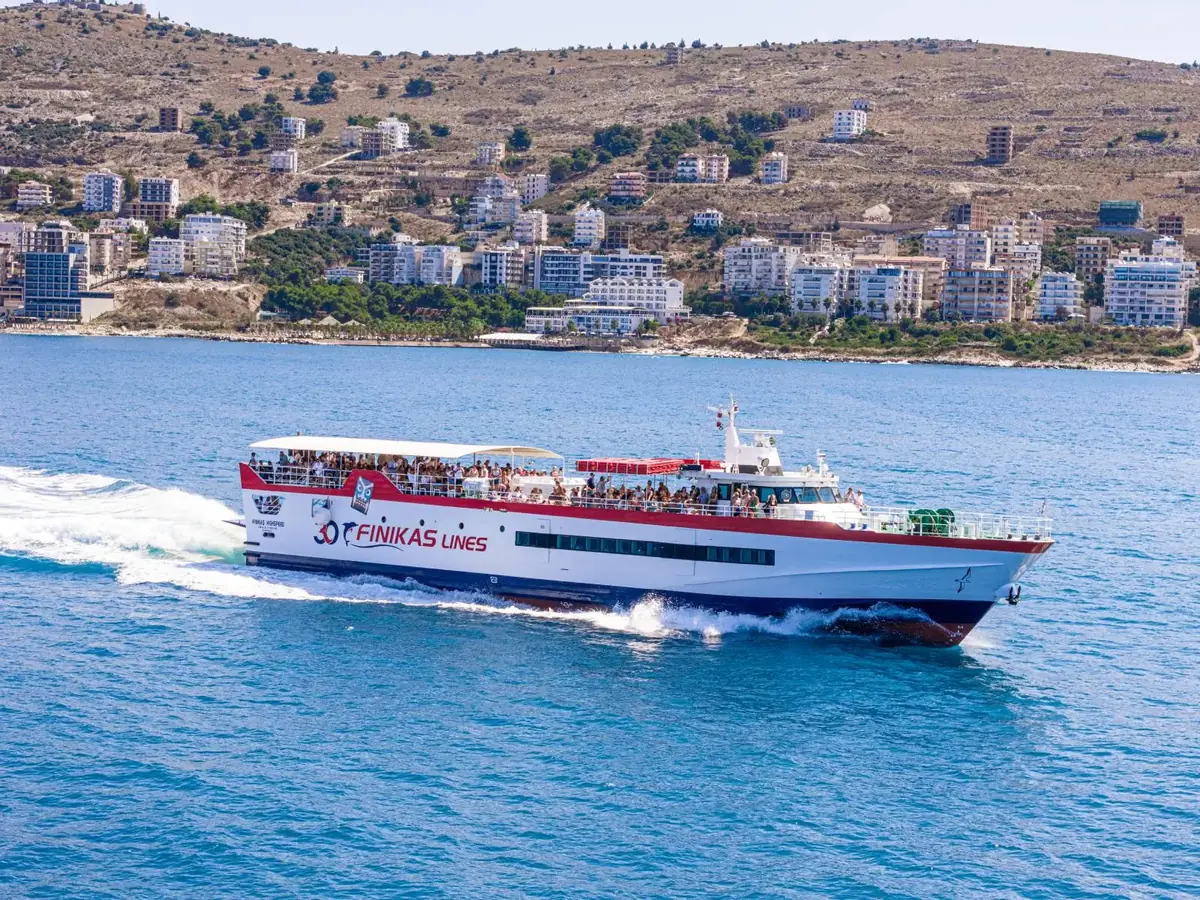
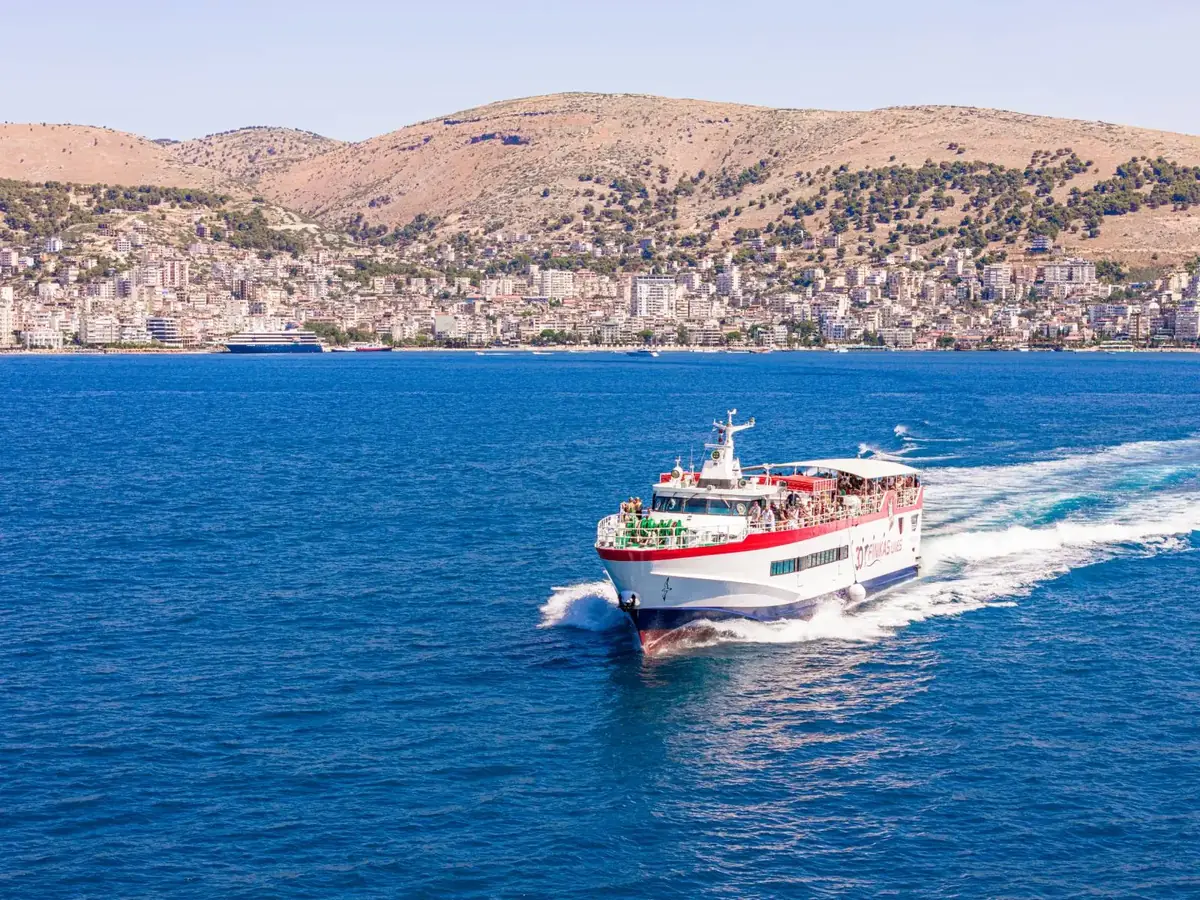
The Corfu to Saranda ferry takes between 25 minutes and 90 minutes depending on the vessel you choose. Three operators now control this route: Finikas Lines, Ionian Seaways, and Albania Luxury Ferries. Between them, they run high-speed hydrofoils, fast passenger craft, and traditional car ferries.
Choosing the wrong vessel for your needs can easily cost you an hour of vacation time. The high-speed craft cross the roughly 17-mile (28 km) strait in 25 to 45 minutes. This is the default choice for day-trippers and solo travelers.
The conventional passenger and car ferries take 70 to 90 minutes. This is the only option if you are transporting a vehicle, and it is usually the cheaper fare.
The moment the hydrofoil lifts above the Ionian chop, you will understand why it earns the premium. The engines produce a deep mechanical vibration underfoot and a high-pitched whine that makes conversation nearly impossible. It is jarring, brief, and extremely efficient.
Scheduling scales sharply with the season you choose to travel. Winter may bring just one or two daily departures. Peak summer can push that to roughly ten crossings per day across all three operators, but seats sell out, so booking in advance is non-negotiable.
| Vessel Class | Operators | Transit Time | Typical One-Way Fare | Vehicle Transport |
| Fast ferry / hydrofoil | Finikas Lines, Ionian Seaways, Albania Luxury Ferries | 25 – 45 min | ~€25 – €35 (~$29 – $40) | Not available |
| Conventional passenger / car ferry | Finikas Lines, Ionian Seaways, Albania Luxury Ferries | 70 – 90 min | ~€15 – €25 (~$17 – $29) | ~€50 – €60 (~$58 – $70) |
Fares on this route are dynamic and shift with season, operator, and how far ahead you book. Treat these as planning ranges, confirm the live price before you pay, and fold the crossing into your wider Albania trip budget.
Pro Tip: Book directly on the operator’s website rather than through aggregators. The base fare is the same, but you avoid service fees and have a direct line if the crossing is cancelled due to weather. Finikas Lines also discounts same-day return tickets when both legs are issued together, so book the round trip in one transaction.
What documents do you need to cross the Greece to Albania border?
You need a physical passport, not a driver’s license or ID card, because Albania sits outside the Schengen Area and this is a full external border crossing in both directions. Budget significantly more time here than the crossing itself requires.
The bigger change is on the Greek side. Greece now operates the EU Entry/Exit System, the biometric border platform that replaced routine passport stamping across the Schengen Area. On your first registration, border officers record your fingerprints and a facial image alongside your passport data, and that digital record is retained for three years. Subsequent crossings within that window are faster because the biometrics are already on file.
In practice, this means the first exit from Corfu takes longer than travelers expect, and peak-season queues at the international terminal have been the single most common complaint on this route. Passengers regularly report standing 30 to 90 minutes at passport control in direct summer sun. That is the number to plan around, not the 30-minute crossing.
ETIAS, the separate pre-travel authorization for visa-exempt visitors, is not yet operational. No application is required at this stage, but the launch timeline has moved repeatedly, so verify status on the official EU travel portal before you book.
On the Albanian side, the rules are unusually generous. Under Albania’s entry requirements for US citizens, no visa is needed and you may stay up to one year without a residence permit, a far longer allowance than the 90-day Schengen limit and counted entirely separately from your Schengen days. Albanian officers increasingly log entries electronically rather than stamping passports, so keep your ferry boarding pass as proof of your entry date.
Pro Tip: Bring a paper copy of your onward travel and accommodation details. Biometric registration is automated, but secondary questioning is not, and a screenshot on a phone with no signal is a weak answer at a border desk.
Should you print your ferry tickets?
You should print your tickets because two of the three operators still expect physical documentation at the gate, and port agents are inconsistent about accepting screens. Digital tickets work in some booking channels, but you should not gamble a border crossing on which agent you draw.
Booking through the operators’ own sites generally produces a ticket you are expected to print. Booking through certain third-party platforms produces a scannable e-ticket that boards directly. If you are unsure which you hold, print it. The cost of being wrong is your entire day.
Both Finikas Lines and Ionian Seaways maintain physical ticket offices on Ethnikis Antistaseos, the road running alongside the New Port, roughly a five to ten minute walk from the international terminal. This is not a separate trip into Corfu Old Town, which is a common misreading that sends travelers in the wrong direction.
Visit the ticket office the day before departure rather than the morning of. Port queues move unpredictably during the travel season, and a printing problem two hours before boarding is a trip-ending scenario.
- Location: Ethnikis Antistaseos, New Port area, Corfu
- Cost: Free to print at the office
- Best for: All passengers crossing an international border, no exceptions
How do you get from Corfu airport to the ferry port?
The cheapest option is Blue Line Bus No. 15, which departs from outside the airport arrivals terminal and terminates at the New Port. The ground transit covers about 2 miles (3 km), and there is a trap embedded in it that most guides skip entirely.
The bus fare is €1.30 (roughly $1.50) for the Zone A route linking Airport, San Rocco Square, and Port. Buying on board costs more, and ticket machines are not reliably available at the airport stop, so carry small cash.
The real problem is frequency, not price. Line 15 is not a shuttle. Gaps between departures run from roughly 65 minutes to more than two hours on weekdays and stretch further on Sundays, and service does not run late into the evening. Anyone treating it as a turn-up-and-go connection to a fixed ferry departure is taking a serious risk. Check the posted timetable the moment you land rather than assuming a half-hourly service.
The second trap is the terminal itself. The domestic and international sections of the port sit several hundred meters apart. Arrive at the wrong one and you will miss your ferry. Official taxis take 10 to 15 minutes and cost roughly €15 to €25 (about $17 to $29). Walking the route takes over 40 minutes and is impractical with luggage in summer heat.
Pro Tip: Tell the taxi driver specifically “New Port” or “Limani Neo” and mention Albania. Some drivers default to the cruise or domestic terminal without that clarification.
What is the Corfu ferry terminal like?
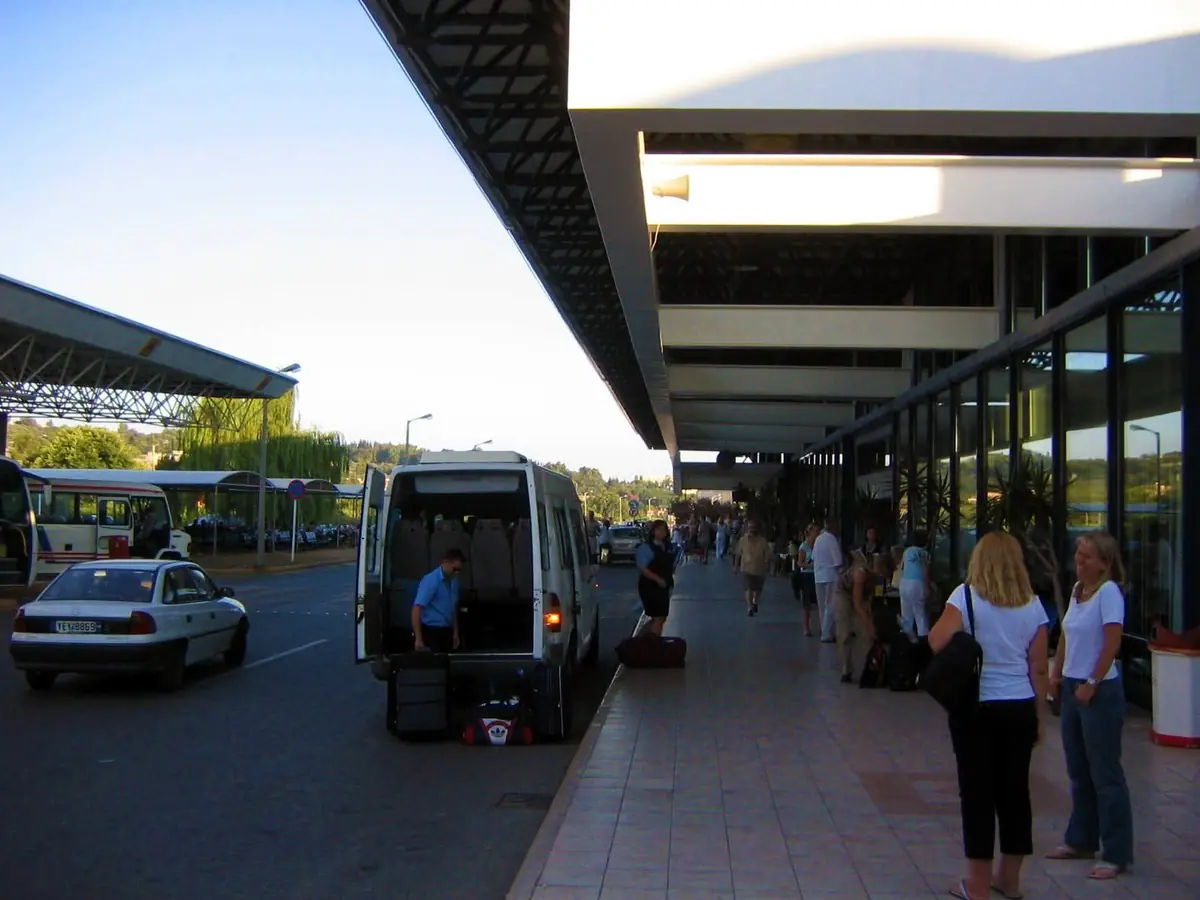
Arrive at the New Port international terminal with realistic expectations because seating is severely limited and the queue often forms outside the building. This is not an airport lounge, and shade is scarce.
Operators ask passengers to be at the international passenger terminal at least one hour before departure, and vehicle passengers the same for customs processing. Given biometric border checks, treat one hour as the floor rather than the target in July and August.
Once you clear Greek exit passport control, a duty-free shop operates inside the international departure zone. This is your last opportunity to buy spirits, fragrances, or cosmetics at EU-exempt prices, and Saranda has no comparable retail on the other side.
There is also a small coffee bar past security that is basic but functional. Grab water and a snack before boarding, because the high-speed crossings have no onboard food or drink service and toilets on some vessels are minimal.
Pro Tip: Fill a water bottle before you join the passport queue. Travelers faint in that line every summer, and there is no water available once you are committed to it.
What is the time difference between Greece and Albania?
Greece is one hour ahead of Albania, a fact that quietly destroys more itineraries here than any other logistical failure. Greece observes Eastern European Time while Albania observes Central European Time, and both shift for daylight saving on the same dates, so the one-hour gap holds year-round.
If your fast ferry departs Corfu at 09:00 Greek time, the 30-minute crossing means you arrive in Saranda at 08:30 Albanian time. Every published ferry schedule uses the local time of the departure port, not your destination.
The return trip is where travelers get burned. If your return ferry departs Saranda at 20:30, that is Albanian time. If your phone has silently re-synced to Greek time, which smartphones do automatically as they pick up cross-border signal, you are already running an hour late without knowing it.
Pro Tip: The moment you board in Corfu, set a second world clock on your phone showing Albanian time. Keep both clocks visible for the entire visit, and write your return ferry departure time on your lock screen in Albanian local time.
How do you get cash in Saranda without getting scammed?
Walk 5 to 10 minutes into the city center to an official bank ATM rather than using the machines at the port gate. Albania runs on the Albanian Lek (ALL), a closed currency you cannot obtain before you arrive. Some tourist-facing restaurants accept Euros, but at a punishing rate.
Every local taxi, market stall, and bus runs strictly on Lek. The moment you exit Albanian customs, you will see ATMs positioned directly at the gate. Do not use them.
Independent machines at the port entrance typically charge a flat fee of several hundred Lek per withdrawal, stacked on top of a poor internal exchange rate. Bank-operated ATMs from BKT, Credins, or Raiffeisen offer fair rates and lower fees. Withdraw around 10,000 Lek, roughly $115, in a single transaction to cover a full day comfortably rather than paying the fee twice.
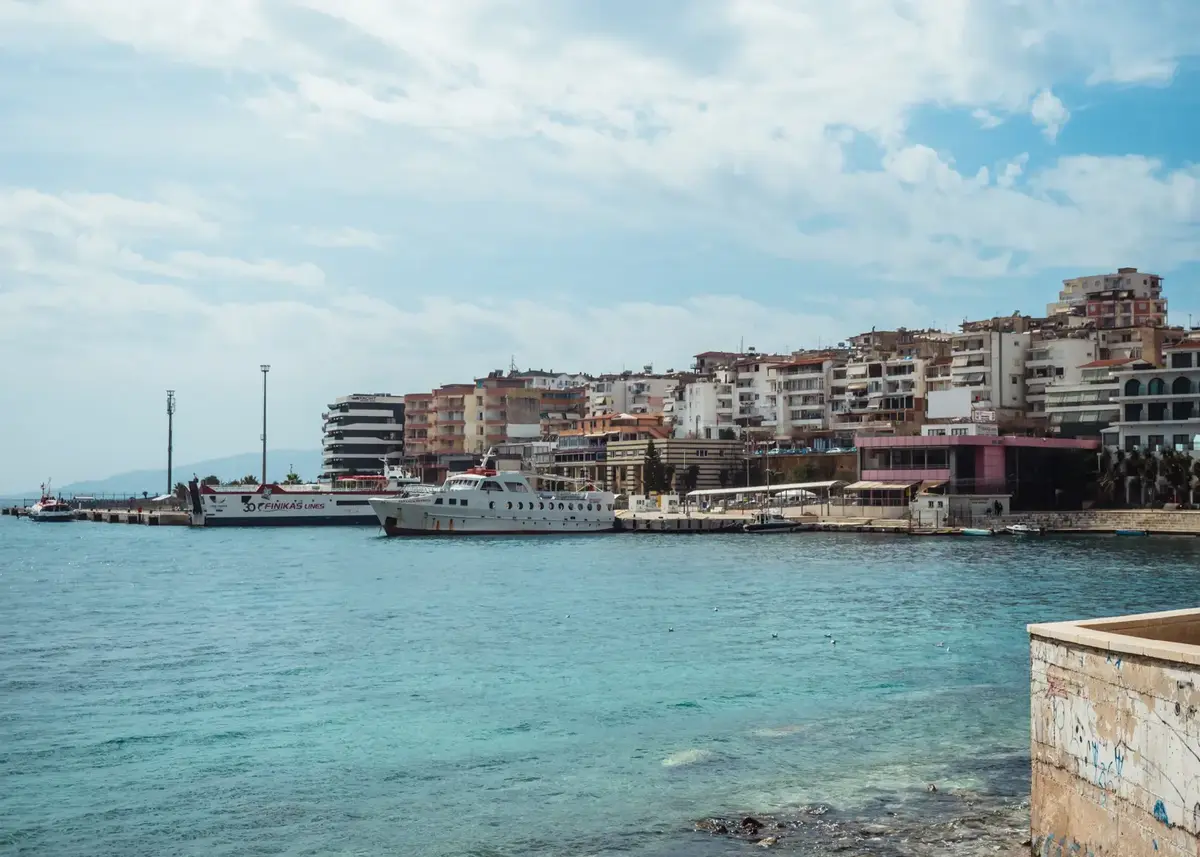
Standing on the port embankment counting unfamiliar banknotes while a taxi driver waits with the meter running is disorienting. Do the mental math in advance. The Lek trades at roughly 87 to 90 to the US dollar, so 100 Lek is a little over a dollar, 1,000 Lek is about $11, and 5,000 Lek is about $57. Rates move, so check before you travel.
Pro Tip: Alert your US bank to your travel plans before departure. Albanian bank machines frequently trigger fraud holds on US cards with no prior international activity, and a declined card at the port is a bad place to discover this.
Will my US cell phone plan work in Albania?
Your US plan may technically connect in Albania, but it will rarely work well, because Albania is not in the EU and therefore falls outside the cheap European roaming buckets most US carriers sell. Some plans include Albania at heavily throttled speeds, others treat it as a premium daily-pass destination, and coverage along the Adriatic is inconsistent even where roaming is nominally included. Check your specific plan’s country list rather than assuming Greece and Albania are treated the same.
For a day trip, an eSIM is the better answer. You install it before leaving Corfu, it activates on arrival, and you skip the SIM shop entirely. Albania eSIM plans run from about $4 for a small allowance to roughly $15 to $20 for 10GB, and most providers route through the same local networks, so price is the main differentiator.
If you are staying several days, a physical local SIM offers better value. The two providers are Vodafone Albania and ONE Albania. ONE currently operates the widest 5G footprint, including Saranda and Ksamil, while Vodafone remains strong across the Riviera generally. Tourist data packs typically run 2,000 to 2,500 Lek, around $23 to $29, and you must bring your passport because Albanian regulations require ID for SIM registration.
Pro Tip: Sort your data before getting into any taxi. Uber and Bolt do not operate anywhere in Albania. Local apps such as Patoko, Speed Taxi, VrapOn, and Clust do, and having one running is the only reliable way to avoid a negotiated fare from a driver who watched you step off a ferry.
Where can you store luggage in Saranda?
Three digital storage networks operate in Saranda: Bounce, Radical Storage, and Stasher. If you are executing a day trip, a luggage storage arrangement is non-negotiable. Saranda’s promenade is uneven and sun-baked, and rolling a heavy bag along it for eight hours is not a strategy.
All three networks connect travelers to verified hotels, cafes, and shops that hold bags securely, several of them within a few minutes’ walk of the ferry terminal. Prices start around €3.50 to €5 per bag per day, with insurance coverage included or available as a small add-on.
Book your storage slot online before your ferry departs from Corfu. It takes two minutes and eliminates a major variable on arrival, when you are already managing passport control, cash, and a clock running an hour behind the one on your phone.
- Location: Verified partner businesses across central Saranda, several near the port
- Cost: From roughly €3.50 to €5 per bag per day (about $4 to $6)
- Best for: Day-trippers from Corfu and travelers arriving before hotel check-in
What is the best Saranda day trip itinerary?
With a first-morning ferry and a last-evening return, you have roughly 10 to 12 hours on the ground. The optimal route is built around high-value coastal experiences and zero inland time-wasters. For a single day, skip both the Blue Eye spring and Butrint National Park.
The Blue Eye is beautiful, but the inland round-trip eats two or more hours of your window and the spring itself is a brief stop. Butrint is a genuinely compelling UNESCO site with an entry fee of 1,000 Lek, about $11, but it needs three or more dedicated hours to do properly. Save both for an overnight trip.
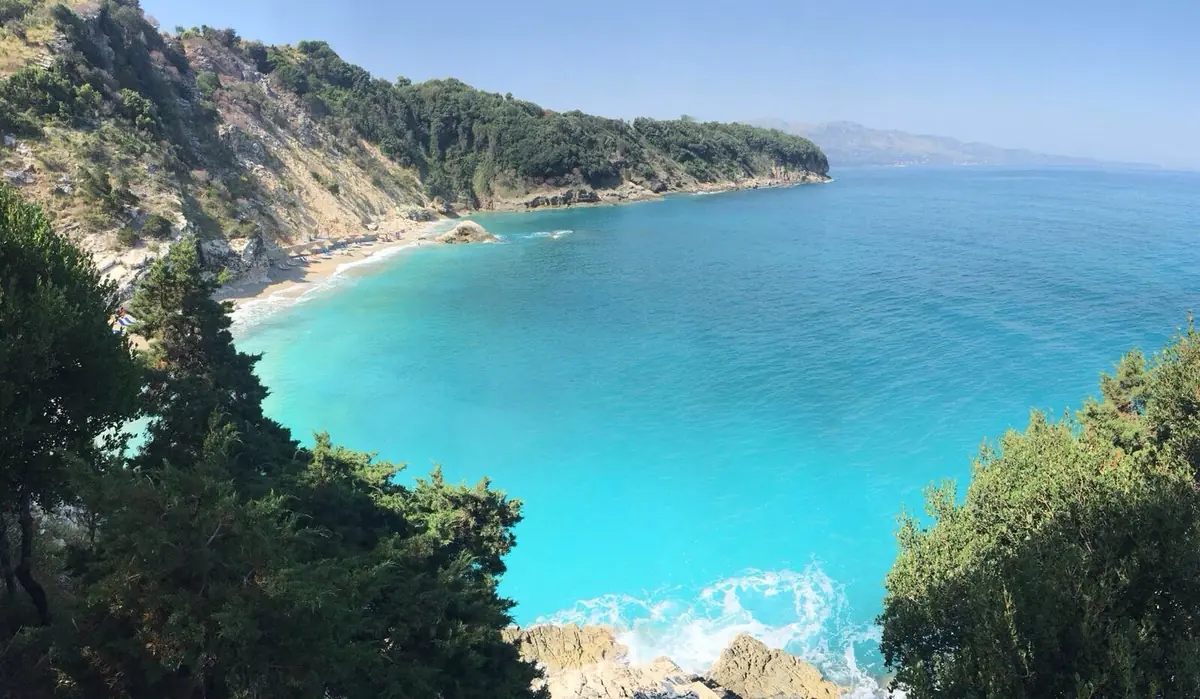
In the morning, sort your data and cash within a 30-minute maximum budget. Then head south to Pulëbardhës Beach, which is quieter than the main Saranda promenade with clear water and minimal crowds. Plan two to three hours here.
In the afternoon, travel north to Ksamil, a cluster of white-sand beaches facing several small offshore islands. The nearest island sits about 100 meters out and is swimmable in calm conditions. Water taxis run roughly €3 to €5 round-trip, and sunbeds at the beach clubs cost around €6 to €15 per day depending on position. Budget two to three hours.
One warning worth taking seriously: in July and August, Ksamil is one of the busiest beach destinations in the Adriatic, with main beaches full by mid-morning and beach clubs running loud music all day. If you are visiting in high season and want quiet water, weight your day toward Pulëbardhës instead, and if you are picking a base for a longer stay, weigh Saranda against Ksamil before you book a room.
There is a cheap alternative to taxis that most day-trippers miss, and it works much like bus travel across the rest of Albania. An hourly local bus leaves from near the Saranda ferry terminal, passes through Ksamil, and continues to Butrint for around 200 Lek, roughly $2.30. It takes longer than a taxi and runs on cash only, but it removes the fare negotiation entirely.
Heading south from the port, the green cypress slopes of Corfu that were on the horizon an hour ago recede quickly behind you. What comes into focus instead is Saranda’s tightly packed coastal development, with concrete apartments stacked up the hillside in dense rows. The contrast is immediate and stark.
In the evening, return to Saranda town by 17:00 Albanian time. Grab dinner on the promenade, then find a bar near the port for sunset. Be at the port gate at least 45 minutes before your scheduled departure in Albanian time, and earlier in peak season when the passport queue backs up.
Pro Tip: Confirm your return ferry time in Albanian local time before you leave Corfu in the morning. Write it on your phone lock screen and do not rely on the ferry company to remind you.
The complete journey at a glance
Here is every step of the journey in order for quick reference. First, take Blue Line Bus No. 15 from the CFU airport arrivals area for €1.30, checking the posted timetable on arrival because gaps can exceed two hours. Collect or print your tickets at the operator offices on Ethnikis Antistaseos near the New Port.
Next, proceed to the New Port international terminal at least one hour ahead to clear Greek exit passport control and biometric registration. Board for a 25 to 45-minute fast crossing or a 70 to 90-minute conventional ferry.
Arrive at Saranda port and clear Albanian border control, keeping your boarding pass as proof of entry. Activate your eSIM or buy a local SIM. Find a bank ATM in the city center to withdraw Lek, strictly avoiding the port machines. Drop your luggage with Bounce, Radical Storage, or Stasher.
Finally, open a local taxi app or catch the Ksamil bus and begin your itinerary.
The Corfu to Saranda ferry is fast, affordable, and one of the most rewarding short crossings in Southern Europe. The crossing itself takes less than an hour. What determines whether the trip is seamless or stressful is every decision in the 90 minutes on either side of it.
Get the time zone right, budget properly for the biometric border queue, skip the port ATMs, and print your ticket. The rest takes care of itself, and the hours you save go straight into the things to do in Saranda once you land. Fares, timetables, and border procedures do change, so confirm the current details with the ferry operators and official government sources before you book.